Sankhya Yoga
Krishna begins the real teaching. The eternal soul, the steady mind, action without attachment. The chapter that holds the Gita's most quoted verse: 2.47.
All 72 verses below.
Wisdom translation, edited by Ankur Shukla. Commentary AI-drafted, human-reviewed. Reviewed June 2026. Methodology →
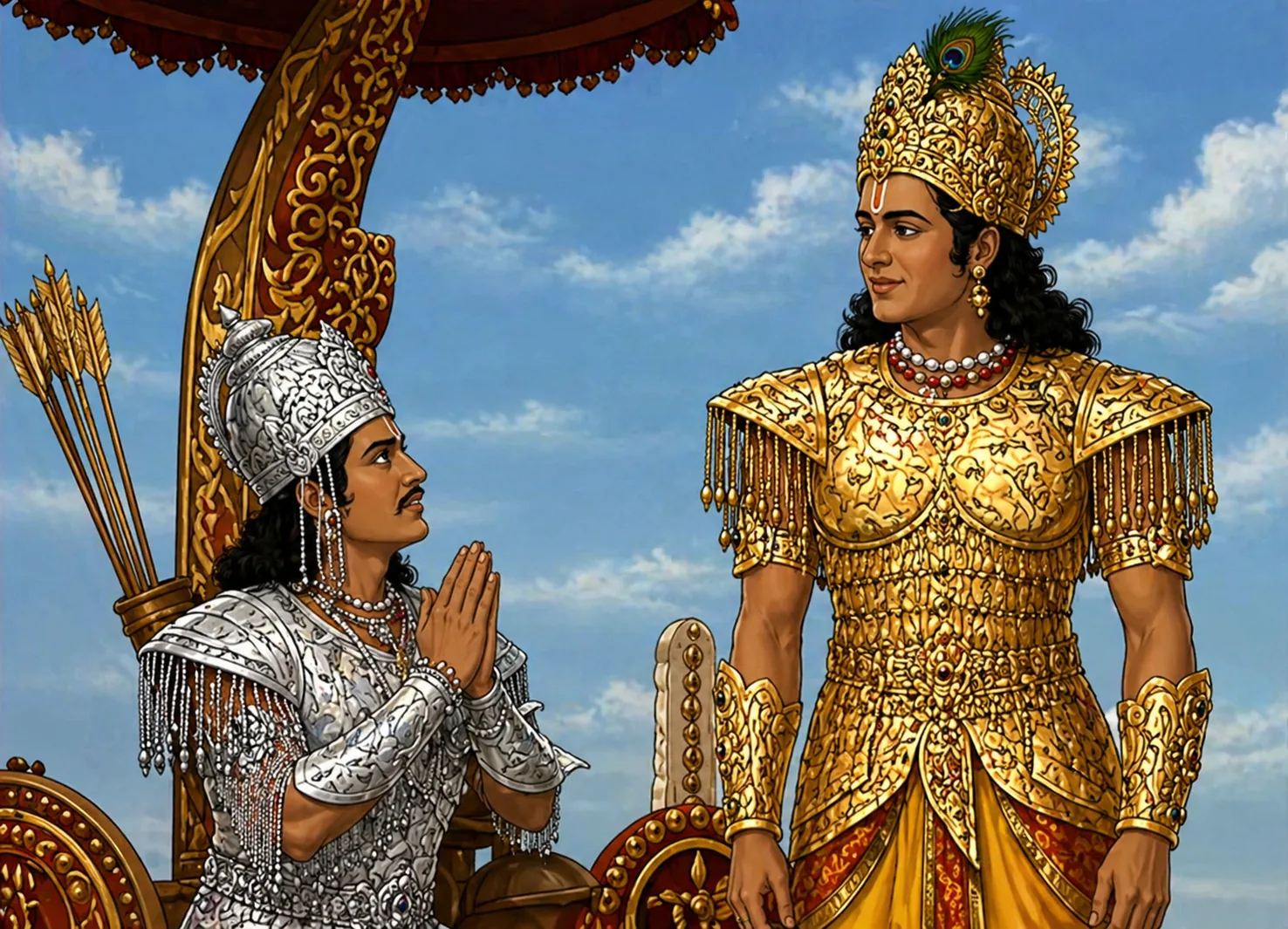
“Grief opens the door for instruction.”
Even the deepest collapse can become the starting point of guidance.
Read full verse 2.1 →All verses
- 2.1Ch. 2
Grief opens the door for instruction.
Even the deepest collapse can become the starting point of guidance.
- 2.2Ch. 2
Delusion has no place in a decisive moment.
A hard moment does not excuse surrendering to confusion. You can notice weakness without obeying it.
- 2.3Ch. 2
Weakness is optional; the call to act remains.
There is strength in refusing to stay collapsed when duty calls.
- 2.4Ch. 2
Respect can make necessary action feel unbearable.
Some conflicts hurt because the people involved still matter to you.
- 2.5Ch. 2
A victory that destroys reverence is already a loss.
Some gains cost too much. Clear conscience matters more than winning.
- 2.6Ch. 2
Honest uncertainty is the first crack in moral paralysis.
It is a relief to name confusion honestly before forcing a choice.
- 2.7Ch. 2
Clarity begins when you admit you cannot see the right action alone.
It is a relief to admit confusion and ask for guidance instead of pretending to know.
- 2.8Ch. 2
No outer victory can cure an inner collapse.
When grief takes over, even the biggest prizes stop looking valuable.
- 2.9Ch. 2
Refusal has stopped the war inside him.
Sometimes the hardest moment is not action, but the silence after refusing it.
- 2.10Ch. 2
Guidance begins when grief is met without rejection.
Even in collapse, the teaching begins with presence, not panic.
- 2.11Ch. 2
Clear seeing ends grief where the wise know none is needed.
It brings relief by showing that clear seeing can hold loss without collapsing into sorrow.
- 2.12Ch. 2
What truly exists was never born and never lost.
Fear softens when you stop treating the body as the whole story.
- 2.13Ch. 2
What changes form is not what you truly are.
There is relief in seeing change as natural, not tragic.
- 2.14Ch. 2
Passing sensations lose power when you stop treating them as permanent.
You do not have to be ruled by every sensation. Calm endurance gives you room to choose wisely.
- 2.15Ch. 2
Freedom begins where pain and pleasure stop controlling you.
You do not need to be ruled by every high and low. Steadiness itself becomes strength.
- 2.16Ch. 2
What passes away was never ultimate; what is real cannot vanish.
You can stop treating every passing fear or loss as ultimate. Some things vanish; what is real stays.
- 2.17Ch. 2
What truly pervades everything cannot be destroyed.
Fear loosens when you realize what is deepest in you cannot be harmed.
- 2.18Ch. 2
What is truly you cannot be destroyed, so duty remains.
Fear loosens when you stop treating the body as the whole story.
- 2.19Ch. 2
What you are cannot be reduced to killer or victim.
Fear loosens when you stop identifying life with what can be destroyed.
- 2.20Ch. 2
What you are cannot be touched by birth or death.
Fear softens when you stop treating your deepest identity as fragile.
- 2.21Ch. 2
Clear seeing makes violence look absurd.
The fear around death loosens when you see what cannot be destroyed.
- 2.22Ch. 2
What you are does not end when one body is left behind.
A fear of bodily loss softens when you see change as a transition, not an ending.
- 2.23Ch. 2
Your deepest reality is beyond every physical force.
Fear loosens when you stop treating the deepest part of you as fragile.
- 2.24Ch. 2
What you are cannot be harmed by anything that changes.
What you truly are is untouched by change, so fear loses its grip.
- 2.25Ch. 2
What is deepest in you was never available for loss.
There is relief in seeing that what matters most was never fragile.
- 2.26Ch. 2
Even the plain fact of change is no reason to drown in sorrow.
You do not need to collapse into grief just because change is happening.
- 2.27Ch. 2
What must change is not a reason for grief.
Some things are not yours to control, and peace begins where resistance ends.
- 2.28Ch. 2
What appears briefly was never meant to be clung to.
Sorrow loosens when you stop treating a passing form as permanent.
- 2.29Ch. 2
The true self remains mysterious even after endless hearing.
Curiosity is not enough; real understanding requires a deeper kind of seeing.
- 2.30Ch. 2
What is most real in a person cannot be killed, so grief loses its ground.
Loss feels different when you remember that what is deepest in a person cannot be cut off.
- 2.31Ch. 2
Right action can feel hard and still be the best choice.
Clarity can end inner conflict. Once duty is seen, wavering becomes unnecessary.
- 2.32Ch. 2
A righteous burden can become the highest opening.
Hard duty can be a privilege, not a burden.
- 2.33Ch. 2
Avoiding the right duty does not protect you; it stains you.
Avoiding the hard right thing can feel safer, but it leaves a heavier mark than action.
- 2.34Ch. 2
A honored life can be wounded more by shame than by death.
Honor can feel more fragile than life itself, and avoiding your duty can wound it deeply.
- 2.35Ch. 2
Retreat from duty, and respect turns to shrinkage.
Avoiding the hard act can cost you the respect you already earned.
- 2.36Ch. 2
Public shame can hurt more than physical danger.
Shame can sting harder than pain when your identity is on the line.
Did you like this chapter?
- 2.37Ch. 2
Act now; the result does not cancel the duty.
Courage grows when the outcome stops being the reason to act.
- 2.38Ch. 2
Equanimity frees action from the stain of panic and craving.
Inner steadiness makes hard action possible without guilt or panic.
- 2.39Ch. 2
Clear understanding frees action from bondage.
The same truth can free you both in thought and in action.
- 2.40Ch. 2
Even a tiny start on the right path protects you from fear.
You can begin imperfectly without dread. Small practice still counts and still changes you.
- 2.41Ch. 2
Resolute seeing unifies the mind; hesitation multiplies it.
Clarity feels lighter than indecision. One firm choice calms the whole mind.
- 2.42Ch. 2
Beautiful words can hide a mind trapped by desire.
Not every beautiful promise is wisdom; some words are designed to seduce, not free you.
- 2.43Ch. 2
Flowery promises can keep desire alive while pretending to guide you.
Not every impressive teaching frees you. Some teachings only dress up craving.
- 2.44Ch. 2
Craving scatters the mind before wisdom can settle.
Clarity returns when craving stops steering the mind.
- 2.45Ch. 2
Freedom begins when gain and loss stop defining you.
There is relief in not being ruled by constant wanting, fear, or comparison.
- 2.46Ch. 2
Complete understanding makes lesser sources unnecessary.
There is relief in not needing endless guidance once the deeper truth is seen.
- 2.47Ch. 2
Action belongs to you; the result does not.
There is relief in giving your full effort without carrying the burden of the result.
- 2.48Ch. 2
Equanimity turns action into yoga.
You can stay calm without stopping action. Inner balance makes effort cleaner and less painful.
- 2.49Ch. 2
Clear discernment is richer than reward-chasing.
You can stop measuring your worth by what you get back.
- 2.50Ch. 2
Clear action frees you from the weight of both success and failure.
You do not have to be trapped by the moral weight of every result.
- 2.51Ch. 2
Freedom comes when action is done without clutching its reward.
You can do the work and stop clutching the reward. That loosening brings real relief.
- 2.52Ch. 2
Clear seeing ends the pull of future pleasures.
Clarity itself loosens craving. You do not have to force detachment when confusion ends.
- 2.53Ch. 2
Yoga begins when the mind stops being pulled in every direction.
Relief comes from knowing clarity is not forced; it settles when the mind stops being pulled around.
- 2.54Ch. 2
Steady wisdom must be recognizable in ordinary movement.
Real wisdom should show up in ordinary behavior, not just in ideas.
- 2.55Ch. 2
Steadiness begins when desire no longer defines your sense of enough.
There is relief in not needing anything extra to feel complete.
- 2.56Ch. 2
Steadiness remains when pleasure and pain lose their grip.
You do not have to be ruled by every rise and fall. Calm can remain while life changes.
- 2.57Ch. 2
Steady wisdom does not need life to feel favorable.
You can meet life fully without being pulled around by every result.
- 2.58Ch. 2
Steadiness begins when the senses stop running outward.
You do not need to chase every attraction. Real steadiness begins when attention comes home.
- 2.59Ch. 2
Craving ends only when a higher reality becomes more compelling.
Real freedom comes from seeing more clearly, not just forcing restraint.
- 2.60Ch. 2
Restraint fails without disciplined senses.
Willpower alone is not enough; the senses need training too.
- 2.61Ch. 2
Wisdom becomes steady only when the senses are no longer in charge.
Self-control is not repression; it creates the inner steadiness needed for clear judgment.
- 2.62Ch. 2
What you dwell on becomes what you cling to, then what burns you.
There is relief in catching the chain early, before a small craving hardens into a reaction you regret.
- 2.63Ch. 2
Anger first distorts seeing, then destroys the mind that should guide action.
You can feel the warning inside anger before it turns into damage.
- 2.64Ch. 2
Freedom comes from meeting experience without attraction or aversion.
You do not have to flee life to stay clear inside.
- 2.65Ch. 2
Clear seeing ends suffering and lets understanding settle at once.
There is relief in realizing that peace of mind is not a luxury; it is the doorway out of suffering.
- 2.66Ch. 2
Without inner discipline, even happiness has no place to stand.
Peace is not accidental; it grows from inner discipline.
- 2.67Ch. 2
One uncontrolled sense can carry the mind away.
A small lapse of attention can undo a lot of inner steadiness.
- 2.68Ch. 2
Steady wisdom begins when the senses stop ruling your attention.
You feel less pulled around when attention stops chasing every temptation.
- 2.69Ch. 2
What the many pursue in sleep, the wise leave behind awake.
You can stop measuring life by what the crowd wants and begin seeing what actually matters.
- 2.70Ch. 2
Peace belongs to the one who stays steady while desire moves.
You do not have to fight every desire; you can let it move through without letting it steer you.
- 2.71Ch. 2
Peace begins when wanting, owning, and self-importance fall away.
There is relief in moving through life without needing to own, control, or prove anything.
- 2.72Ch. 2
Steadiness in the supreme reality ends confusion, even at life’s edge.
There is relief in knowing that clarity can become so deep it cannot be shaken, even at the end.