It is never born and never dies. It did not come into being, and it will not cease. Unborn, eternal, everlasting, ancient, it is not destroyed when the body is destroyed.
— Krishna
❋
Bhagavad Gita · 2.20
Hindi · हिन्दी
यह शरीरी न कभी जन्मता है और न मरता है तथा यह उत्पन्न होकर फिर होनेवाला नहीं है । यह जन्मरहित, नित्यनिरन्तर रहनेवाला, शाश्वत और पुराण अनादि है । शरीरके मारे जानेपर भी यह नहीं मारा जाता ॥
The verse in reading order — each Sanskrit word with its meaning beneath. Hover a word to focus on it.
न जायतेis not bornम्रियतेdies) वा (or) कदाचित् (at any timeनायम्this one notभूत्वाhaving becomeभविताwill become) वा (or) न भूयः (not againअजःunbornनित्यःeternalशाश्वतःeverlastingअयम्thisपुराणःancientन हन्यतेis not slainहन्यमानेbeing slain) शरीरे (in the body
Read literallyis not born · dies) वा (or) कदाचित् (at any time · this one not · having become · will become) वा (or) न भूयः (not again · unborn · eternal · everlasting · this · ancient · is not slain · being slain) शरीरे (in the body
Understanding the verse
✦
It shifts attention from bodily loss to the unbroken reality that witnesses change.
The true self is never born and never dies. It does not begin with the body, and it is not destroyed when the body ends.
02
On the battlefield
Context & commentary
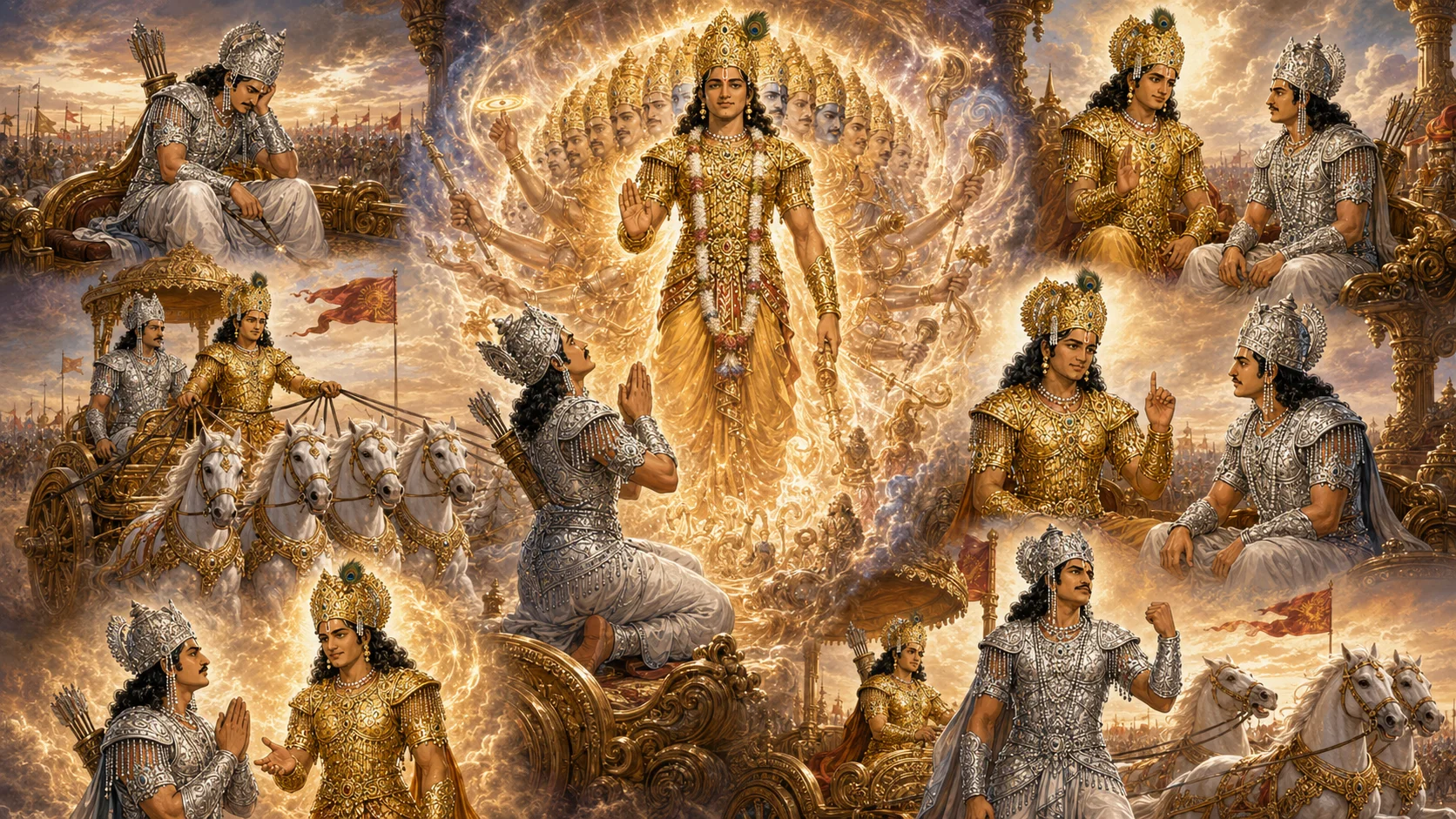
On Kurukshetra, Arjuna is frozen by grief at the thought of killing relatives. Krishna deepens the teaching: the true self does not enter birth or death. The body can be struck; what lives within it cannot be ended.
03
In your life
Why this verse still matters
You sit beside a hospital bed or a graveside and feel everything collapsing. This verse asks you to see that the person you love, and the deepest part of yourself, are not limited to the body alone.
The takeaway
“Fear softens when you stop treating your deepest identity as fragile.”
The true self is never born and never dies. It does not begin with the body, and it is not destroyed when the body ends.
Who speaks Bhagavad Gita 2.20?
Krishna speaks this verse, on the battlefield of Kurukshetra, in the chapter titled "Sankhya Yoga" (The Yoga of Knowledge).
Which chapter of the Bhagavad Gita contains verse 2.20?
Verse 20 sits in Chapter 2 of the Bhagavad Gita — Sankhya Yoga, "The Yoga of Knowledge". The chapter has 72 verses in total.
Why does Bhagavad Gita 2.20 matter today?
You sit beside a hospital bed or a graveside and feel everything collapsing. This verse asks you to see that the person you love, and the deepest part of yourself, are not limited to the body alone.
It shifts attention from bodily loss to the unbroken reality that witnesses change.
What this verse means
The true self is never born and never dies. It does not begin with the body, and it is not destroyed when the body ends.
Context & commentary
On Kurukshetra, Arjuna is frozen by grief at the thought of killing relatives. Krishna deepens the teaching: the true self does not enter birth or death. The body can be struck; what lives within it cannot be ended.
Why this verse still matters
You sit beside a hospital bed or a graveside and feel everything collapsing. This verse asks you to see that the person you love, and the deepest part of yourself, are not limited to the body alone.
“Fear softens when you stop treating your deepest identity as fragile.”
Explore related themes: atman (12 verses), krishna teaching (11 verses)