Arjuna Vishada Yoga
Two armies face each other on Kurukshetra. Arjuna sees his own kin across the field, and his bow falls. The Gita begins with a man unable to act.
All 47 verses below.
Wisdom translation, edited by Ankur Shukla. Commentary AI-drafted, human-reviewed. Reviewed June 2026. Methodology →
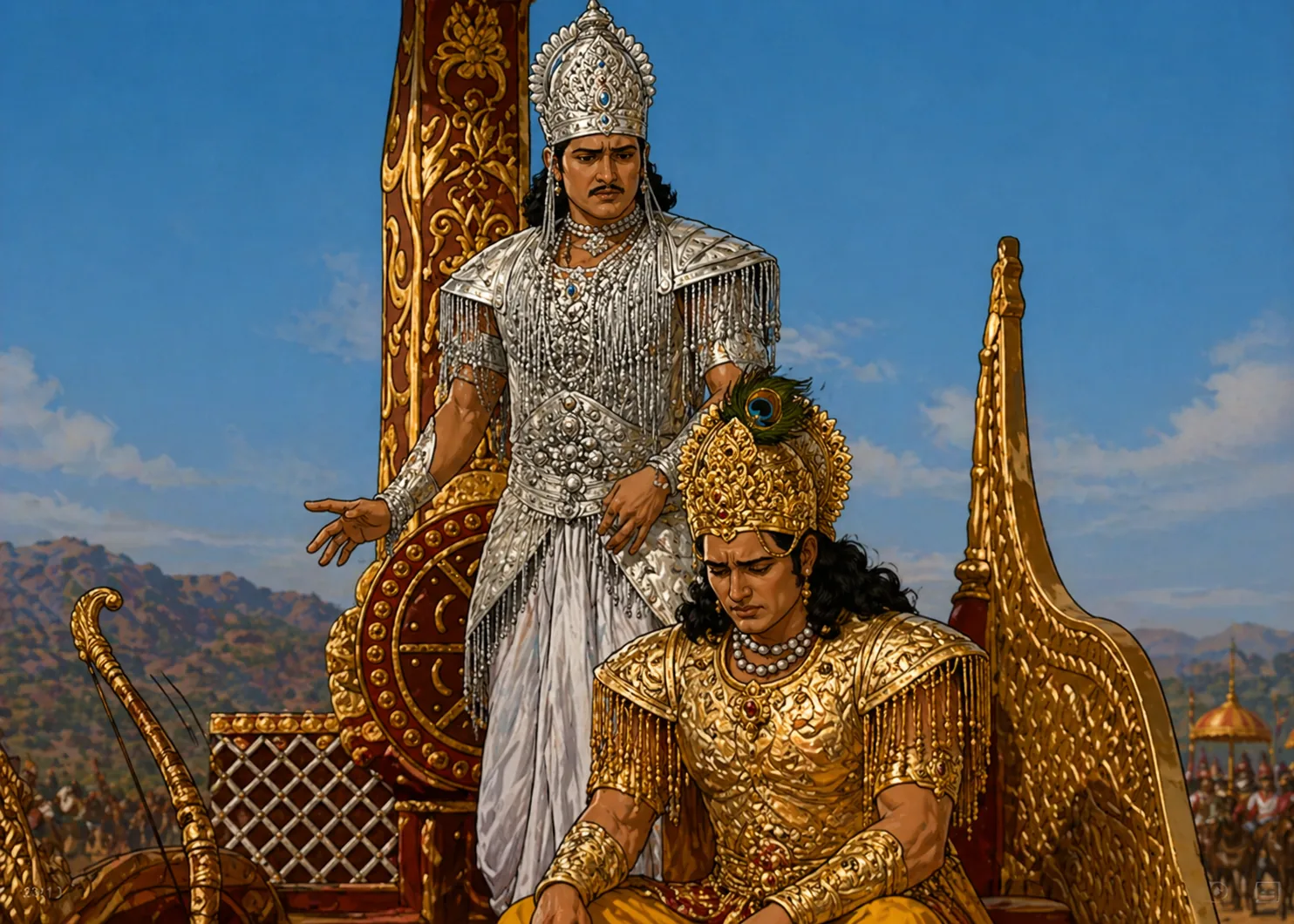
“The war begins in a question, not a sword strike.”
Before any action begins, uncertainty can feel heavier than the battle itself.
Read full verse 1.1 →All verses
- 1.1Ch. 1
The war begins in a question, not a sword strike.
Before any action begins, uncertainty can feel heavier than the battle itself.
- 1.2Ch. 1
War becomes real the moment the enemy is seen clearly.
The scene tightens before the war begins.
- 1.3Ch. 1
A battlefield can be won first by how it is described.
Comparison and pressure can be used to shake another person's resolve.
- 1.4Ch. 1
The other side is strong, and pretending otherwise changes nothing.
The verse builds tension by showing that the other side is formidable, not weak.
- 1.5Ch. 1
The battlefield is already full of power and named allies.
The battlefield is crowded with strength on both sides, and the conflict is real.
- 1.6Ch. 1
The enemy line is full of elite fighters.
The scale of the coming battle becomes clear: this is not a small clash, but a war between equals.
- 1.7Ch. 1
Pride counts its own strength when fear is near.
Even pride wants an audience. He is not just listing names; he is trying to steady his side.
- 1.8Ch. 1
Fear clings to strength by naming it aloud.
Sometimes fear speaks as inventory: count your allies before the fight begins.
- 1.9Ch. 1
Confidence built on numbers still trembles before battle.
Pride can inflate strength into certainty, even before the first blow lands.
- 1.10Ch. 1
Fear can declare defeat before the battle starts.
Panic makes the mind measure strength badly and speak from fear.
- 1.11Ch. 1
Victory begins with disciplined formation, not scattered strength.
The army's first move is pure coordination: hold the line, protect the key commander, do not break formation.
- 1.12Ch. 1
A single battle cry can turn fear into momentum.
The moment before conflict can electrify a whole side.
- 1.13Ch. 1
The war announces itself before the first blow.
The battlefield is no longer quiet. The clash of war has begun to announce itself.
- 1.14Ch. 1
Resolve answers chaos before words begin.
A calm, powerful response can change the whole feel of a moment.
- 1.15Ch. 1
The war begins in sound before a single strike.
The moment is set by sound before the fighting starts.
- 1.16Ch. 1
The war begins to answer back in sound.
The battlefield is filling with sound, and both sides are being drawn into the moment.
- 1.17Ch. 1
Names and conches turn hesitation into commitment.
The scene builds tension: the war is no longer abstract; every name makes the confrontation real.
- 1.18Ch. 1
Allied resolve announces itself before the battle starts.
Strength can be announced before a single blow is struck.
- 1.19Ch. 1
A single sound can break resolve before battle begins.
Some moments hit before any sword is raised. The body knows the battle has already begun.
- 1.20Ch. 1
The battle reaches its threshold, and action begins before words do.
The body moves toward action even when the mind is about to hesitate.
- 1.21Ch. 1
Clear sight comes before decisive action.
Before a hard act, he chooses to look clearly instead of rushing forward.
- 1.22Ch. 1
Clear seeing comes before irreversible action.
Before a hard fight, he wants to see clearly instead of rushing blindly.
- 1.23Ch. 1
Conflict becomes real when you look at the people involved.
Before a hard choice, he looks directly at the people involved instead of hiding from the reality.
- 1.24Ch. 1
The chariot is placed where choice becomes unavoidable.
The pause before action matters. Clarity begins when you face the real center of the conflict.
Did you like this chapter?
- 1.25Ch. 1
Seeing the people involved makes denial impossible.
Before the conflict becomes action, Arjuna is made to face the people he must fight.
- 1.26Ch. 1
Recognition turns battle into sorrow.
The enemy is no longer abstract. The sight of familiar faces turns battle into grief.
- 1.27Ch. 1
The battle becomes unbearable when every side is family.
Seeing familiar faces can make a fight feel unbearable.
- 1.28Ch. 1
Compassion can stop the warrior before the first arrow flies.
Love can make violence feel unbearable, even when duty is waiting.
- 1.29Ch. 1
The body reveals fear before the mind can explain it.
Overwhelm shows up in the body before it becomes a decision.
- 1.30Ch. 1
Fear strips away control before a single arrow is released.
Overwhelm can make even strength feel useless. The body and mind collapse together when fear takes over.
- 1.31Ch. 1
A victory that destroys your own people is not worth having.
When the heart is already broken, even victory can look empty.
- 1.32Ch. 1
Victory means nothing when the price is the destruction of what you love.
When the goal feels hollow, even success stops mattering.
- 1.33Ch. 1
The prize is empty when the people attached to it stand in the line of fire.
Grief deepens when the people you would fight for are the same people you might have to fight.
- 1.34Ch. 1
Blood ties make victory feel like loss.
The conflict feels unbearable because the enemy is not abstract — it is family.
- 1.35Ch. 1
No prize can justify killing what is sacred to you.
Some choices feel wrong even when they promise everything. The heart can refuse what ambition wants.
- 1.36Ch. 1
Violence against kin brings no joy; it only deepens the wound.
Moral clarity can feel painful, but it keeps you from confusing victory with peace.
- 1.37Ch. 1
Kinship makes violence feel unbearable.
You can feel the cost of violence before you act, and that honesty matters.
- 1.38Ch. 1
Greed blinds people to the damage they are causing.
Clear seeing can survive even in a room full of pressure and blindness.
- 1.39Ch. 1
Clear sight makes withdrawal from harm the only sane choice.
Seeing the damage clearly makes hesitation feel responsible, not weak.
- 1.40Ch. 1
Destroy the family, and the moral order inside it collapses.
A broken structure does not stay neutral for long; it quickly trains people toward harm.
- 1.41Ch. 1
When order breaks, the damage spreads into future generations.
Moral collapse feels frightening because it spreads beyond one person and damages the whole community.
- 1.42Ch. 1
Breaking family order is imagined as ruin that reaches even the dead.
Fear of collapse can make a person see one violent choice as a disaster for generations.
- 1.43Ch. 1
When conduct breaks, the inherited order that protects everyone breaks too.
A collapse in conduct spreads outward, erasing the habits that hold a community together.
- 1.44Ch. 1
Breaking family duty brings suffering that lasts beyond one lifetime.
The fear is not abstract anymore. He feels the cost of war reaching into the family line.
- 1.45Ch. 1
Greed can make even victory feel like a crime.
A clear conscience can appear even in the middle of confusion.
- 1.46Ch. 1
Harming loved ones feels worse than losing your own life.
The heart can feel so burdened that even defeat seems kinder than harming loved ones.
- 1.47Ch. 1
Grief can make even a warrior lay down his weapons.
Sometimes the body stops before the heart can bear one more step.