The verse in reading order — each Sanskrit word with its meaning beneath. Hover a word to focus on it.
वासांसिclothesजीर्णानिworn-outयथाasविहायhaving discardedनवानिnewगृह्णातिtakesनरःa personअपराणिotherतथाsoशरीराणिbodiesविहायhaving discardedजीर्णानिworn-outअन्यानिotherसंयातिgoes toनवानिnewदेहीthe embodied one
Read literallyclothes · worn-out · as · having discarded · new · takes · a person · other · so · bodies · having discarded · worn-out · other · goes to · new · the embodied one
Understanding the verse
✦
It shifts attention from identifying with the body to seeing the body as a temporary covering.
The true self passes from one body to another the way a person changes clothes.
02
On the battlefield
Context & commentary
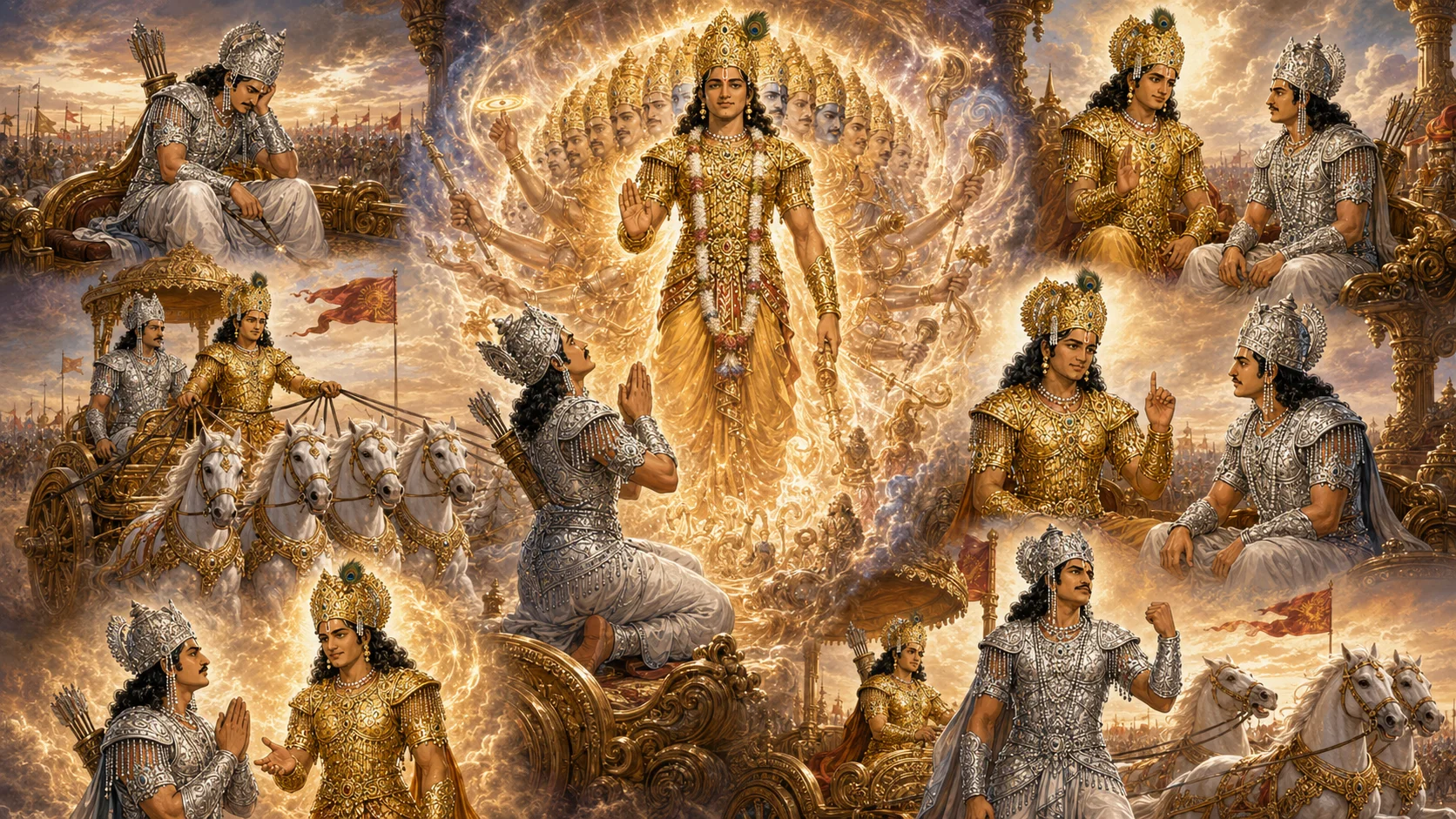
On Kurukshetra, Arjuna is frozen by grief and fear. Krishna has just said the true self is unborn and indestructible. Now he gives a simple image: bodies are like clothes, and the embodied one moves on.
03
In your life
Why this verse still matters
Standing beside a hospital bed, you watch a loved one weaken and feel helpless. This image does not erase grief, but it reminds you that change touches the body, not the deepest reality.
The takeaway
“A fear of bodily loss softens when you see change as a transition, not an ending.”
The true self passes from one body to another the way a person changes clothes.
Who speaks Bhagavad Gita 2.22?
Krishna speaks this verse, on the battlefield of Kurukshetra, in the chapter titled "Sankhya Yoga" (The Yoga of Knowledge).
Which chapter of the Bhagavad Gita contains verse 2.22?
Verse 22 sits in Chapter 2 of the Bhagavad Gita — Sankhya Yoga, "The Yoga of Knowledge". The chapter has 72 verses in total.
Why does Bhagavad Gita 2.22 matter today?
Standing beside a hospital bed, you watch a loved one weaken and feel helpless. This image does not erase grief, but it reminds you that change touches the body, not the deepest reality.
It shifts attention from identifying with the body to seeing the body as a temporary covering.
What this verse means
The true self passes from one body to another the way a person changes clothes.
Context & commentary
On Kurukshetra, Arjuna is frozen by grief and fear. Krishna has just said the true self is unborn and indestructible. Now he gives a simple image: bodies are like clothes, and the embodied one moves on.
Why this verse still matters
Standing beside a hospital bed, you watch a loved one weaken and feel helpless. This image does not erase grief, but it reminds you that change touches the body, not the deepest reality.
“A fear of bodily loss softens when you see change as a transition, not an ending.”