The embodied one who rises beyond these three qualities, which arise from the body, is freed from birth, death, old age, and sorrow, and attains immortality.
— Krishna
❋
Bhagavad Gita · 14.20
Hindi · हिन्दी
देहधारी विवेकी मनुष्य देहको उत्पन्न करनेवाले इन तीनों गुणोंका अतिक्रमण करके जन्म, मृत्यु और वृद्धावस्थारूप दुःखोंसे रहित हुआ अमरताका अनुभव करता है ॥
The verse in reading order — each Sanskrit word with its meaning beneath. Hover a word to focus on it.
गुणान्qualitiesएतान्theseअतीत्यhaving gone beyondत्रीन्threeदेहीthe embodied oneदेहसमुद्भवान्born from the bodyजन्म-मृत्यु-जरा-दुःखैःby birth, death, old age, and sorrowविमुक्तःfreedअमृतम्immortalityअश्नुतेattains
Read literallyqualities · these · having gone beyond · three · the embodied one · born from the body · by birth, death, old age, and sorrow · freed · immortality · attains
Understanding the verse
✦
It shifts attention from managing symptoms of change to seeing the self as untouched by them.
A person who rises above the three qualities that shape the body is no longer bound by birth, death, old age, or sorrow.
02
On the battlefield
Context & commentary
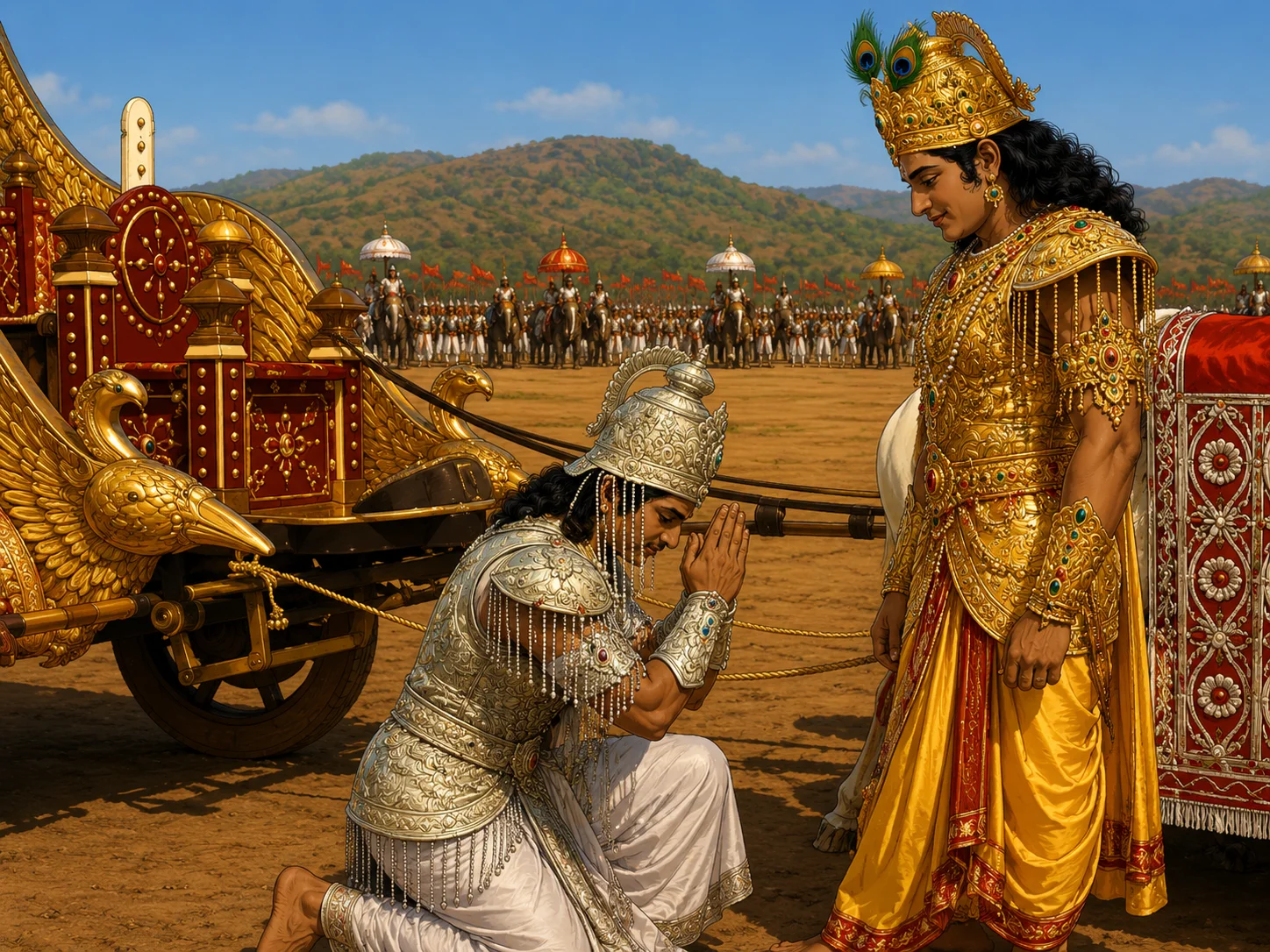
On the battlefield of Kurukshetra, Arjuna is frozen between duty and grief. Krishna has just explained the three qualities and their grip on human life. Now he points to the way beyond them: freedom from the cycle of bodily suffering.
03
In your life
Why this verse still matters
You watch your body age in the mirror, then feel the panic rise with every ache, deadline, and loss. This verse says the deepest part of you is not trapped in that churn.
The takeaway
“There is relief in seeing that suffering belongs to change, not to what is deepest in you.”
Explore related themes: gunas(47 verses), moksha(34 verses)
Common questions
What does Bhagavad Gita 14.20 mean?
A person who rises above the three qualities that shape the body is no longer bound by birth, death, old age, or sorrow.
Who speaks Bhagavad Gita 14.20?
Krishna speaks this verse, on the battlefield of Kurukshetra, in the chapter titled "Gunatraya Vibhaga Yoga" (The Three Modes of Material Nature).
Which chapter of the Bhagavad Gita contains verse 14.20?
Verse 20 sits in Chapter 14 of the Bhagavad Gita — Gunatraya Vibhaga Yoga, "The Three Modes of Material Nature". The chapter has 27 verses in total.
Why does Bhagavad Gita 14.20 matter today?
You watch your body age in the mirror, then feel the panic rise with every ache, deadline, and loss. This verse says the deepest part of you is not trapped in that churn.
It shifts attention from managing symptoms of change to seeing the self as untouched by them.
What this verse means
A person who rises above the three qualities that shape the body is no longer bound by birth, death, old age, or sorrow.
Context & commentary
On the battlefield of Kurukshetra, Arjuna is frozen between duty and grief. Krishna has just explained the three qualities and their grip on human life. Now he points to the way beyond them: freedom from the cycle of bodily suffering.
Why this verse still matters
You watch your body age in the mirror, then feel the panic rise with every ache, deadline, and loss. This verse says the deepest part of you is not trapped in that churn.
“There is relief in seeing that suffering belongs to change, not to what is deepest in you.”
Explore related themes: gunas (47 verses), moksha (34 verses)