When the seer understands that no doer exists apart from the three qualities, and knows the divine nature beyond them, that seer reaches my being.
— Krishna
❋
Bhagavad Gita · 14.19
Hindi · हिन्दी
जब विवेकी विचारकुशल मनुष्य तीनों गुणोंके सिवाय अन्य किसीको कर्ता नहीं देखता और अपनेको गुणोंसे पर अनुभव करता है, तब वह मेरे स्वरूपको प्राप्त हो जाता है ॥
The verse in reading order — each Sanskrit word with its meaning beneath. Hover a word to focus on it.
नान्यम्no otherगुणेभ्यःthan the qualitiesकर्तारम्doerयदाwhenद्रष्टाthe seerअनुपश्यतिsees clearlyगुणेभ्यःthan the qualitiesचandपरम्beyondवेत्तिknowsमद्भावम्my natureसःthat oneअधिगच्छतिattains
Read literallyno other · than the qualities · doer · when · the seer · sees clearly · than the qualities · and · beyond · knows · my nature · that one · attains
Understanding the verse
✦
It shifts responsibility from ego to clear seeing, so action can happen without false ownership.
Clear seeing reveals that action belongs to the three qualities, not to a separate personal doer. When a person sees beyond them, they come to Krishna's nature.
02
On the battlefield
Context & commentary
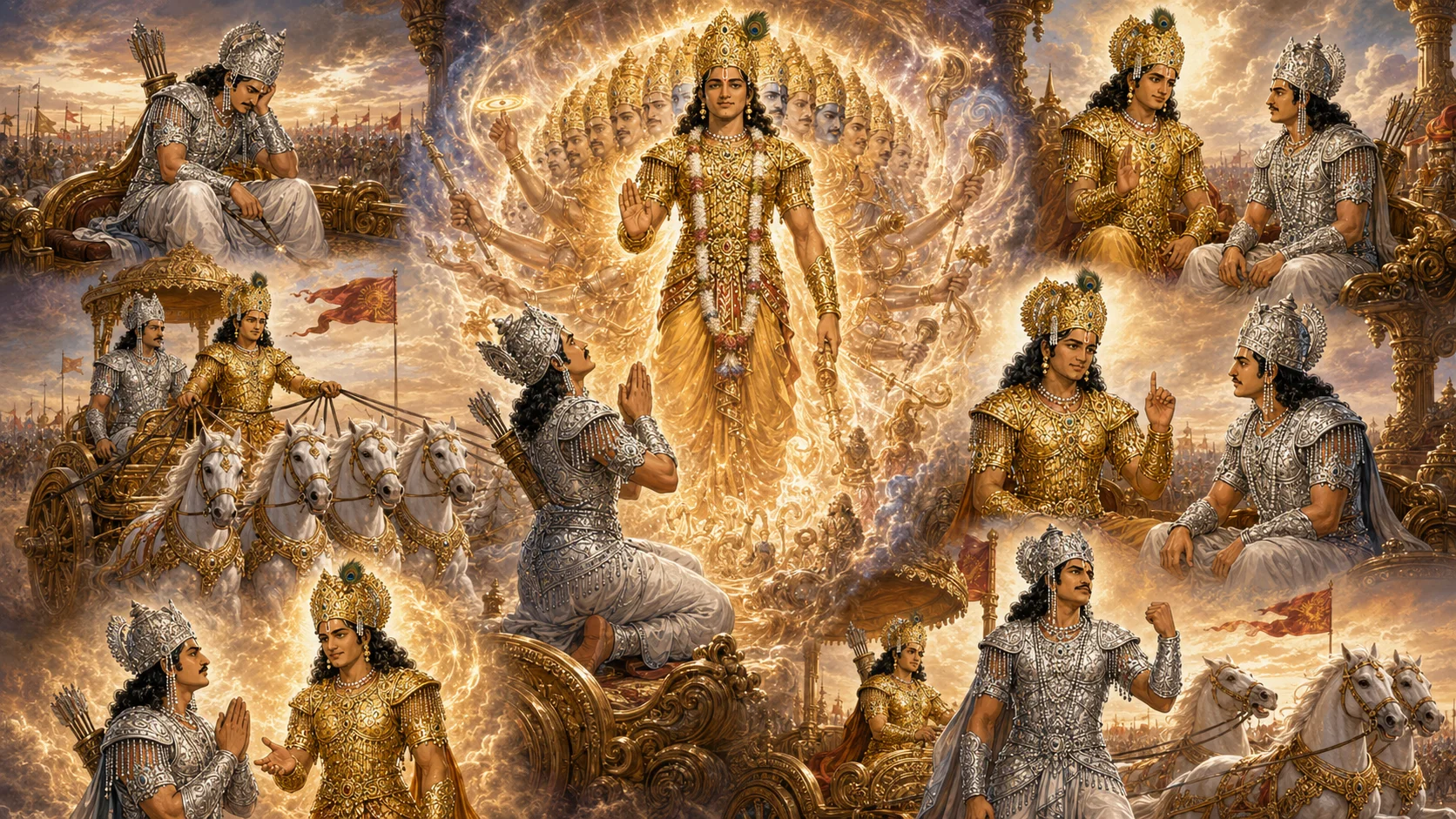
On Kurukshetra, Arjuna is frozen between duty and grief. Krishna explains that the world runs through the three qualities, not through a separate ego-doer. The one who sees this clearly moves toward Krishna’s own nature.
03
In your life
Why this verse still matters
You replay a painful conversation for hours, blaming yourself for every word. Then it clicks: much of what happened came from moods, habits, and pressures larger than one isolated self.
The takeaway
“It brings relief from the burden of personal control.”
Explore related themes: gunas(47 verses), prakriti(31 verses), viveka(15 verses)
Common questions
What does Bhagavad Gita 14.19 mean?
Clear seeing reveals that action belongs to the three qualities, not to a separate personal doer. When a person sees beyond them, they come to Krishna's nature.
Who speaks Bhagavad Gita 14.19?
Krishna speaks this verse, on the battlefield of Kurukshetra, in the chapter titled "Gunatraya Vibhaga Yoga" (The Three Modes of Material Nature).
Which chapter of the Bhagavad Gita contains verse 14.19?
Verse 19 sits in Chapter 14 of the Bhagavad Gita — Gunatraya Vibhaga Yoga, "The Three Modes of Material Nature". The chapter has 27 verses in total.
Why does Bhagavad Gita 14.19 matter today?
You replay a painful conversation for hours, blaming yourself for every word. Then it clicks: much of what happened came from moods, habits, and pressures larger than one isolated self.

It shifts responsibility from ego to clear seeing, so action can happen without false ownership.
What this verse means
Clear seeing reveals that action belongs to the three qualities, not to a separate personal doer. When a person sees beyond them, they come to Krishna's nature.
Context & commentary
On Kurukshetra, Arjuna is frozen between duty and grief. Krishna explains that the world runs through the three qualities, not through a separate ego-doer. The one who sees this clearly moves toward Krishna’s own nature.
Why this verse still matters
You replay a painful conversation for hours, blaming yourself for every word. Then it clicks: much of what happened came from moods, habits, and pressures larger than one isolated self.
“It brings relief from the burden of personal control.”
Explore related themes: gunas (47 verses), prakriti (31 verses), viveka (15 verses)