Thinking about sense objects creates attachment to them. Attachment gives rise to desire; desire gives rise to anger.
— Krishna
❋
Bhagavad Gita · 2.62
Hindi · हिन्दी
विषयोंका चिन्तन करनेवाले मनुष्यकी उन विषयोंमें आसक्ति पैदा हो जाती है । आसक्तिसे कामना पैदा होती है । कामनासे क्रोध पैदा होता है । क्रोध होनेपर सम्मोह मूढ़भाव हो जाता है । सम्मोहसे स्मृति भ्रष्ट हो जाती है । स्मृति भ्रष्ट होनेपर बुद्धिका नाश हो जाता है । बुद्धिका नाश होनेपर मनुष्यका पतन हो जाता है ॥
Read literallywhile thinking of · sense objects · for a person · attachment · to them · arises · from attachment · is born · desire · from desire · anger · arises strongly
Understanding the verse
✦
It teaches you to interrupt the chain at the first attachment, not after the anger has already taken root.
Fixating on pleasures or objects creates attachment. Attachment turns into wanting, and wanting turns into anger when blocked.
02
On the battlefield
Context & commentary
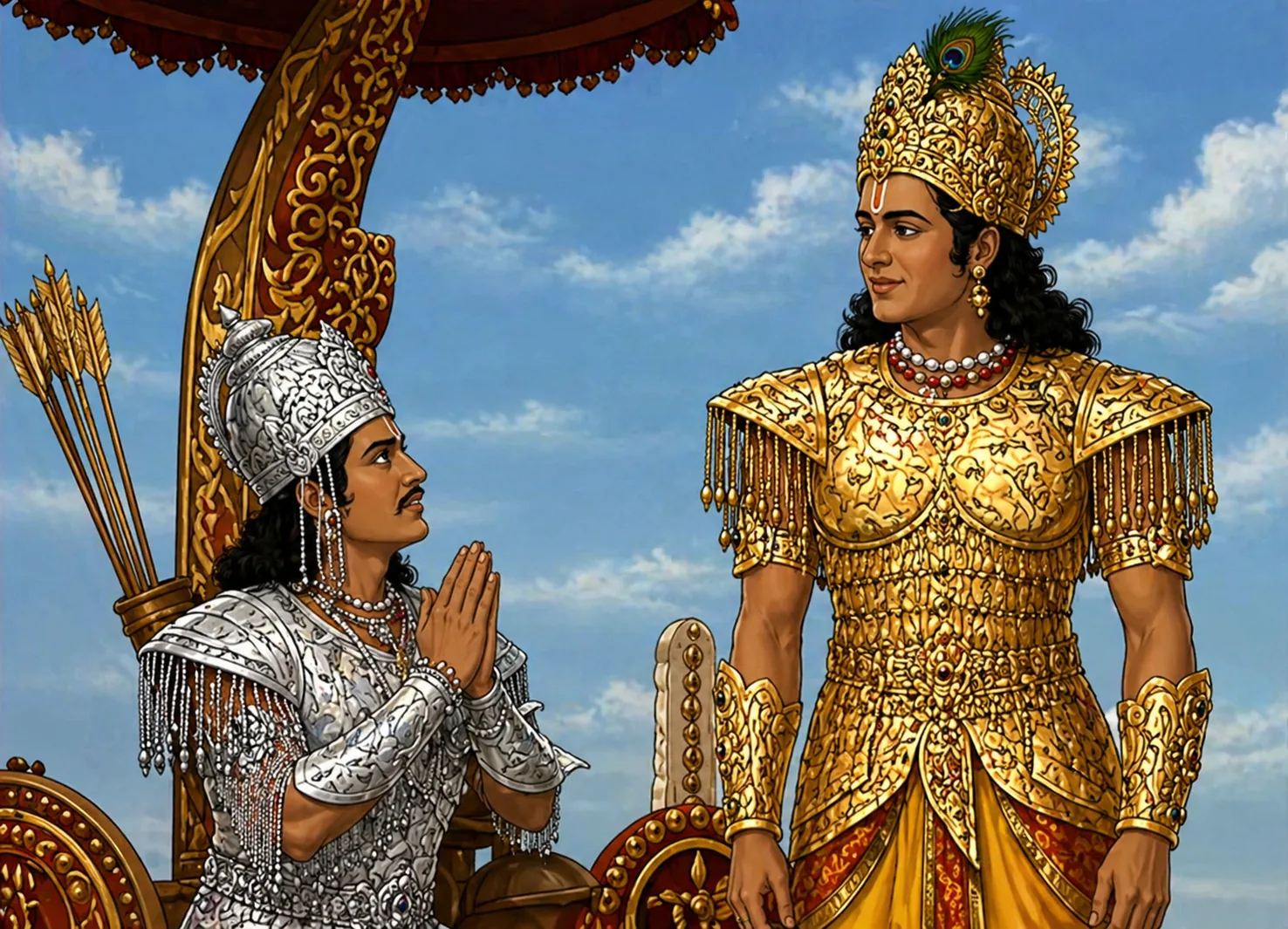
On the battlefield, Arjuna is frozen and Krishna is tracing the inner mechanics of collapse. He shows how the mind falls step by step: thought, attachment, desire, anger, confusion, ruin. This verse explains why self-mastery matters.
03
In your life
Why this verse still matters
You keep checking a message thread, then the silence starts to sting, then irritation takes over. The verse names that slide from fixation to fury before it owns you.
The takeaway
“There is relief in catching the chain early, before a small craving hardens into a reaction you regret.”
Explore related themes: manas(49 verses), kama(23 verses), indriya(19 verses)
Common questions
What does Bhagavad Gita 2.62 mean?
Fixating on pleasures or objects creates attachment. Attachment turns into wanting, and wanting turns into anger when blocked.
Who speaks Bhagavad Gita 2.62?
Krishna speaks this verse, on the battlefield of Kurukshetra, in the chapter titled "Sankhya Yoga" (The Yoga of Knowledge).
Which chapter of the Bhagavad Gita contains verse 2.62?
Verse 62 sits in Chapter 2 of the Bhagavad Gita — Sankhya Yoga, "The Yoga of Knowledge". The chapter has 72 verses in total.
Why does Bhagavad Gita 2.62 matter today?
You keep checking a message thread, then the silence starts to sting, then irritation takes over. The verse names that slide from fixation to fury before it owns you.

It teaches you to interrupt the chain at the first attachment, not after the anger has already taken root.
What this verse means
Fixating on pleasures or objects creates attachment. Attachment turns into wanting, and wanting turns into anger when blocked.
Context & commentary
On the battlefield, Arjuna is frozen and Krishna is tracing the inner mechanics of collapse. He shows how the mind falls step by step: thought, attachment, desire, anger, confusion, ruin. This verse explains why self-mastery matters.
Why this verse still matters
You keep checking a message thread, then the silence starts to sting, then irritation takes over. The verse names that slide from fixation to fury before it owns you.
“There is relief in catching the chain early, before a small craving hardens into a reaction you regret.”
Explore related themes: manas (49 verses), kama (23 verses), indriya (19 verses)