Shraddhatraya Vibhaga Yoga
Three kinds of faith. Three kinds of food. Three kinds of sacrifice and giving. The Gita on what your daily choices reveal about you.
All 28 verses below.
Wisdom translation, edited by Ankur Shukla. Commentary AI-drafted, human-reviewed. Reviewed June 2026. Methodology →
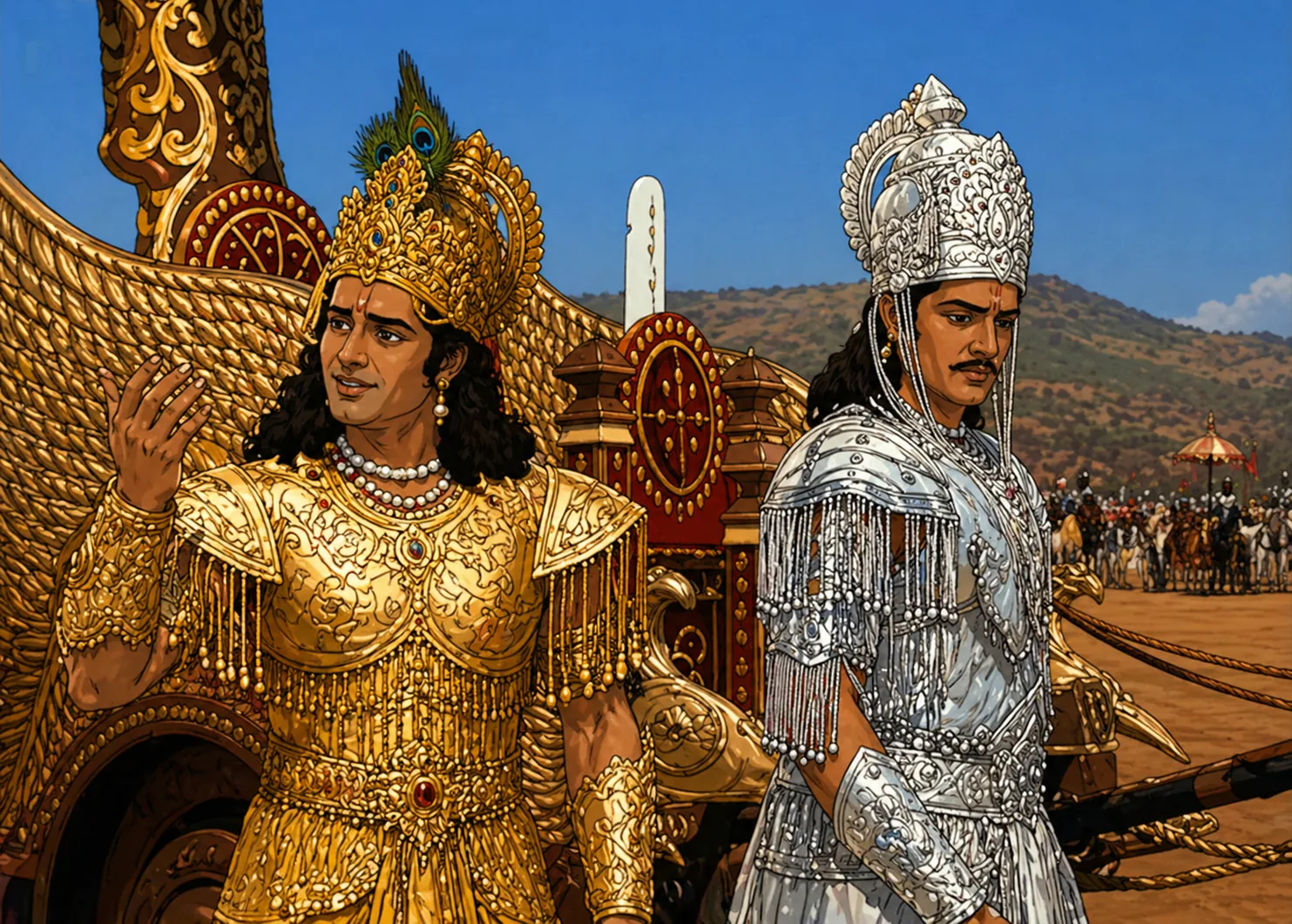
“Faith alone does not reveal its quality; the motive beneath it does.”
It is okay to question what drives belief instead of assuming every sincere act is equally clear.
Read full verse 17.1 →All verses
- 17.1Ch. 17
Faith alone does not reveal its quality; the motive beneath it does.
It is okay to question what drives belief instead of assuming every sincere act is equally clear.
- 17.2Ch. 17
Faith takes the shape of the nature beneath it.
Your deepest beliefs are not random; they reveal the quality of your inner state.
- 17.3Ch. 17
Trust is not just held; it becomes the person.
What you repeatedly trust quietly forms your character.
- 17.4Ch. 17
Faith reveals itself in what each person chooses to revere.
Your deepest tendencies quietly choose what you revere.
- 17.5Ch. 17
Harsh effort without right guidance can deepen ego instead of cleansing it.
Not every hard practice is cleansing. Struggle can still feed ego.
- 17.6Ch. 17
Harshness is not holiness when it destroys the body and ignores what lives within.
Not every hard practice is noble. Discipline without wisdom can become self-harm.
- 17.7Ch. 17
Even sacred actions differ; their inner quality decides their worth.
Not every noble act has the same quality. The inner motive changes everything.
- 17.8Ch. 17
Wholesome food quietly builds the conditions for a steadier life.
What you eat shapes how steady, clear, and cheerful you feel.
- 17.9Ch. 17
What excites the senses can quietly produce suffering.
What feels exciting in the moment can quietly wear you down afterward.
- 17.10Ch. 17
What you repeatedly choose to consume reveals the heaviness within.
Your cravings can reveal your condition before your thoughts do.
- 17.11Ch. 17
Right action becomes pure when reward stops being the reason.
There is relief in doing what is right without bargaining for a payoff.
- 17.12Ch. 17
An offering for reward or applause loses its purity.
It exposes the hidden craving to be seen, praised, or rewarded, so you can notice it before it shapes your actions.
- 17.13Ch. 17
Ritual without trust becomes empty and heavy.
What you do matters less than the sincerity and care you bring to it.
- 17.14Ch. 17
The body itself can become a disciplined offering.
Spiritual discipline is not abstract. It begins with how you treat your body and other people.
Did you like this chapter?
- 17.15Ch. 17
Speech becomes discipline when it tells the truth without creating harm.
Your words can become a form of self-training, not just self-expression.
- 17.16Ch. 17
A trained mind is its own austerity.
Inner strength is not noise. It grows when the mind becomes steady and clear.
- 17.17Ch. 17
True discipline is clean only when reward is no longer the motive.
Real discipline feels lighter when it is not bargaining for payoff.
- 17.18Ch. 17
Practice for applause collapses into instability.
You can feel the difference between sincere effort and performance. The second leaves you emptier, even when others clap.
- 17.19Ch. 17
Pain imposed in ignorance only deepens confusion.
Real discipline should make you clearer and kinder, not harsher toward yourself or others.
- 17.20Ch. 17
Giving becomes pure when nothing is being bought in return.
Generosity feels lighter when it is free of self-interest.
- 17.21Ch. 17
A gift becomes lesser the moment it starts asking for something back.
Generosity feels lighter when it is not secretly a trade.
- 17.22Ch. 17
A gift can become degrading when respect is missing.
Even generosity loses its value when it is careless or contemptuous.
- 17.23Ch. 17
Sacred action matters because it points beyond itself to what is real.
Sacred words are not decoration; they point the mind back to what is most real.
- 17.24Ch. 17
Sacred action begins by naming the supreme reality first.
Even disciplined action can begin with reverence, not just habit.
- 17.25Ch. 17
Freedom deepens when action stops demanding a private return.
You can act with devotion and still let go of what comes back.
- 17.26Ch. 17
What is real and worthy carries the mark of sat.
It gives a clean standard: what is real, noble, and worthy of praise deserves your full trust.
- 17.27Ch. 17
Steady offering makes ordinary action sacred.
Your effort becomes meaningful when it is steady and offered with sincerity.
- 17.28Ch. 17
Trust is what makes action real; without it, effort becomes empty.
Trust is what makes effort alive; without it, even noble action feels hollow.