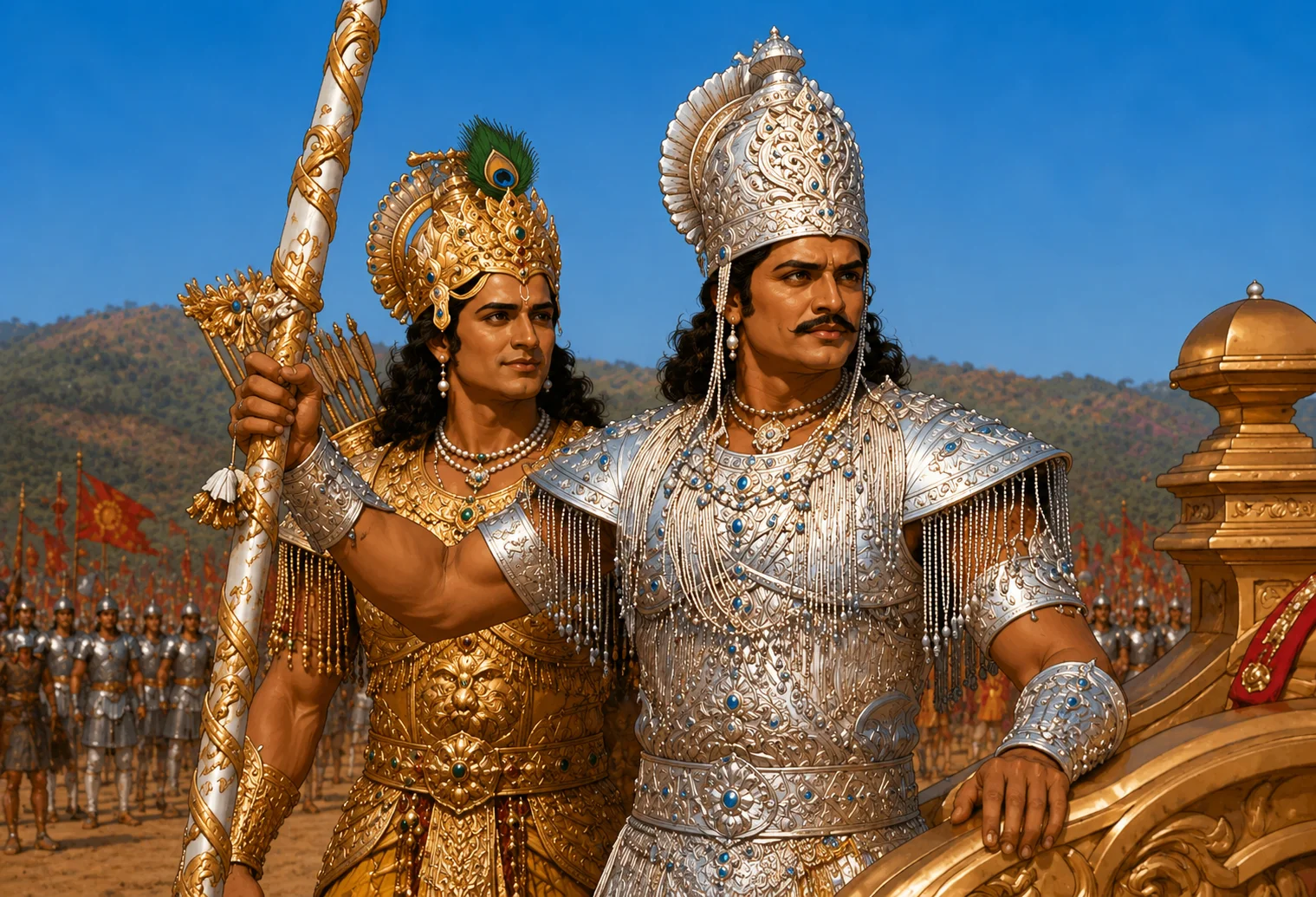
Chapter 18 is the longest chapter in the Bhagavad Gita, seventy-eight verses, more than twice the length of most others. It is also the most comprehensive. Krishna does not introduce many new teachings here. Instead, he revisits the most important ones, recasts them in their final form, and pulls them together into a single concluding argument. The chapter is, in a real sense, the Gita reading itself back to itself. By the end of it, Arjuna's doubt is gone and the war can proceed. By the end of it, the reader is left with two of the most important verses in the entire book, 18.65 and 18.66, the final teaching and the most secret teaching.
What is unusual about Chapter 18 is its rhythm. The early verses are taxonomic, three kinds of renunciation, three kinds of action, three kinds of doer, three kinds of intelligence, three kinds of resolve, three kinds of happiness. The chapter goes through these methodically. Then, around verse 50, the tone shifts. The taxonomies recede. The closing verses become personal again. Krishna offers Arjuna his most direct, most tender, and most absolute teachings, the ones that have echoed for two thousand years not because they are clever but because they are, at their root, an invitation to take refuge.
Renunciation Is Not What Most People Think
Chapter 18 opens with Arjuna's final question. What is the difference between sannyāsa (renunciation) and tyāga (letting go)? The two words have been used through the Gita, sometimes synonymously, sometimes with subtle distinctions. Arjuna wants the definitive answer.
Krishna gives it in verse 18.2. Some wise people say renunciation means giving up desire-driven actions. Others say it means giving up the fruits of all actions. The first is sannyāsa in its narrow sense, giving up specific kinds of activities. The second is tyāga, the inner letting go of results that the Gita has been teaching since Chapter 2. The chapter will, in subsequent verses, side with the second. The truly renounced person is not the one who has stopped acting. It is the one who has stopped clutching the result. This was already the Gita's position in Chapter 5 and 6. Chapter 18 makes it the final position.
सर्वकर्मफलत्यागं प्राहुस्त्यागं विचक्षणाः ॥
kāmyānāṃ karmaṇāṃ nyāsaṃ sannyāsaṃ kavayo viduḥ |
sarva-karma-phala-tyāgaṃ prāhus tyāgaṃ vicakṣaṇāḥ ||
Any Action Has Five Causes, You Are One of Them
Verses 18.13 and 18.14 contain one of the Gita's most useful pieces of analytic philosophy. Every action, Krishna says, has five causes. The body (the field where the action happens). The doer (the seemingly individual agent). The various instruments (senses, organs, tools). The many different efforts (the actual movements involved). And the fifth: daivam, the unseen force, divine grace, the larger order. Five causes converge on every action. The ego claims to be one of them. It is not the only one.
Why does this matter? Because most of our suffering about action comes from imagining we are the sole cause. When the action succeeds, we feel inflated. When it fails, we feel devastated. Both reactions assume we are doing the work alone. The Gita's five-fold analysis shows that we are, in fact, one of five contributors. The other four, body, instruments, efforts, divine factor, were also necessary. Even when you act perfectly, the result is not yours alone to claim. Even when you act poorly, the result is not yours alone to blame. The five causes share the responsibility, and that sharing is, oddly, the source of peace.
विविधाश्च पृथक्चेष्टा दैवं चैवात्र पञ्चमम् ॥
vividhāś ca pṛthak ceṣṭā daivaṃ caivātra pañcamam ||
Without Egoic Ownership, the Stain Doesn't Stick
Verse 18.17 contains a sentence that has troubled commentators for centuries. Krishna says: the one whose understanding remains unstained, who has no sense of separate self in the action, does not kill, even if he kills all these beings, and is not bound.
Read carelessly, this is a moral horror. Read carefully, it is a precise teaching about what binds and what doesn't. The verse is not licensing violence. It is identifying what makes an action heavy. The heaviness of an action is not in the action itself; it is in the egoic claim attached to it. The same act, performed by a person who has authentically identified with the larger pattern of dharma rather than with personal want, lands differently in the universe than the same act performed for personal advantage. In Arjuna's specific case, he is being asked to fight a war he did not choose, against opponents who are on the wrong side of dharma, with no personal hatred. The verse is saying that, in such a case, the act can be performed without binding the actor.
हत्वापि स इमाँल्लोकान्न हन्ति न निबध्यते ॥
hatvāpi sa imāṁl lokān na hanti na nibadhyate ||
The Intelligence That Knows What Frees and What Binds
Through verses 18.20-39, Krishna gives the now-familiar three-fold analysis applied to knowledge, action, doer, intelligence, and resolve. Verse 18.30 stands out from the rest. It defines the sattvic intelligence (the highest quality of buddhi) as the intelligence that knows the difference between what should be pursued and what should be withdrawn from, between what should be done and what should not, between fear and fearlessness, between bondage and liberation.
Notice the five pairs. Pravṛtti / nivṛtti. Kārya / akārya. Bhaya / abhaya. Bandha / mokṣa. The highest intelligence is not impressive knowledge or sophisticated argument. It is the ability to discriminate, in any moment, between these five pairs. What direction leads forward and what direction draws back. What action should be done and what action should not. What is genuine fear and what is unnecessary fear. What binds the atman and what frees it. A person with this discrimination, the verse implies, can navigate any situation. A person without it gets repeatedly caught.
बन्धं मोक्षं च या वेत्ति बुद्धिः सा पार्थ सात्त्विकी ॥
bandhaṃ mokṣaṃ ca yā vetti buddhiḥ sā pārtha sāttvikī ||
"The intelligence that knows what binds and what frees, that is the highest intelligence."Bhagavad Gita 18.30
Your Imperfect Duty Over Another's Perfect One
Verse 18.47 is one of the most often-quoted and most often-misunderstood verses in the Gita. Krishna says: better is one's own dharma, even if imperfectly performed, than another's dharma well performed. The performance of one's natural duty leads to no papa. The verse echoes a similar sentence from Chapter 3.
Read carelessly, the verse can sound conservative, a permission to stay in one's caste, one's job, one's marriage, one's role. That is not its main thrust. The deeper teaching is about authenticity. Your work, done in your way, in your voice, with your imperfections, has a kind of integrity that no borrowed work can match, however well-executed. The borrowed work, no matter how polished, is still costume. Your own work, even messy, is the actual transmission of who you are. The Gita is asking you to make peace with the imperfection of your own contribution and to stop comparing it to a more glamorous role you imagine you should be playing.
स्वभावनियतं कर्म कुर्वन्नाप्नोति किल्बिषम् ॥
svabhāva-niyataṃ karma kurvan nāpnoti kilbiṣam ||
What this verse asks you to stop doing: Comparing yourself to another person who appears to be doing what you wish you were doing. Their work is not better than yours because it appears more polished. Their work is theirs. Your work is yours. The Gita's standard is not relative quality; it is fit between the work and the worker. Do your own thing, badly if necessary, but actually do it.
Devoted Love Is How You Actually Know
Verse 18.55 is one of the most quietly important verses near the end of the chapter. Krishna says: through bhakti (devoted love) one truly knows me as I am. Knowing me in truth, one enters into me at once.
Notice the epistemology. The Gita is not saying you can know the Divine through reasoning alone. It is saying that devoted love is itself a form of knowledge, a more accurate one than detached analysis. This is not anti-intellectual. It is just precise. Some things can only be known through the right relationship. A person can be studied, analyzed, and described from outside, and the description will miss what the person is actually like. The same person, encountered through real love, is known differently. The Gita is applying this to the Divine. The deepest knowledge is not the one you assemble from outside. It is the one that arises from inside a real relationship.
ततो मां तत्त्वतो ज्ञात्वा विशते तदनन्तरम् ॥
tato māṃ tattvato jñātvā viśate tad-anantaram ||
The Lord in the Heart, Spinning Us on the Wheel
Verses 18.61 and 18.62 give one of the most evocative images in the Gita. Krishna says: the Lord dwells in the heart of all beings, and by his māyā causes them to revolve, as if mounted on a machine. The image is striking. Each of us is, in this verse, a being mounted on the wheel of life, spinning according to the deepest pattern of our own conditioning. The Lord is not separate from this; the Lord is at the centre of it.
Then comes the instruction. Surrender to that Lord with your whole being. By that grace, you will reach supreme peace and the eternal home. Notice the move. Once you understand that the spinning is happening through you, not by you, the appropriate response is not control. Control was the illusion that produced the suffering. The appropriate response is surrender: handing over the part of your inner life that was trying, futilely, to drive the machine you are mounted on.
भ्रामयन्सर्वभूतानि यन्त्रारूढानि मायया ॥
bhrāmayan sarva-bhūtāni yantrārūḍhāni māyayā ||
"The Lord dwells in the heart of all beings, spinning them like beings mounted on a machine."Bhagavad Gita 18.61
The Two Verses That End the Gita
Now we arrive at the two verses that have, more than any others, defined how the Gita is received. Verse 18.65 first. Man-manā bhava mad-bhakto mad-yājī māṃ namaskuru. Mām evaiṣyasi satyaṃ te pratijāne priyo'si me. Fix your mind on me. Be devoted to me. Worship me. Bow to me. You will come to me. I promise you truly, because you are dear to me. The verse is nearly identical to 9.34. The new thing in 18.65 is the last line. Satyaṃ te pratijāne priyo'si me. I promise you truly. Because you are dear to me.
And then, verse 18.66, what tradition calls the charama śloka: the final verse, the most secret teaching of all. Sarva-dharmān parityajya mām ekaṃ śaraṇaṃ vraja. Abandon all dharmas. Take refuge in me alone. Ahaṃ tvāṃ sarva-pāpebhyo mokṣayiṣyāmi, mā śucaḥ. I will free you from all wrongdoing. Do not grieve. The verse is staggering. After eighteen chapters of dharma (duty, action, restraint, technique, knowledge), Krishna's final instruction is to let go of all of it and rest in him. This is not a cancellation of the previous teaching. It is its completion. The dharmas were the necessary ladder. The ladder, at the top, is finally released. What remains is refuge, and the promise that refuge is enough.
मामेवैष्यसि सत्यं ते प्रतिजाने प्रियोऽसि मे ॥
mām evaiṣyasi satyaṃ te pratijāne priyo'si me ||
अहं त्वा सर्वपापेभ्यो मोक्षयिष्यामि मा शुचः ॥
ahaṃ tvā sarva-pāpebhyo mokṣayiṣyāmi mā śucaḥ ||
"Abandon every duty. Take refuge in me alone. I will free you from all wrongdoing. Do not grieve."Bhagavad Gita 18.66
Arjuna's Confusion Is Gone
Verse 18.73 is one of the most personally moving verses in the Gita. Arjuna, who began the book frozen on the battlefield in tears, speaks: naṣṭo mohaḥ smṛtir labdhā tvat-prasādān mayācyuta. My delusion is destroyed. My memory has been recovered, by your grace, O Achyuta. Sthito'smi gata-sandehaḥ kariṣye vacanaṃ tava. I stand firm, my doubts gone. I will do what you say.
Notice what has happened. Eighteen chapters ago, Arjuna was paralysed. He had set down his bow. He had wept on the chariot floor. He had asked Krishna to teach him. Now, at the end, he stands. The Sanskrit word is sthitaḥ, established, firm. The delusion is gone. The memory is restored, not of facts, but of who he is and what he must do. The doubts are gone. He will act. The Gita's pedagogical project is complete. Not because Arjuna has been given new information. Because the confusion that prevented him from acting has been dissolved.
स्थितोऽस्मि गतसन्देहः करिष्ये वचनं तव ॥
naṣṭo mohaḥ smṛtir labdhā tvat-prasādān mayācyuta |
sthito'smi gata-sandehaḥ kariṣye vacanaṃ tava ||
Where Krishna and Arjuna Are Together, Victory Is Already There
The Gita does not end in Krishna's voice. It does not end in Arjuna's. It ends in the voice of Sanjaya, the narrator who has been describing the dialogue to the blind king Dhritarashtra. Verse 18.78 is Sanjaya's closing comment, and it has become one of the most quoted verses in Indian devotional life.
Wherever Krishna, the master of yoga, is present, and wherever Arjuna, the bow-bearer, is present: there is prosperity, victory, glory, and firm justice. Etat me matiḥ. This is my conviction. The verse is a kind of benediction. It says: when the wisdom of the Divine and the willingness of the seeker are joined, the outcome is already secured. Not because the universe is rigged in favour of any particular agent, but because the right alignment (wisdom and willingness, teacher and student, divine and human) produces its own victory. The Gita ends, not with the war's outcome, but with the assurance that the proper alignment has been achieved. The rest is detail.
तत्र श्रीर्विजयो भूतिर्ध्रुवा नीतिर्मतिर्मम ॥
tatra śrīr vijayo bhūtir dhruvā nītir matir mama ||
What the Gita finally leaves you with: Eighteen chapters of teaching, summarised in two final verses. Fix the mind on the Divine, be devoted, worship, bow, and you will come to me. Abandon every other framework and take refuge here. I will free you, do not grieve. The teaching ends in love. Not in technique. Not in metaphysics. In the assurance that refuge is enough.
The Complete Verse Reference
| Verse | Speaker | Teaching Essence |
|---|---|---|
| 18.1 | Arjuna | Clear seeing begins with asking what must be separated |
| 18.2 | Krishna | Renunciation means releasing both craving and attachment to results |
| 18.3 | Krishna | Renunciation is not simple refusal; some actions must remain |
| 18.4 | Krishna | Renunciation is not one thing; it has distinct forms |
| 18.5 | Krishna | What purifies you should be done, not dropped |
| 18.6 | Krishna | Right action is complete only when desire for reward is dropped |
| 18.7 | Krishna | Right action should not be abandoned just because it feels difficult |
| 18.8 | Krishna | Fearful withdrawal is not freedom; it is avoidance wearing a noble name |
| 18.9 | Krishna | Renunciation means doing what must be done without gripping the result |
| 18.10 | Krishna | Freedom means neither resisting the hard nor craving the pleasant |
| 18.11 | Krishna | Freedom begins when action continues and attachment stops |
| 18.12 | Krishna | The chain of action ends when desire for its fruit ends |
| 18.13 | Krishna | Action has many causes; the ego is not the whole story |
| 18.14 | Krishna | Action has many causes, and no one factor owns the result |
| 18.15 | Krishna | Every deed comes from five causes, not one isolated doer |
| 18.16 | Krishna | Action has many causes; the pure self is not the lone doer |
| 18.17 | Krishna | Without egoic ownership, action leaves no stain |
| 18.18 | Krishna | Action is a system, not a single ego doing everything |
| 18.19 | Krishna | Every action, knower, and deed carries the mark of a quality |
| 18.20 | Krishna | True understanding sees one undivided reality inside every divided form |
| 18.21 | Krishna | Dividing everything into parts is not clarity; it is restless seeing |
| 18.22 | Krishna | Small certainty can hide the least real understanding |
| 18.23 | Krishna | The purest action asks for nothing back |
| 18.24 | Krishna | Desire and ego turn action restless, even when it looks productive |
| 18.25 | Krishna | Blind action begins where clear seeing is absent |
| 18.26 | Krishna | Pure action leaves the ego out and stays calm in victory or defeat |
| 18.27 | Krishna | Craving turns action into a chase for reward and emotional swing |
| 18.28 | Krishna | Dullness in the doer makes even action inert and harmful |
| 18.29 | Krishna | Understanding and resolve differ by the quality that shapes them |
| 18.30 | Krishna | True intelligence recognizes the difference between bondage and freedom |
| 18.31 | Krishna | Restless intelligence cannot tell duty from harm |
| 18.32 | Krishna | Darkness can make the wrong choice feel morally correct |
| 18.33 | Krishna | Steadiness becomes pure when it keeps the whole being aligned |
| 18.34 | Krishna | Steadiness becomes restless when it is tied to reward |
| 18.35 | Krishna | Clinging to fear and sorrow is not strength; it is tamasic inertia |
| 18.36 | Krishna | True happiness begins as discipline and ends as relief |
| 18.37 | Krishna | Lasting ease can begin as discomfort and end as release |
| 18.38 | Krishna | What feels sweetest first can become the harshest later |
| 18.39 | Krishna | Pleasure that dulls you is not relief; it is confusion in disguise |
| 18.40 | Krishna | No state is free from the three qualities of nature |
| 18.41 | Krishna | Your rightful work comes from your nature, not imitation |
| 18.42 | Krishna | True duty begins as disciplined character, not public role |
| 18.43 | Krishna | True strength serves, stands firm, and does not retreat |
| 18.44 | Krishna | Every nature has its own rightful work |
| 18.45 | Krishna | Fulfillment comes from living your own work, not someone else's |
| 18.46 | Krishna | Offering your work to the source of life turns ordinary action into fulfillment |
| 18.47 | Krishna | Your imperfect duty is cleaner than a borrowed perfection |
| 18.48 | Krishna | Your right work is still right, even when it is imperfect |
| 18.49 | Krishna | Freedom arrives when the mind stops reaching outward |
| 18.50 | Krishna | Knowledge has a highest point: direct arrival, not endless thinking |
| 18.51 | Krishna | Purified resolve cuts the pull of craving and aversion |
| 18.52 | Krishna | Freedom grows from deliberate simplicity and steady restraint |
| 18.53 | Krishna | Peace begins when the sense of ownership ends |
| 18.54 | Krishna | Freedom from craving makes room for the highest devotion |
| 18.55 | Krishna | Devoted love turns understanding into immediate nearness |
| 18.56 | Krishna | Continuous action and complete refuge can lead to the same unchanging state |
| 18.57 | Krishna | Hand over the action, and let the mind stay gathered there |
| 18.58 | Krishna | Grace opens the way; ego closes it |
| 18.59 | Krishna | Ego cannot veto what your nature has already chosen |
| 18.60 | Krishna | Resistance cannot cancel what your nature is already set to do |
| 18.61 | Krishna | The deeper mover is not your ego, and surrender begins there |
| 18.62 | Krishna | Wholehearted surrender opens the door to lasting peace |
| 18.63 | Krishna | True guidance ends by returning choice to you |
| 18.64 | Krishna | The deepest teaching is spoken as care, not command |
| 18.65 | Krishna | Wholehearted devotion becomes the shortest path home |
| 18.66 | Krishna | Total refuge ends the burden of fear |
| 18.67 | Krishna | Deep truth must be shared only with those ready to receive it |
| 18.68 | Krishna | Devotion deepens when sacred truth is passed on |
| 18.69 | Krishna | Sharing this teaching becomes the highest form of devotion |
| 18.70 | Krishna | Sincere study of this dialogue becomes worship itself |
| 18.71 | Krishna | Trustful listening can open the door to freedom |
| 18.72 | Krishna | True listening should end confusion, not just collect words |
| 18.73 | Arjuna | Grace ends confusion and turns insight into obedience |
| 18.74 | Sanjaya | A true dialogue can leave the listener shaken and changed |
| 18.75 | Sanjaya | The deepest teaching is received, not invented |
| 18.76 | Sanjaya | A sacred conversation keeps giving joy each time it is remembered |
| 18.77 | Sanjaya | Remembering Krishna's vast form still overwhelms the mind with wonder |
| 18.78 | Sanjaya | Right action carries its own victory |
Did you like this article?