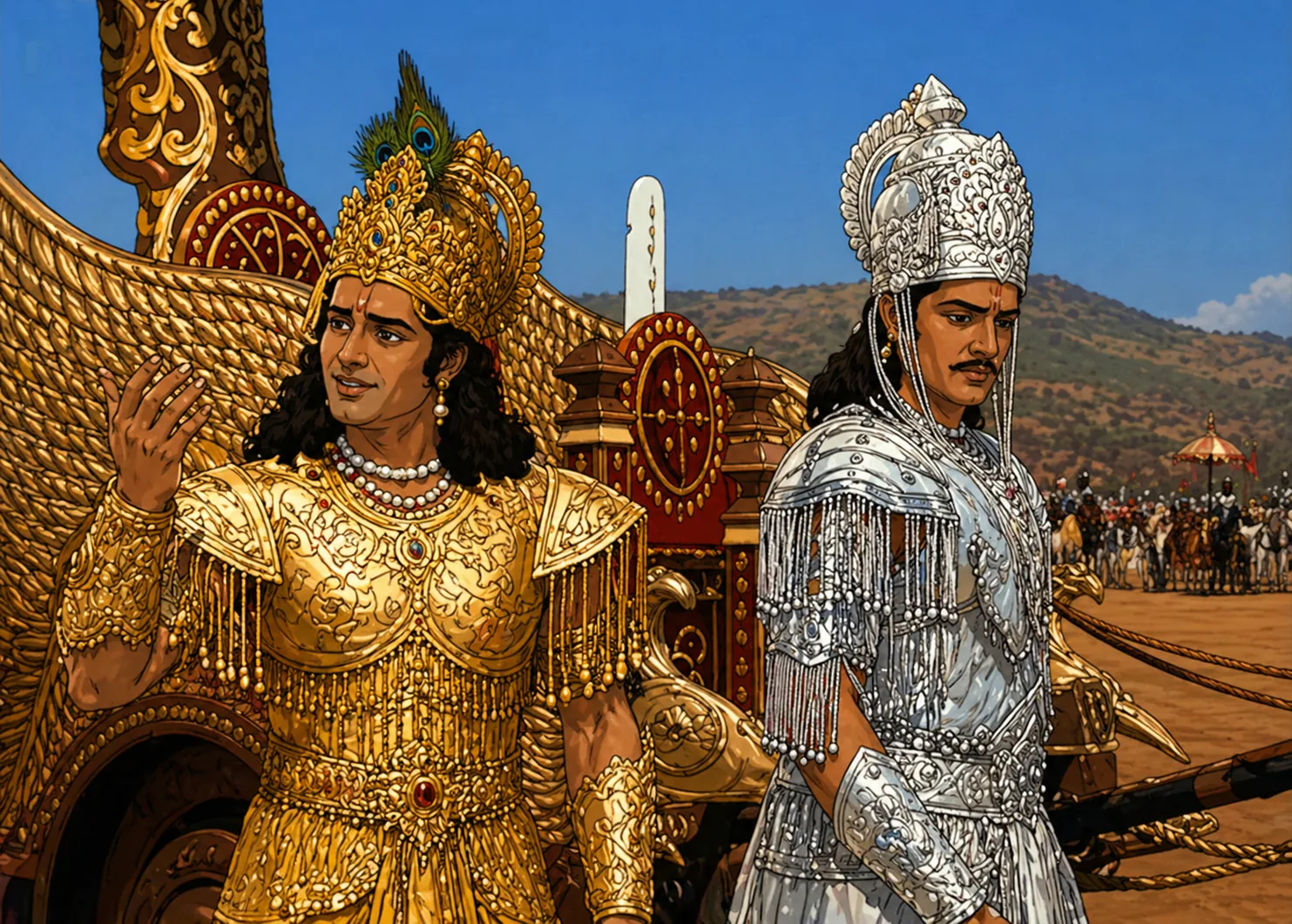
Chapter 17 is the Bhagavad Gita's deepest audit of ordinary life. Arjuna opens it with a practical question: what about people who do not know the scriptures and still act with faith? Are their actions valid? Krishna's answer becomes one of the most psychologically precise teachings in the book. He does not begin by talking about action. He begins by talking about śraddhā (faith, or more accurately, trust). The quality of any action, the chapter argues, is determined by the quality of the trust underneath it. The same outward act (a prayer, a meal, a donation, a discipline) carries entirely different consequences depending on what was being trusted when the act was performed.
Then comes one of the Gita's most quietly devastating sentences. Śraddhā-mayo'yaṃ puruṣaḥ, yo yac-chraddhaḥ sa eva saḥ. The person is made of trust; whatever trust they hold, that is what they become. Read carefully, this is one of the strongest claims in any wisdom literature. You are not made of your beliefs, exactly. You are not made of your actions, exactly. You are made of what you have placed your weight on, what you have come to rely upon at the deepest level. Change that, and you change. Do not change that, and nothing else you do can fundamentally shift you. Chapter 17 is the unfolding of this single insight across the surfaces of daily life: food, sacrifice, austerity, charity.
You Are Made of Trust, and It Becomes What You Trust
Chapter 17 opens with Krishna's claim that śraddhā (faith, or more precisely, trust) comes in three varieties, matching the three gunas of Chapter 14. Sattvic trust. Rajasic trust. Tamasic trust. Same word, different qualities. Some people trust in clarity and steadiness. Some trust in achievement and recognition. Some trust in dullness and convention. The category you fall into is largely the result of your underlying nature.
Then verse 17.3 lands one of the strongest sentences in the Gita. Śraddhā-mayo'yaṃ puruṣaḥ. The person is made of trust. And then: yo yac-chraddhaḥ sa eva saḥ. Whatever a person trusts, that is what they become. The sentence does not say a person has trust. It says a person is trust, specifically the trust they have placed somewhere. Change the placement, change the person. This is the chapter's whole argument, condensed into eight Sanskrit syllables.
श्रद्धामयोऽयं पुरुषो यो यच्छ्रद्धः स एव सः ॥
śraddhā-mayo'yaṃ puruṣo yo yac-chraddhaḥ sa eva saḥ ||
"A person is made of trust. Whatever one trusts, that is what one becomes."Bhagavad Gita 17.3
What You Eat Reveals What You Trust
After the metaphysical opening, Krishna gets remarkably specific. He turns to food. Each kind of food, he says, is dear to a different kind of person, and the preference reveals the underlying quality. Sattvic foods, fresh, nourishing, life-giving, balanced, are preferred by people whose trust is steady and clear. Rajasic foods, overly bitter, sharp, salty, hot, are preferred by the restless and the wanting. Tamasic foods, stale, leftover, putrid, are preferred by those whose inner life has dulled.
The list is one of the most concrete passages in any spiritual text. Modern readers sometimes find it surprising. We expect spiritual literature to discuss meditation and prayer. The Gita discusses meals. Why? Because the chapter's basic claim is that there is no separation between ordinary life and inner life. The food you choose is not a separate question from the trust you live by. It is the same question, expressed at the level of the plate. What you reach for when you are hungry shows what your nervous system has come to rely on. The Gita is saying you can read your own state by what you eat.
रस्याः स्निग्धाः स्थिरा हृद्या आहाराः सात्त्विकप्रियाः ॥
rasyāḥ snigdhāḥ sthirā hṛdyā āhārāḥ sāttvika-priyāḥ ||
Why this is not just dietary advice: The chapter's structure is recursive. Every form of ordinary action (food, sacrifice, austerity, giving) gets the same three-fold analysis. The same underlying quality (trust) shows up everywhere. Your meal, your prayer, your charity, your discipline: all of them reveal what you actually rely on. Chapter 17 is asking you to look across all these surfaces and notice the pattern.
Austerity of Body, Speech, and Mind
Verses 17.14 through 17.17 give one of the cleanest definitions of tapas (austerity) in any tradition. Krishna divides it into three layers. Austerity of body: reverence for the wise, cleanliness, simplicity, sexual restraint, non-violence. Austerity of speech: words that do not agitate, that are true, pleasant, beneficial, and the practice of study. Austerity of mind: serenity, gentleness, silence, self-control, purity of feeling. Three concentric circles. The outer is what you do with your body. The middle is what you do with your speech. The inner is the quality of your mind.
What makes this typology useful is its sequence. The Gita is not telling you to fix the inner life first. It is telling you that the three are linked, and that disciplines in any one can affect the other two. If you cannot yet quiet the mind, work on the speech. If you cannot yet train the speech, work on the body. Each circle supports the others. This is why traditional disciplines often begin with bodily practices, they are the easiest to grip, and they prepare conditions for the subtler work to become possible.
भावसंशुद्धिरित्येतत्तपो मानसमुच्यते ॥
bhāva-saṃśuddhir ity etat tapo mānasam ucyate ||
Words That Do Not Agitate, That Are True, That Help
Verse 17.15 deserves its own pause. The Gita defines austerity of speech as words that meet four criteria. Anudvega-karam: does not agitate. Satya: true. Priya-hita: pleasant and beneficial. And the practice of study and self-reflection. Four standards. Most modern speech fails at least one. Most spiritual speech, in particular, tends to fail the first: words that comfort but agitate the long-term mind, or words that are technically true but delivered without care for the hearing.
What is striking about this verse is the priority order. Anudvega-karam comes first. Before truthful. Before pleasant. Before beneficial. The standard is that the speech does not agitate. This is not a suggestion to avoid hard truths. It is a suggestion that hard truths should be delivered without producing unnecessary disturbance. The Gita is asking for the rare combination of honesty and care. Most speech is honest and careless. Some speech is careful and dishonest. The Gita's standard for austere speech is both at once.
स्वाध्यायाभ्यसनं चैव वाङ्मयं तप उच्यते ॥
svādhyāyābhyasanaṃ caiva vāṅmayaṃ tapa ucyate ||
"Speech that does not agitate, that is true, pleasant, and beneficial, this is the austerity of speech."Bhagavad Gita 17.15
The Quality of a Gift Is in the Giving, Not the Object
Verses 17.20 through 17.22 turn to giving (dāna). Like food, like austerity, giving comes in three forms. Sattvic giving is offered with the feeling that giving is a duty, to a worthy person, at the right place and time, without expectation of return. Rajasic giving is offered with hope of return, or with reluctance, or for the sake of being seen as generous. Tamasic giving is offered at the wrong place, wrong time, to undeserving people, or with contempt and disrespect.
What is striking is that the quality of the gift is determined by the inner state of the giver, not by the magnitude of the object. A small gift given with the right feeling outranks a large gift given for the wrong reasons. This is the Gita's consistent message about action, the outer act is the surface; the underlying motive is the substance. The same charity, performed by two different people, can produce two entirely different effects in the giver, because what the giver is becoming through the act depends on the trust underneath it.
देशे काले च पात्रे च तद्दानं सात्त्विकं स्मृतम् ॥
deśe kāle ca pātre ca tad dānaṃ sāttvikaṃ smṛtam ||
Om, Tat, Sat, Why Sacred Action Has a Naming
Toward the end of the chapter, Krishna names a formula: Oṃ Tat Sat. These are the three traditional designations of Brahman, the supreme reality. The Vedas, the priests, and the sacrifices all began, the verse says, by invocations of these names. The implication is structural. Sacred action requires a naming: a verbal acknowledgement that it is being directed beyond itself, toward what is real.
Why does the naming matter? Because action without naming reverts to ego. The naming is the explicit handing-over. Oṃ begins the act. Tat directs it. Sat grounds it in what is real. The chapter is making the same point as Chapter 9: every action becomes complete when it is offered. Chapter 17 is just adding the technical detail of how the offering happens linguistically. Even a small offering, performed with the right naming, becomes a sacred act. A large offering, performed without the naming, remains a personal transaction.
ब्राह्मणास्तेन वेदाश्च यज्ञाश्च विहिताः पुरा ॥
brāhmaṇās tena vedāś ca yajñāś ca vihitāḥ purā ||
Without Trust, Even the Right Action Is Empty
The chapter closes with one of the Gita's hardest sentences. Verse 17.28 says: any sacrifice, gift, or austerity performed without śraddhā (without trust) is called asat, unreal. Its fruit exists neither here nor hereafter. The verse closes the loop that opened in 17.3. You are made of your trust. Therefore, action without trust does not actually count.
Read carefully, this is not pessimism. It is calibration. The Gita is making the same point that contemporary psychology calls intrinsic motivation. Action performed because you authentically believe in it operates differently from action performed because you were told to. The first transforms the actor; the second leaves them roughly where they were. Aśraddhayā hutaṃ (offered without trust) is the form of the second. The chapter ends by warning against the most common form of religious failure: performing the actions and not believing in them. Performing without trust, the chapter says, produces no real fruit. The action was technically done. The actor did not change.
असदित्युच्यते पार्थ न च तत्प्रेत्य नो इह ॥
asad ity ucyate pārtha na ca tat pretya no iha ||
What Chapter 17 finally asks of you: Audit your life. The food. The speech. The austerities. The giving. Ask, of each, what trust is underneath. Not what you say you believe. What you actually reach for, when no one is watching. That is what you are slowly becoming. Change the placement of the trust, and the rest of the chapter (the food, the speech, the giving) will start to follow on its own.
The Complete Verse Reference
| Verse | Speaker | Teaching Essence |
|---|---|---|
| 17.1 | Arjuna | Faith alone does not reveal its quality; the motive beneath it does |
| 17.2 | Krishna | Faith takes the shape of the nature beneath it |
| 17.3 | Krishna | Trust is not just held; it becomes the person |
| 17.4 | Krishna | Faith reveals itself in what each person chooses to revere |
| 17.5 | Krishna | Harsh effort without right guidance can deepen ego instead of cleansing it |
| 17.6 | Krishna | Harshness is not holiness when it destroys the body and ignores what lives within |
| 17.7 | Krishna | Even sacred actions differ; their inner quality decides their worth |
| 17.8 | Krishna | Wholesome food quietly builds the conditions for a steadier life |
| 17.9 | Krishna | What excites the senses can quietly produce suffering |
| 17.10 | Krishna | What you repeatedly choose to consume reveals the heaviness within |
| 17.11 | Krishna | Right action becomes pure when reward stops being the reason |
| 17.12 | Krishna | An offering for reward or applause loses its purity |
| 17.13 | Krishna | Ritual without trust becomes empty and heavy |
| 17.14 | Krishna | The body itself can become a disciplined offering |
| 17.15 | Krishna | Speech becomes discipline when it tells the truth without creating harm |
| 17.16 | Krishna | A trained mind is its own austerity |
| 17.17 | Krishna | True discipline is clean only when reward is no longer the motive |
| 17.18 | Krishna | Practice for applause collapses into instability |
| 17.19 | Krishna | Pain imposed in ignorance only deepens confusion |
| 17.20 | Krishna | Giving becomes pure when nothing is being bought in return |
| 17.21 | Krishna | A gift becomes lesser the moment it starts asking for something back |
| 17.22 | Krishna | A gift can become degrading when respect is missing |
| 17.23 | Krishna | Sacred action matters because it points beyond itself to what is real |
| 17.24 | Krishna | Sacred action begins by naming the supreme reality first |
| 17.25 | Krishna | Freedom deepens when action stops demanding a private return |
| 17.26 | Krishna | What is real and worthy carries the mark of sat |
| 17.27 | Krishna | Steady offering makes ordinary action sacred |
| 17.28 | Krishna | Trust is what makes action real; without it, effort becomes empty |
Did you like this article?