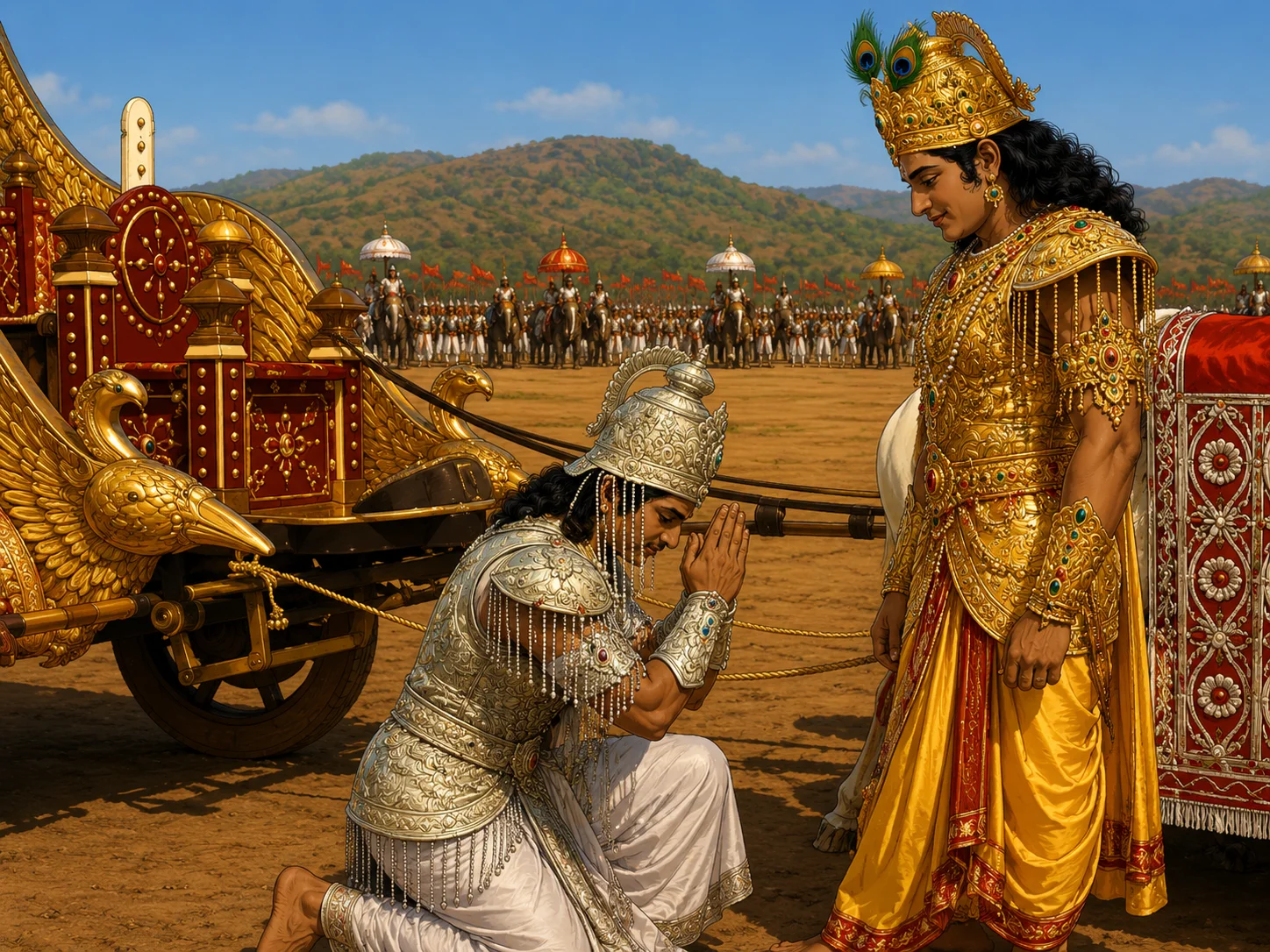
Chapter 14 is, in a sense, the Gita's psychology textbook. After Chapter 13 separated the knower from the field, Chapter 14 turns to the field itself and asks the next question: what is the field made of? Krishna's answer is one of the most enduring frameworks in Indian thought: the doctrine of the three guṇas. Sattva: clarity, lightness, the felt sense of inner brightness. Rajas: passion, restlessness, the engine of wanting and doing. Tamas: dullness, inertia, the heaviness that pulls you under.
What makes the doctrine useful is that it is not moralistic. The three gunas are not good and bad. Each is a force, each has a function, each is binding in its own way. The chapter's project is to name them clearly enough that you can recognize which one is operating in you, in any given moment, without confusing the force with yourself. And then, at the chapter's quiet climax, Krishna names the state called guṇātīta, beyond the gunas. That state is not a different kind of feeling. It is the freedom of no longer being captured by whichever feeling happens to be present.
Sattva, Rajas, Tamas, the Three Forces of Inner Life
Verse 14.5 introduces the framework. Sattva, rajas, and tamas (three qualities arising from prakṛti, nature) bind the imperishable inner self to the body. Each is a different way the field captures the knower. The capture is not violent; it works by identification. You feel clear, you identify as the clarity. You feel driven, you identify as the drive. You feel heavy, you identify as the heaviness. In each case, the knower forgets it is the knower and merges with the quality. The chapter is the patient training in not doing this.
What is unusual about the Gita's framing here is that it gives no preference. Most spiritual traditions tell you to prefer light over dark, clarity over dullness, virtue over vice. The Gita acknowledges that sattva is closer to liberation than the other two, but warns immediately that even sattva binds. The goal is not to live always in the highest force. The goal is to be free of capture by any force, including the most pleasant one.
निबध्नन्ति महाबाहो देहे देहिनमव्ययम् ॥
nibadhnanti mahā-bāho dehe dehinam avyayam ||
Even Clarity Binds, the Subtlest Trap
Verse 14.6 is the chapter's most subtle and most easily missed teaching. Krishna says sattva, clarity, binds through attachment to happiness and to knowledge. The verse is a warning specifically directed at the spiritually advancing person. You meditate. You become clearer. You feel lighter. And you start to crave that clarity. The craving is rajas dressed up as sattva. The bondage looks like progress.
Anyone who has had a particularly good week of practice knows this trap. The state was pleasant. You started planning your life around producing more of it. The producing became its own anxiety. The Gita is saying, the state was real, but your relationship to it has now made it sticky. The freedom is not in having more sattva. It is in having sattva without grasping it. The same warning applies to spiritual knowledge. You learn something true; you start defining yourself by knowing it. The knowing becomes another rung of the same ladder, only now the ladder is invisible because the rung looks like the destination.
सुखसङ्गेन बध्नाति ज्ञानसङ्गेन चानघ ॥
sukha-saṅgena badhnāti jñāna-saṅgena cānagha ||
"Even sattva binds, through attachment to happiness, and through attachment to knowledge."Bhagavad Gita 14.6
How Restlessness Chains You
Verse 14.7 names rajas with precision: born of craving and attachment, it binds through attachment to action. This is the dominant guna of most modern adult life. The next email. The next task. The next achievement. The next message reply. Rajas is the force that keeps you in motion and never lets you ask, in any given moment, whether the motion is what you actually want.
What is hard about rajas is that it looks productive. Sattva looks calm; tamas looks lazy; rajas looks like getting things done. From the outside, the rajasic life appears to be a successful life. The Gita's diagnosis is that the productivity is its own kind of capture. You are not driving the action; the craving is driving you. The verse is asking you to notice that the engine has become the driver. Stopping is not the answer (the Gita is not anti-action). Recognizing that the action is not yours, even while you do it, is the answer.
तन्निबध्नाति कौन्तेय कर्मसङ्गेन देहिनम् ॥
tan nibadhnāti kaunteya karma-saṅgena dehinam ||
The Pull of Heaviness, Why It Wins Quietly
Verse 14.8 names tamas with equal precision: born of ignorance, it deludes all embodied beings, binding them through heedlessness, laziness, and sleep. Pramāda. Ālasya. Nidrā. The three forms in which tamas captures a life are not dramatic. They are gentle. Heedlessness: the slow drift of not paying attention. Laziness: the comfortable refusal to make the necessary move. Sleep: both literal and the metaphorical sleep of going through life without questioning it.
What makes tamas dangerous is that it does not announce itself. It feels like rest. It feels like deserved easing. It feels like "I'll start tomorrow." The verse is a careful warning. The thing pulling you down is not pulling violently. It is pulling so softly that you participate in it. Every time you choose comfort over the right action, every time you postpone the necessary conversation, every time you scroll for thirty more minutes when you could have slept, that is tamas, doing its quiet work. Naming it is the first step in stopping it.
प्रमादालस्यनिद्राभिस्तन्निबध्नाति भारत ॥
pramādālasya-nidrābhis tan nibadhnāti bhārata ||
A working diagnostic from Chapter 14: Three times today, ask: what is operating in me right now? If everything looks clear and I am grasping it: sattva, going sticky. If I am driven, restless, never enough: rajas. If I am drifting, postponing, sleepy without being tired: tamas. The naming itself is half the work. You cannot dissolve what you have not first identified.
How to Tell Which Guna Is Operating
Verses 14.11 through 14.17 give the diagnostic markers for each guna. Sattva shows up as inner light, clarity in all the senses, openness, understanding. Rajas shows up as restless activity, many projects, much wanting, no settling. Tamas shows up as fog, confusion, drowsiness, the inability to start. The list is practical, not poetic. The Gita wants you to be able to identify, in any given hour, which force is the dominant one.
Verse 14.17 condenses the diagnostic: from sattva comes knowledge; from rajas, greed; from tamas, negligence and delusion. Each force produces its characteristic outputs. Once you know the outputs, you can read backwards from your day. A day full of clear seeing, sattva was strong. A day full of wanting and rushing, rajas dominated. A day where nothing got done and nothing felt important, tamas had the floor. The Gita is teaching a kind of inner meteorology. You start to read your own weather.
ज्ञानं यदा तदा विद्याद्विवृद्धं सत्त्वमित्युत ॥
jñānaṃ yadā tadā vidyād vivṛddhaṃ sattvam ity uta ||
प्रमादमोहौ तमसो भवतोऽज्ञानमेव च ॥
pramāda-mohau tamaso bhavato'jñānam eva ca ||
Going Beyond the Three, What Gunatita Actually Looks Like
Arjuna, naturally, asks the obvious question. What does the person look like who has gone beyond the three gunas? How do they behave? Krishna's answer in verses 14.22 through 14.25 is one of the most precise portraits in the Gita. The guṇātīta (the one beyond the gunas) does not hate light, activity, or confusion when they appear. Does not crave them when they disappear. Sits as if at the side of everything, unmoved, knowing that the gunas are doing what gunas do.
Notice what the portrait does not say. It does not say the gunas stop appearing. It does not say the person no longer experiences clarity, restlessness, or dullness. It says the person no longer reacts to the appearing and disappearing of these states. The states still arise. The reactivity has dropped. The freedom is not from the weather. It is from being captured by the weather. You can have a tamasic afternoon and not be defeated by it. You can have a sattvic morning and not chase it. The same is true of every other state. Freedom is the dropped grip, not the dropped weather.
न द्वेष्टि सम्प्रवृत्तानि न निवृत्तानि काङ्क्षति ॥
prakāśaṃ ca pravṛttiṃ ca moham eva ca pāṇḍava |
na dveṣṭi sampravṛttāni na nivṛttāni kāṅkṣati ||
तुल्यप्रियाप्रियो धीरस्तुल्यनिन्दात्मसंस्तुतिः ॥
tulya-priyāpriyo dhīras tulya-nindātma-saṃstutiḥ ||
How You Actually Cross, Unwavering Devotion
Verse 14.26 names the bridge. Asked how one goes beyond the three gunas, Krishna answers, by serving me with unwavering devotion. The one who does this, he says, transcends the gunas and becomes fit for union with the supreme reality.
Why devotion? Because devotion gives the mind something to rest on that is outside the gunas. The gunas operate on what is inside the field, clarity, restlessness, dullness, but devotion is directed toward what is outside the field altogether. When attention is genuinely placed on the Divine, the gunas continue to come and go in their familiar patterns, but the centre of identification has shifted. You are no longer being moved by the weather, because your inner centre has moved to higher ground. The chapter is saying that this is the practical way through, not analysis of the gunas (which the chapter has just given), but devotion that rests beyond them.
स गुणान्समतीत्यैतान्ब्रह्मभूयाय कल्पते ॥
sa guṇān samatītyaitān brahma-bhūyāya kalpate ||
"The one who serves me with unwavering devotion goes beyond these forces and becomes fit for union."Bhagavad Gita 14.26
The Complete Verse Reference
| Verse | Speaker | Teaching Essence |
|---|---|---|
| 14.1 | Krishna | Some knowledge does not inform you; it completes you |
| 14.2 | Krishna | True understanding makes beginning and ending stop ruling you |
| 14.3 | Krishna | All birth comes from a source beyond personal control |
| 14.4 | Krishna | All forms arise from one source, and the divine gives them life |
| 14.5 | Krishna | Nature's three forces keep the changeless one identified with the body |
| 14.6 | Krishna | Even clarity becomes bondage when you cling to its pleasure |
| 14.7 | Krishna | Craving turns action into a chain |
| 14.8 | Krishna | Confusion binds most through laziness, not force |
| 14.9 | Krishna | Each force traps you in a different way: comfort, activity, or blindness |
| 14.10 | Krishna | What dominates the mind is temporary, not who you are |
| 14.11 | Krishna | Inner brightness is the sign that clarity is taking over |
| 14.12 | Krishna | Restless wanting multiplies action, but never settles the mind |
| 14.13 | Krishna | Darkness does not stay still; it breeds neglect and confusion |
| 14.14 | Krishna | A clear state carries consciousness toward a clearer destination |
| 14.15 | Krishna | Your strongest tendency decides the shape of your next beginning |
| 14.16 | Krishna | Action carries its own flavor of result |
| 14.17 | Krishna | Your mental weather has causes: clarity, craving, and confusion grow from different qualities |
| 14.18 | Krishna | Your inner quality decides the direction of your life |
| 14.19 | Krishna | Freedom begins when you stop mistaking qualities for a personal doer |
| 14.20 | Krishna | Freedom begins when the three qualities no longer define you |
| 14.21 | Arjuna | Real freedom must be visible, livable, and learnable |
| 14.22 | Krishna | Freedom begins when changing states stop controlling your response |
| 14.23 | Krishna | Freedom begins when movement happens, but identity does not |
| 14.24 | Krishna | Steadiness means nothing external gets to decide your centre |
| 14.25 | Krishna | Freedom begins when praise, blame, and personal impulse lose their power over you |
| 14.26 | Krishna | Steady devotion can carry you beyond the forces that shape ordinary life |
| 14.27 | Krishna | All ultimate freedom rests in Krishna, not apart from him |
Did you like this article?