The Bhagavad Gita is 700 verses across 18 chapters. You can read it in 2 to 4 hours straight through. But most people never finish it. Not because it's too long or too difficult, but because they don't know where to start, what to expect, or how to actually approach the text. This guide is designed to fix that. It tells you what the Gita is, why it matters, which translation to pick, and the single best way to read it.
What the Bhagavad Gita Is (And What It Isn't)
The Bhagavad Gita is often referred to as a spiritual text, a holy scripture, or an ancient wisdom tradition. All of that is true. But it is also worth being specific about what the book actually is: a philosophical conversation between two men on a battlefield.
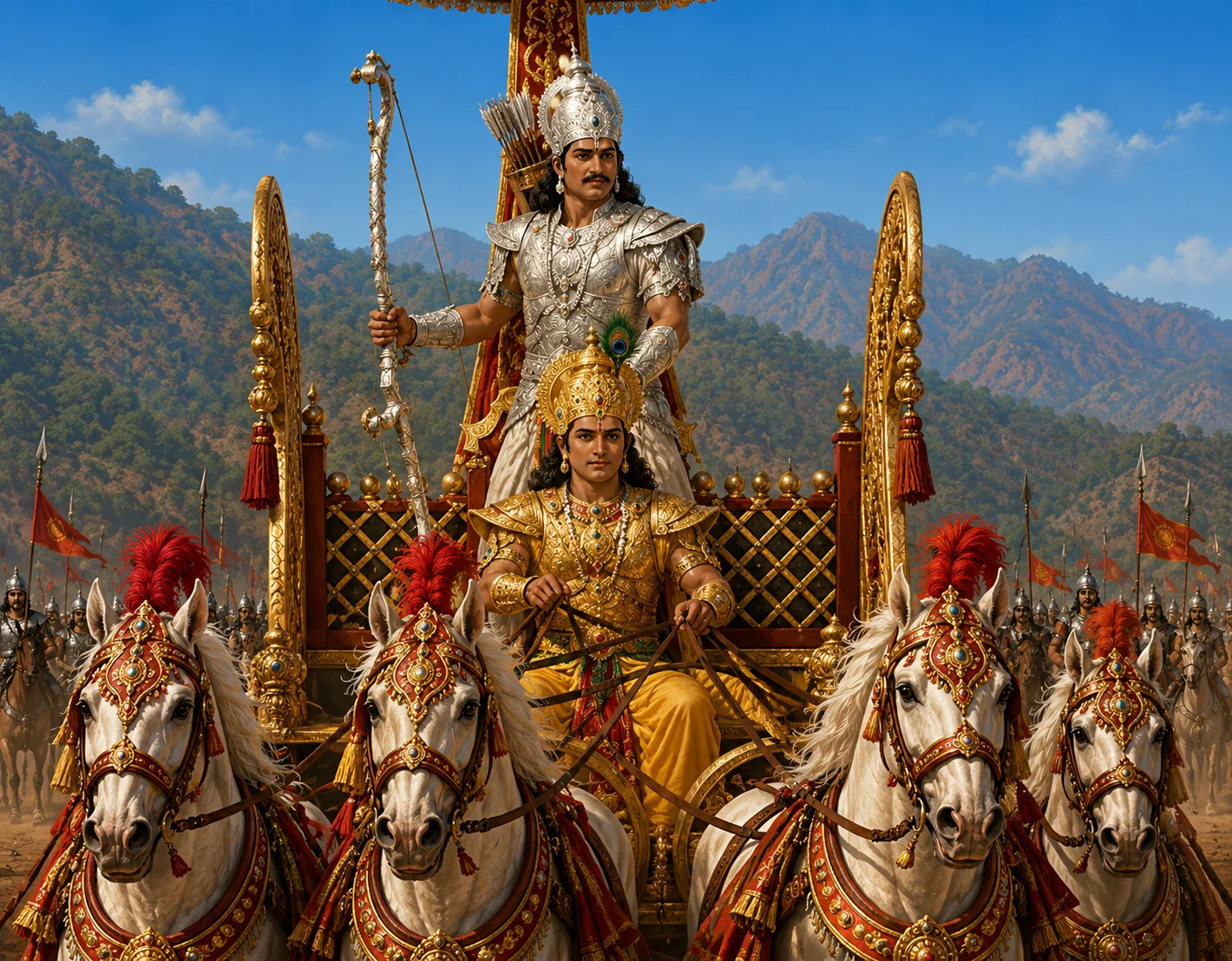
One of them, Arjuna, is a warrior. He has arrived at the greatest battlefield of the age, about to fight in a war that will determine the fate of kingdoms. But in the moments before the battle begins, Arjuna experiences a total psychological breakdown. He cannot do this. He will not fight his own cousins. He feels ashamed. He feels afraid. He feels confused about what is right. He tells his charioteer that he is going to abandon the battle and walk away.
The charioteer's name is Krishna. And as Arjuna is spiraling into despair, Krishna begins to teach. The Bhagavad Gita is the 700 verses of that teaching. It is not a how-to guide for meditation. It is not a collection of comforting quotes. It is a serious philosophical conversation about the nature of the self, the meaning of duty, the proper way to act in the world, the reality of death, and how to live without being consumed by fear or desire.
The genius of the Gita is that this conversation happens in real time, in the context of a real crisis. It is not theoretical knowledge delivered from a distance. It is a man in the middle of psychological breakdown being offered a complete philosophical restructuring of how to understand what is happening to him.
The 18 Chapters: A Quick Map
The Gita is organized into 18 chapters, each with its own focus. Here is a brief overview so you know what to expect.
Chapters 1 and 2 set the stage. Chapter 1 is entirely devoted to Arjuna's crisis, his physical and mental breakdown, his questions, his despair. Chapter 2 is where the philosophical teaching begins. Krishna introduces the foundational ideas: the eternal nature of the atman, the nature of action and inaction, the concept of equanimity, and the beginning of the teaching on karma and dharma.
Chapters 3 through 6 explore the practical paths. Chapter 3 is devoted to Karma Yoga, the yoga of action. Chapter 4 introduces the concept of wisdom (jnana). Chapter 5 continues the teaching on action. Chapter 6 focuses on meditation and the discipline of the mind.
Chapters 7 through 12 go deeper into knowledge and devotion. Chapter 7 discusses the nature of the Supreme. Chapters 8 through 12 develop the concept of bhakti, devotion, and the different ways to approach the divine.
Chapters 13 through 18 are the most metaphysical. They explore the nature of consciousness, the three qualities (gunas), and culminate in Krishna's final teaching about surrendering all duty to the divine.
For a complete beginner, the essential reading is Chapters 1 through 6. These give you the setup, the emotional context, and the core philosophical teachings. The rest deepens and expands on these themes.
Where to Start: Read Chapter 1 First
Many people skip Chapter 1. They think it's just the setup and want to get to the philosophy. Don't do this. Chapter 1 is essential.
In Chapter 1, you meet Arjuna. You experience his crisis. You read his exact words: his fear, his shame, his sense of paralysis. You understand the emotional and human stakes of what is about to be taught. This makes everything that follows land with force. The philosophy in Chapter 2 is not abstract knowledge, it is Krishna's direct response to a man in breakdown.
Then read Chapter 2. This is where the core teachings begin. Here you encounter ideas like the atman, the difference between action and inaction, the concept of equanimity, and the beginning of karma yoga. Verse 2.47, "You have a right to perform your duties, but not to the fruits", appears here. This single verse contains the foundation of the entire Gita's ethics.
Which Translation Should You Choose?
There are many English translations of the Gita. Each has a different flavor. Here are the most widely recommended options.
The Bhagavad Gita As It Is, translated and commented on by A.C. Bhaktivedanta Swami Prabhupada, is the most thorough. Each verse includes Sanskrit, transliteration, word-for-word translation, and extensive commentary. It is dense and devotional in its approach. If you want depth and don't mind a more devotional lens, this is excellent. The downside is that the commentary can feel overly specific to one school of interpretation.
The Bhagavad Gita: A New Translation, translated by Eknath Easwaran, is widely considered the most readable in English. Easwaran's translation is clear, meditative, and philosophically sound. The introduction and chapter-by-chapter commentary are accessible. If you want something that is easy to read and understand on a first pass, this is the one most people recommend.
The Bhagavad Gita, translated by Barbara Stoler Miller, is scholarly and beautifully written. Miller's translation is poetic without being flowery. If you want something that is both intellectually rigorous and linguistically elegant, this is worth considering.
The Living Bhagavad Gita: A Comprehensive Presentation for Modern Times, by Sri Swami Satchidananda, takes an ecumenical approach and relates the teachings to modern life. It is accessible and thoughtful.
Alternatively, read one verse a day on the Wisdom app. You get the Sanskrit, the transliteration, the meaning, and the context, all in under a minute. This slower approach, spread over a year, allows each verse to do its work on you.
Five Landmark Verses to Read Today
If you want to get a taste of the Gita right now, here are five verses that capture different aspects of the teaching.
मामकाः पाण्डवाश्चैव किमकुर्वत सञ्जय ॥
māmakāḥ pāṇḍavāś caiva kim akurvata sañjaya ||
मा कर्मफलहेतुर्भूर्मा ते सङ्गोऽस्त्वकर्मणि ॥
mā karmaphalaheturbhūrmā te saṅgo'stvakarmaṇi ||
स्वभावनियतं कर्म कुर्वन्नाप्नोति किल्बिषम् ॥
svabhāvaniyataṃ karma kurvann āpnoti kilbiṣam ||
What to Expect: The Gita Challenges You
When you begin reading the Gita, expect it to challenge some of your assumptions. It is not a comforting text. It is a rigorous text. It asks difficult questions about the nature of duty, the meaning of violence, the reality of death, and what constitutes a wise life.
Some of it will speak to you immediately. Some of it will feel opaque on the first reading. Some of it you will need to return to again and again. This is normal. The Gita is not meant to be read once and filed away. It is meant to be lived with. The understanding deepens over time, as you apply the teaching to your actual life.
The Gita's power lies not in being fully understood the first time, but in being returned to again and again. A verse that seemed distant on one reading becomes suddenly relevant during a crisis, or during a moment of decision, or during a quiet reflection on a morning. The text works on you over time.
The Best Approach: One Verse a Day
The Gita has 700 verses. Read at one verse per day, it takes two years. This sounds slow. It is actually perfect. Each verse has time to settle into you. You read it in the morning when you are quiet. Then, during the day, when you encounter situations it speaks to, the verse comes back to mind. This is how the Gita's teaching actually works. It is not intellectual accumulation. It is practical application and gradual understanding.