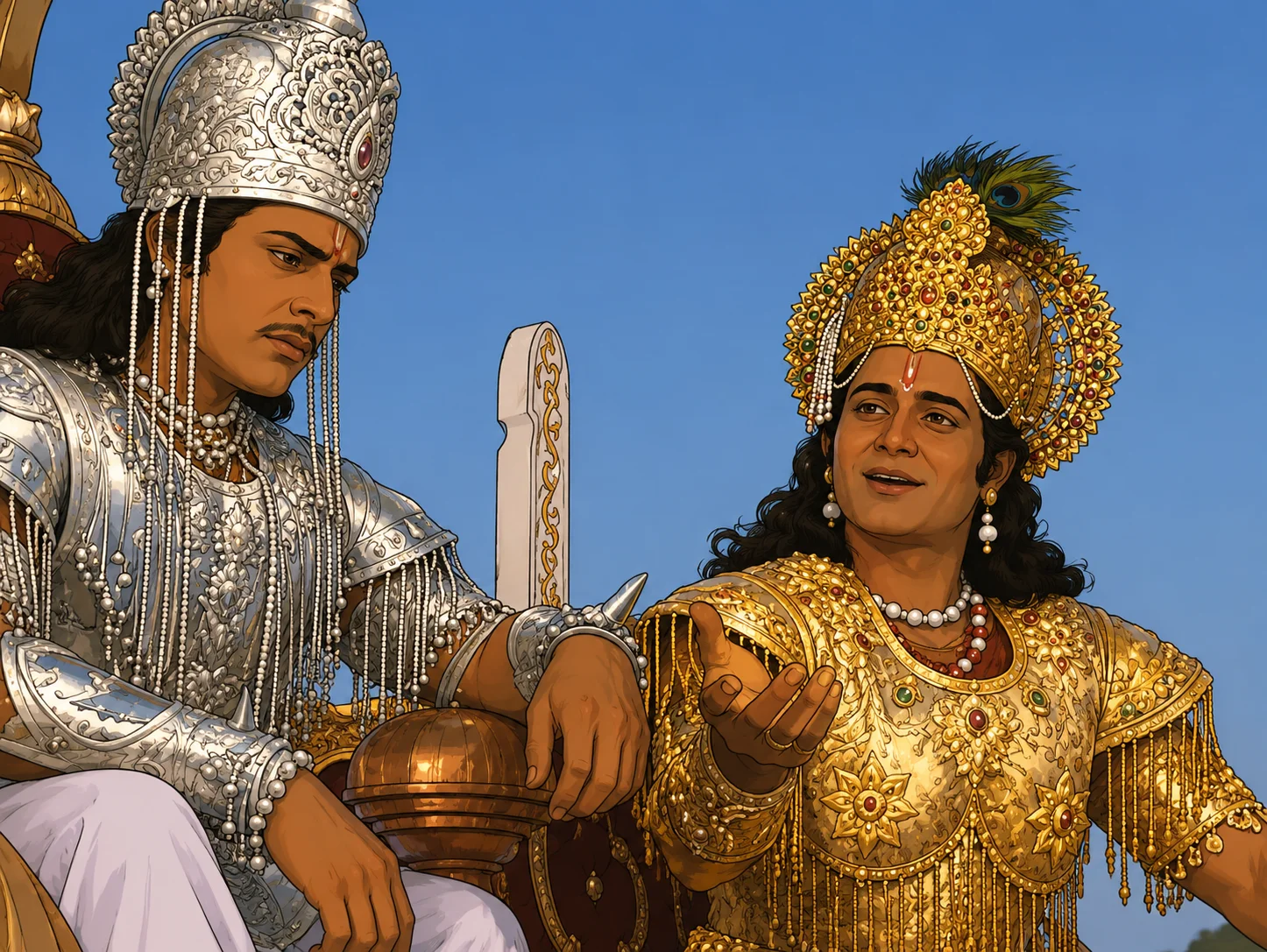
Chapter 9 is the chapter where the Bhagavad Gita pulls the curtain back. After eight chapters of philosophical preparation, duty, renunciation, action, meditation, the metaphysics of the two natures, the imperishable Brahman, Krishna now turns to Arjuna and says, in effect: now I will tell you the royal secret. Rāja-vidyā, rāja-guhya. The king of all knowledge, the king of all secrets. And then he describes that secret in a way that surprises everyone who has been bracing for difficulty. The royal secret is not complicated. It is not reserved for the highly trained. It is, in his exact words, su-sukhaṃ kartum, supremely easy to practice.
This is the structural pivot of the Gita. Chapter 8 ended with a quiet redirection away from transactional spiritual merit. Chapter 9 follows immediately with the simplest practice in the entire book, bring me a leaf, a flower, a fruit, water, offered with love, and I will accept it. Across thirty-four verses, Krishna will say things that have shaped Hindu devotional life for two thousand years. That he holds everything but is held by nothing. That undivided devotion is met by unwavering protection. That even a flawed person who turns wholeheartedly toward the Divine is to be considered righteous. And finally, the line that has consoled more sufferers than possibly any other in the book: my devotee never perishes.
The Highest Knowledge Is Also the Easiest to Live
Chapter 9 begins with a promise that quietly upends a lot of received spiritual culture. Krishna calls this teaching the king of all knowledge, and then he describes it with words that no other tradition typically uses for highest truth. He says it is pavitram, pure. Pratyakṣa-avagamam, directly knowable, immediately experienceable. Dharmyam, aligned with right living. Su-sukhaṃ kartum, supremely easy to practice. And avyayam, imperishable.
Notice what Krishna is doing with this list. He is dismantling, in advance, every argument for why the deepest truth must be hard, hidden, reserved for the long-disciplined. The Gita's most exalted teaching is announced as the most accessible. This is not anti-discipline, the previous chapter spent twenty-eight verses on training the mind. It is a statement that the destination of the discipline, once reached, turns out to have been close to home all along.
प्रत्यक्षावगमं धर्म्यं सुसुखं कर्तुमव्ययम् ॥
pratyakṣāvagamaṃ dharmyaṃ susukhaṃ kartum avyayam ||
"The king of knowledge, the king of secrets, pure, directly knowable, and supremely easy to practice."Bhagavad Gita 9.2
I Hold the Universe, But the Universe Doesn't Hold Me
Verse 9.4 contains a metaphysical claim that takes most readers two or three rereadings to understand. Krishna says: all this universe is pervaded by my unmanifest form. All beings dwell in me. But I do not dwell in them. The grammar is the surprise. The verse asserts immanence, beings are in the Divine, and immediately denies the reverse. The Divine is not contained in beings, even though they are contained in the Divine.
Western theological categories struggle with this. It is not pantheism (Bhagavan = everything). It is not classical theism (Bhagavan is separate from everything). It is what the Vaishnava tradition would later call achintya-bheda-abheda, inconceivable simultaneous difference and non-difference. The image is asymmetric. The container is in you, but you are not in the container. Practically, this lets the Gita say two things that other traditions have to choose between: everything is sacred, and the sacred is not exhausted by everything.
मत्स्थानि सर्वभूतानि न चाहं तेष्ववस्थितः ॥
mat-sthāni sarva-bhūtāni na cāhaṃ teṣv avasthitaḥ ||
Why People Miss the Supreme: Because the Supreme Looks Ordinary
Verse 9.11 is one of the Gita's most psychologically realistic moments. Krishna says, with a kind of resigned honesty: fools dismiss me when I take a human form, not knowing my higher nature. The verse is not just about Krishna's particular incarnation. It is a general observation about how perception works. We dismiss the ordinary because it is ordinary. We expect the sacred to be unmistakable, accompanied by signs, framed by formality, evidently special. When the sacred shows up looking like a slightly tired man in a chariot, we miss it.
This is the Gita's reply to the persistent human appetite for spiritual spectacle. The Divine is not failing to appear. It is appearing in forms our perception has trained itself to ignore. The teacher in the next room. The grieving parent in the elevator. The slightly worn-out friend who keeps showing up. Verse 9.11 is asking you, with some patience, to look again at the ordinary, because the ordinary is where the Divine has chosen to live.
परं भावमजानन्तो मम भूतमहेश्वरम् ॥
paraṃ bhāvam ajānanto mama bhūta-maheśvaram ||
What this looks like in practice: You decide a person isn't worth your full attention because they look unremarkable. You decide a task isn't worth your full presence because it isn't important enough. You decide a moment isn't worth your full awareness because it's just a Wednesday afternoon. The Gita says each of these decisions is a small loss. The Wednesday afternoon is what you were given. The unremarkable person is who showed up.
Yoga-kshema: The Most Tender Promise in the Gita
Verse 9.22 is, depending on the reader, either the most consoling or the most distrusted verse in the Gita. Krishna says: those who think of me alone, who worship with unwavering focus, for them, I carry both yoga (what they don't have) and kṣema (what they already have). I bring them what they need; I preserve what they hold.
Modern readers often hesitate at this verse. It can sound like a transactional promise, believe hard enough, and the universe will provide. That is not the verse's structure. The condition is not belief. The condition is undivided attention. Ananyāś cintayanto, those who think of me without thinking of anything else. This is rare. Most prayer is hedged with backup plans. The verse is describing the unhedged state, and saying that, in that state, the providing happens. Whether it is a metaphysical promise or a psychological observation, the verse names something real: the mind that is not splitting itself between Bhagavan and Plan B is met differently than the one that is.
तेषां नित्याभियुक्तानां योगक्षेमं वहाम्यहम् ॥
teṣāṃ nityābhiyuktānāṃ yoga-kṣemaṃ vahāmy aham ||
"For those whose minds rest entirely in me, I carry what they lack and preserve what they hold."Bhagavad Gita 9.22
Leaf, Flower, Fruit, Water, The Cheapest Offering Wins
Verse 9.26 has shaped two thousand years of Hindu devotional life. Krishna says: whoever offers me a leaf, a flower, a fruit, or water, with devotion, I accept it from the pure-hearted. The list is deliberately humble. Leaf. Flower. Fruit. Water. Things any person, anywhere, in any economic state, can find. The Gita is making an inclusivity claim long before anyone called it that. Devotion is not a luxury good.
Notice the structure of the verse. The object offered is almost irrelevant. The qualifier is everything. Bhaktyā prayacchati, offered with devotion. Prayatātmanaḥ, from a sincere heart. The cost is measured in love, not in the value of the item. A glass of water given with full presence is more complete, in this scheme, than an elaborate ritual performed mechanically. The verse is a permanent rebuke to spiritual showmanship.
तदहं भक्त्युपहृतमश्नामि प्रयतात्मनः ॥
tad ahaṃ bhakty-upahṛtam aśnāmi prayatātmanaḥ ||
Whatever You Do, Offer It
If verse 9.26 widens the door, verse 9.27 widens it further. Krishna says: whatever you do, whatever you eat, whatever you offer, whatever you give, whatever austerity you perform, offer all of it to me. The verse closes any remaining gap between sacred action and ordinary action. There is no longer a category of activity outside the field of offering. Everything goes in.
Read literally, this is a transformation of how a life can feel. The work email is an offering. The meal is an offering. The difficult conversation is an offering. None of these become magically pleasant by being offered. But they stop being yours alone. The weight changes. You are no longer carrying the day to extract benefit from it; you are passing it through your hands toward something larger. This is the practical content of karma yoga, and Chapter 9 is where the practice gets named most directly.
यत्तपस्यसि कौन्तेय तत्कुरुष्व मदर्पणम् ॥
yat tapasyasi kaunteya tat kuruṣva mad-arpaṇam ||
A working practice from 9.27: Before the next task, take three seconds to mentally say, I do this as an offering. Then do it as you would have done it anyway. After a week, the practice becomes unnecessary because the orientation has shifted. The doing has quietly become offering. The day starts being lighter.
Even the Person of Bad Conduct, If They Turn
Verses 9.30 and 9.31 are some of the most generous in the entire Gita, and they are sometimes the most controversial. Krishna says: even a person of very bad conduct, if they worship me with undivided devotion, is to be considered righteous, because their resolve is rightly made. They quickly become a person of dharma, and they attain lasting peace. And then comes the line: na me bhaktaḥ praṇaśyati, my devotee never perishes.
Read carelessly, this can sound like a cheap absolution. Read carefully, it is one of the most morally serious claims in the book. The verse is not saying past conduct doesn't matter. It is saying the direction of the atman matters more than its history. A clean turning, not a cleaner past, is what is required. The verse is the Gita's most explicit rejection of the idea that anyone is too far gone to begin. The door is open from where you are now.
साधुरेव स मन्तव्यः सम्यग्व्यवसितो हि सः ॥
sādhur eva sa mantavyaḥ samyag vyavasito hi saḥ ||
कौन्तेय प्रतिजानीहि न मे भक्तः प्रणश्यति ॥
kaunteya pratijānīhi na me bhaktaḥ praṇaśyati ||
"Declare it openly, Arjuna, my devotee never perishes."Bhagavad Gita 9.31
Fix the Mind, Be Devoted, Worship, Bow, The Total Orientation
Chapter 9 ends with the verse that becomes the Gita's signature closing instruction. It will be repeated, almost word for word, at the very end of the book in 18.65. Man-manā bhava mad-bhakto mad-yājī māṃ namaskuru. Fix the mind on me. Be devoted to me. Worship me. Bow to me. Four imperatives, all pointing in one direction. The verse asks for total orientation, attention, feeling, action, posture, all aligned.
Why does this become the closing of so many of the Gita's chapters? Because it is the Gita's compressed practice. Strip away the philosophy, the metaphysics, the long debates about action and renunciation, and what remains is this. Where is your attention going? Where is your love going? Where are your actions going? Where is your respect going? If all four are pointing one way, the rest follows. The royal secret of Chapter 9 is, finally, this orientation.
मामेवैष्यसि युक्त्वैवमात्मानं मत्परायणः ॥
mām evaiṣyasi yuktvaivam ātmānaṃ mat-parāyaṇaḥ ||
The Complete Verse Reference
| Verse | Speaker | Teaching Essence |
|---|---|---|
| 9.1 | Krishna | The deepest truth frees only a heart that does not resist it |
| 9.2 | Krishna | The highest truth is both profound and simple to live |
| 9.3 | Krishna | Without trust, the highest teaching cannot carry you beyond repetition |
| 9.4 | Krishna | The supreme reality holds everything without being held by anything |
| 9.5 | Krishna | The supreme reality sustains all beings without being contained by them |
| 9.6 | Krishna | What moves everywhere still rests in the divine |
| 9.7 | Krishna | What seems like ending is only a return before another beginning |
| 9.8 | Krishna | Life unfolds through a power larger than individual will |
| 9.9 | Krishna | Action can continue without leaving a chain behind |
| 9.10 | Krishna | Change is not chaotic; it unfolds within a higher order |
| 9.11 | Krishna | Ordinary appearance can hide the highest reality |
| 9.12 | Krishna | A confused mind turns even hope, effort, and learning into waste |
| 9.13 | Krishna | True devotion begins when the mind recognises the imperishable source |
| 9.14 | Krishna | Steady devotion becomes a life of continual remembrance |
| 9.15 | Krishna | The same reality can be approached as one, many, or all-encompassing |
| 9.16 | Krishna | All sacred action is already filled with the divine presence |
| 9.17 | Krishna | All sources of life and meaning are gathered in Krishna |
| 9.18 | Krishna | Everything rests in one imperishable source |
| 9.19 | Krishna | Opposites do not stand outside the divine; they flow from it |
| 9.20 | Krishna | Rewarded devotion still keeps you bound to return |
| 9.21 | Krishna | What is won by wanting is lost by time |
| 9.22 | Krishna | Unwavering devotion is met by unwavering support |
| 9.23 | Krishna | All sincere worship reaches the one reality, even when the form is confused |
| 9.24 | Krishna | Every offering matters only when you know who receives it |
| 9.25 | Krishna | Devotion does not stay abstract; it carries you to its chosen end |
| 9.26 | Krishna | A small offering becomes complete when devotion fills it |
| 9.27 | Krishna | Every action becomes complete when it is offered |
| 9.28 | Krishna | Freedom begins when even the result is no longer yours to carry |
| 9.29 | Krishna | Equality is universal; intimacy is born through devotion |
| 9.30 | Krishna | Undivided devotion can outweigh even a deeply flawed life |
| 9.31 | Krishna | Devotion quickly changes a person and protects them from ruin |
| 9.32 | Krishna | No birth or status can block one who takes refuge |
| 9.33 | Krishna | What does not last cannot finally satisfy; turn your life toward the divine |
| 9.34 | Krishna | Total orientation toward the divine becomes the way to reach the divine |
Did you like this article?