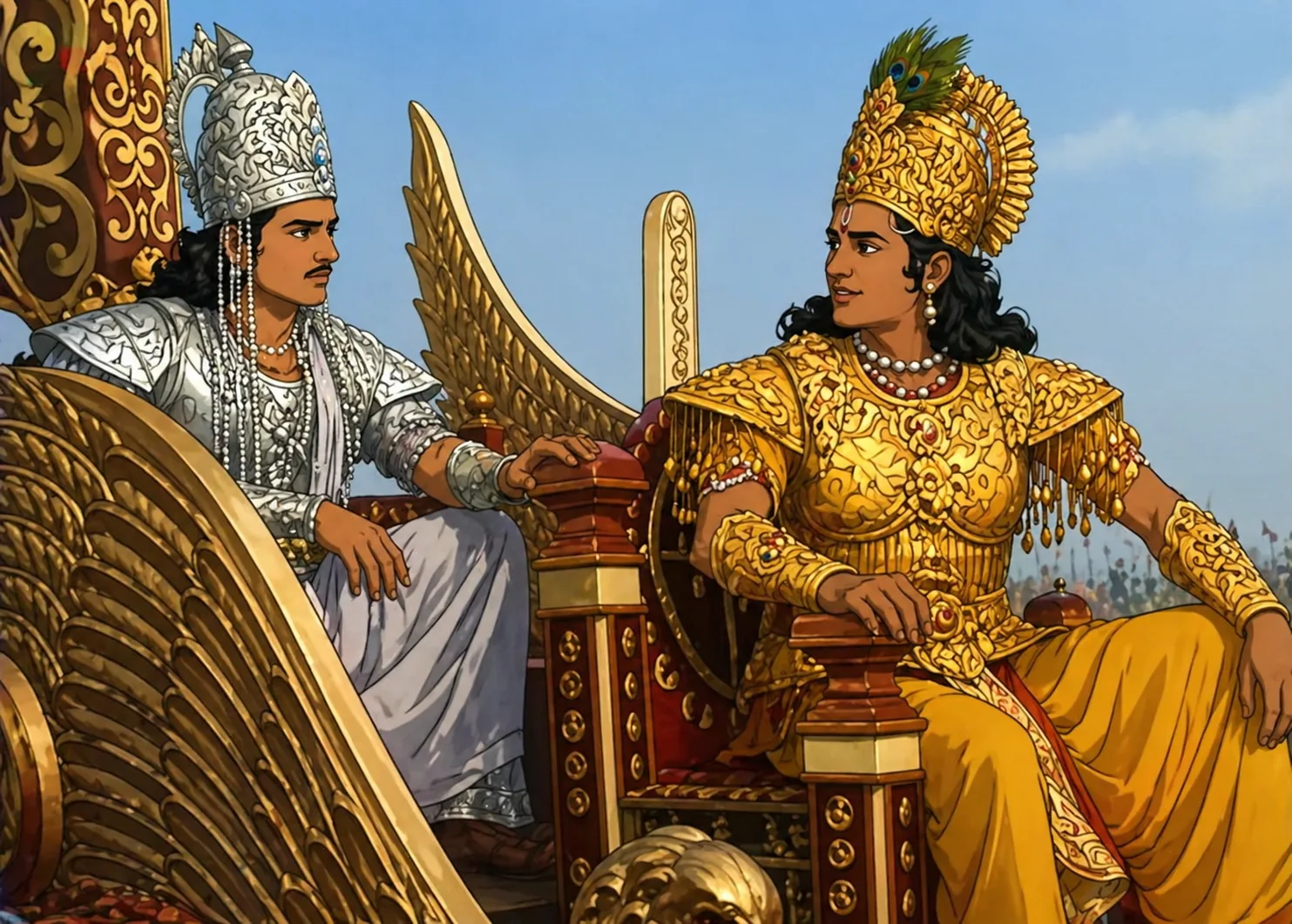
Chapter 8 is a chapter about death, and therefore, though it does not announce this directly, a chapter about every moment that is not yet death. Krishna begins by defining seven terms Arjuna has just asked about: Brahman, adhyatma, karma, adhibhuta, adhidaiva, adhiyajna, and the question of what happens at the moment of departure. The first answers are crisp, almost technical. Then the chapter pivots to its real subject, which is not the metaphysical inventory but the practical question that sits underneath every spiritual practice ever invented: what state of mind will I be in at the end?
Most modern readers flinch from this question because it sounds morbid. The Gita treats it the opposite way. The question is not morbid, it is clarifying. The state of mind at the end, the Gita says, is not a separate event. It is the cumulative output of everything the mind has practiced. The most quietly serious sentence in Chapter 8 is verse 8.6: whatever state of being you remember at the end, you reach that state, because the mind has been shaped by it. The end follows the practice. Therefore the practice is the end, already begun.
Krishna Gets Technical, The Seven Terms
Arjuna opens Chapter 8 with a series of definitional questions. What is Brahman? What is the inner self? What is action? What is the field of beings? What is the divine? What is the inner sacrifice? And what happens at the moment of departure from the body? Krishna's reply is unusually crisp and structured. He defines each term in two lines, almost like a glossary, before moving to the chapter's deeper teaching.
Most readers skip past these opening verses, looking for the more famous teaching that follows. But the definitions matter. They establish that the Gita's spiritual vocabulary is not vague. Brahman is the imperishable, the supreme. Adhyatma is one's own nature. Karma is the creative offering that brings beings into existence. The Gita is not a mystical wash. It is a precise system, with terms that mean specific things.
भूतभावोद्भवकरो विसर्गः कर्मसंज्ञितः ॥
akṣaraṃ brahma paramaṃ svabhāvo'dhyātmam ucyate |
bhūta-bhāvodbhava-karo visargaḥ karma-saṃjñitaḥ ||
Whatever You Remember at the End, That You Become
After the definitions, Krishna moves to the chapter's most personal teaching. The state of mind you hold at the moment of leaving the body shapes what you carry forward. The first time you read this, it can feel ominous, like a final exam. Read more carefully, the verse is not ominous. It is mechanical. It is just describing how attention works.
Verse 8.6 says: whatever state a person remembers at the end, that state they reach, because the mind has been shaped by it. The Sanskrit phrase is sadā tad-bhāva-bhāvitaḥ, always conditioned by that state. The Gita is making an unsentimental claim about habit. Whatever the mind has been trained to return to, that is where it will go when consciousness loses its anchors. Death just removes the anchors. The direction was already set.
यः प्रयाति स मद्भावं याति नास्त्यत्र संशयः ॥
yaḥ prayāti sa mad-bhāvaṃ yāti nāsty atra saṃśayaḥ ||
तं तमेवैति कौन्तेय सदा तद्भावभावितः ॥
taṃ tam evaiti kaunteya sadā tad-bhāva-bhāvitaḥ ||
"Whatever state the mind has long been shaped by, that is what it becomes at the end."Bhagavad Gita 8.6
You Will Leave With What You Rehearsed
Once 8.6 lands, 8.7 and 8.8 become urgent rather than abstract. Krishna says: therefore, at all times remember me, and fight. Notice the verb, fight. The Gita does not split spiritual practice from the conduct of daily life. The training of attention happens inside the work, not instead of it.
Verse 8.8 then makes the cumulative claim explicit. The mind trained by practice (abhyāsa-yoga), fixed on nothing else, reaches the supreme. The word abhyāsa recurs across the Gita, repetition, the patient grooving of a habit. Your end-state, the chapter says, will be the dominant groove of your attention. So the question is not what you intend to be at the end. The question is what you are practicing right now, repeatedly, when no one is watching.
परमं पुरुषं दिव्यं याति पार्थानुचिन्तयन् ॥
paramaṃ puruṣaṃ divyaṃ yāti pārthānucintayan ||
Translated for the modern reader: Whatever you spend your attention on, scrolling, worrying, planning, watching, learning, loving, is what your mind will gravitate toward when the lights start going down. The Gita is not threatening you with this. It is informing you. Your end-state is being authored, daily, by your most repeated thought patterns.
Constant Remembrance Makes the Divine Easy to Reach
After the difficult teachings on death, Krishna offers a verse that lightens the chapter's tone. He says: for the one whose mind is wholly on me, who remembers me constantly, I am easy to reach. The Sanskrit word is sulabhah. Easy. Not difficult. Not a reward at the end of an austere struggle. Easy.
This is one of the chapter's most consoling verses. The path the Gita has been describing, disciplined remembrance, training of attention, does not stay difficult. After the initial period of building the habit, the habit carries itself. The Divine is not playing hard to get. The Divine is playing easy to get, but the easiness requires a continuity of attention that most lives never assemble. The verse is an invitation, not a warning.
तस्याहं सुलभः पार्थ नित्ययुक्तस्य योगिनः ॥
tasyāhaṃ sulabhaḥ pārtha nitya-yuktasya yoginaḥ ||
"For the one whose mind is undivided and remembers me constantly, I am easy to reach."Bhagavad Gita 8.14
Brahma's Day and Brahma's Night, Putting Your Week Into Perspective
Halfway through Chapter 8 the camera pulls back enormously. Krishna describes Brahma's day, a thousand yugas long. Brahma's night, the same. The numbers are not meant as cosmology in the modern sense. They are meant as a sudden reframing of scale. Your life, your project, your urgent week, all of it sits inside something so much larger that ordinary urgency becomes embarrassing.
What is the practical use of this? The Gita is doing what good astronomy still does. It is making your problems smaller without making them meaningless. The deadline at work matters. The argument with a friend matters. But against a thousand yugas of Brahma's day, the argument cannot also be cosmic. It must take its place. This is how the Gita reduces anxiety, not by denying the importance of things, but by setting them inside a frame so large that no single thing can be allowed to feel infinite.
रात्रिं युगसहस्रान्तां तेऽहोरात्रविदो जनाः ॥
rātriṃ yuga-sahasrāntāṃ te'ho-rātra-vido janāḥ ||
The Path That Does Not Return
After the cosmology, Krishna names the destination. He calls it akṣaram, the imperishable, and says: those who reach it do not return. The Sanskrit phrase is yaṃ prāpya na nivartante. Having reached it, they do not come back. This is the Gita's deepest claim about liberation. It is not a better next life. It is the end of the cycle of needing a next life.
Modern readers sometimes find this troubling. Doesn't "not coming back" mean leaving everything behind? The Gita's answer, implicit across the chapter, is that what you leave behind is the compulsion to return, the unfinished wanting, the unresolved grief, the unspent attachment. The verse is not promising annihilation. It is promising completion. The pearls are still on the thread. You have just stopped being a pearl.
यं प्राप्य न निवर्तन्ते तद्धाम परमं मम ॥
yaṃ prāpya na nivartante tad dhāma paramaṃ mama ||
Beyond Merit: The Chapter's Final Word
Chapter 8 ends with a quiet sentence that subverts much of the earlier conversation. Krishna says: the yogi who knows the two paths (of light and of darkness, of returning and of not returning) goes beyond all the fruits of Vedas, sacrifices, austerities, and gifts. The yogi attains the primal supreme abode.
Notice what just happened. Krishna has spent the chapter teaching practice, training, remembrance. Then at the end he says, the truly understanding yogi has surpassed even the merit accumulated by sacrifices and austerities. The point is not that practice is wasted. The point is that practice is not a transaction. You are not stacking up cosmic merit points. You are becoming something, and the something has its own destination that does not need the merit. The Gita is, here, undercutting transactional spirituality even while teaching it.
अत्येति तत्सर्वमिदं विदित्वा योगी परं स्थानमुपैति चाद्यम् ॥
atyeti tat sarvam idaṃ viditvā yogī paraṃ sthānam upaiti cādyam ||
How Chapter 8 ends: Not with a triumph. Not with a technique. With a quiet redirection. The yogi who has truly understood the chapter no longer needs the ladder of merit they have been climbing. The end-state has nothing to do with what you have accumulated. It has to do with what you have become.
The Complete Verse Reference
| Verse | Speaker | Teaching Essence |
|---|---|---|
| 8.1 | Arjuna | Clear seeing starts by asking what each word truly means |
| 8.2 | Arjuna | Real understanding begins by asking what remains when life is ending |
| 8.3 | Krishna | What lasts, what you are, and what you do are not the same |
| 8.4 | Krishna | The changing world, the cosmic order, and the inner witness are not separate |
| 8.5 | Krishna | The last remembered presence shapes the next state of being |
| 8.6 | Krishna | The end follows the state you have trained |
| 8.7 | Krishna | Action and remembrance can happen together without conflict |
| 8.8 | Krishna | What the mind has practiced most will claim you at the end |
| 8.9 | Krishna | Hold the ungraspable source in mind, not the passing form |
| 8.10 | Krishna | Steady devotion carries awareness beyond the body's final threshold |
| 8.11 | Krishna | The imperishable is reached by giving up desire, not by feeding it |
| 8.12 | Krishna | Mastery of senses and mind prepares one for the final passage |
| 8.13 | Krishna | Final remembrance can carry consciousness beyond the body |
| 8.14 | Krishna | Constant remembrance makes the divine easy to reach |
| 8.15 | Krishna | True arrival ends the need to come back |
| 8.16 | Krishna | Even the highest attainments return; only union with Krishna does not |
| 8.17 | Krishna | Cosmic time reveals how small ordinary urgency is |
| 8.18 | Krishna | Everything formed returns to the unmanifest in time |
| 8.19 | Krishna | All formed things return and rise again under nature's compulsion |
| 8.20 | Krishna | What is deepest in reality cannot be destroyed by any ending |
| 8.21 | Krishna | The highest arrival is beyond return |
| 8.22 | Krishna | Undivided devotion reaches the one presence that holds all beings |
| 8.23 | Krishna | Not every departure leads the same way; some return, others do not |
| 8.24 | Krishna | The final passage opens for those who know the supreme reality |
| 8.25 | Krishna | Some routes only delay return; they do not end the cycle |
| 8.26 | Krishna | Some choices free you from the cycle; others send you back into it |
| 8.27 | Krishna | Understanding the two paths keeps the mind unshaken |
| 8.28 | Krishna | Knowing the way beyond rewards leads to the highest home |
Did you like this article?