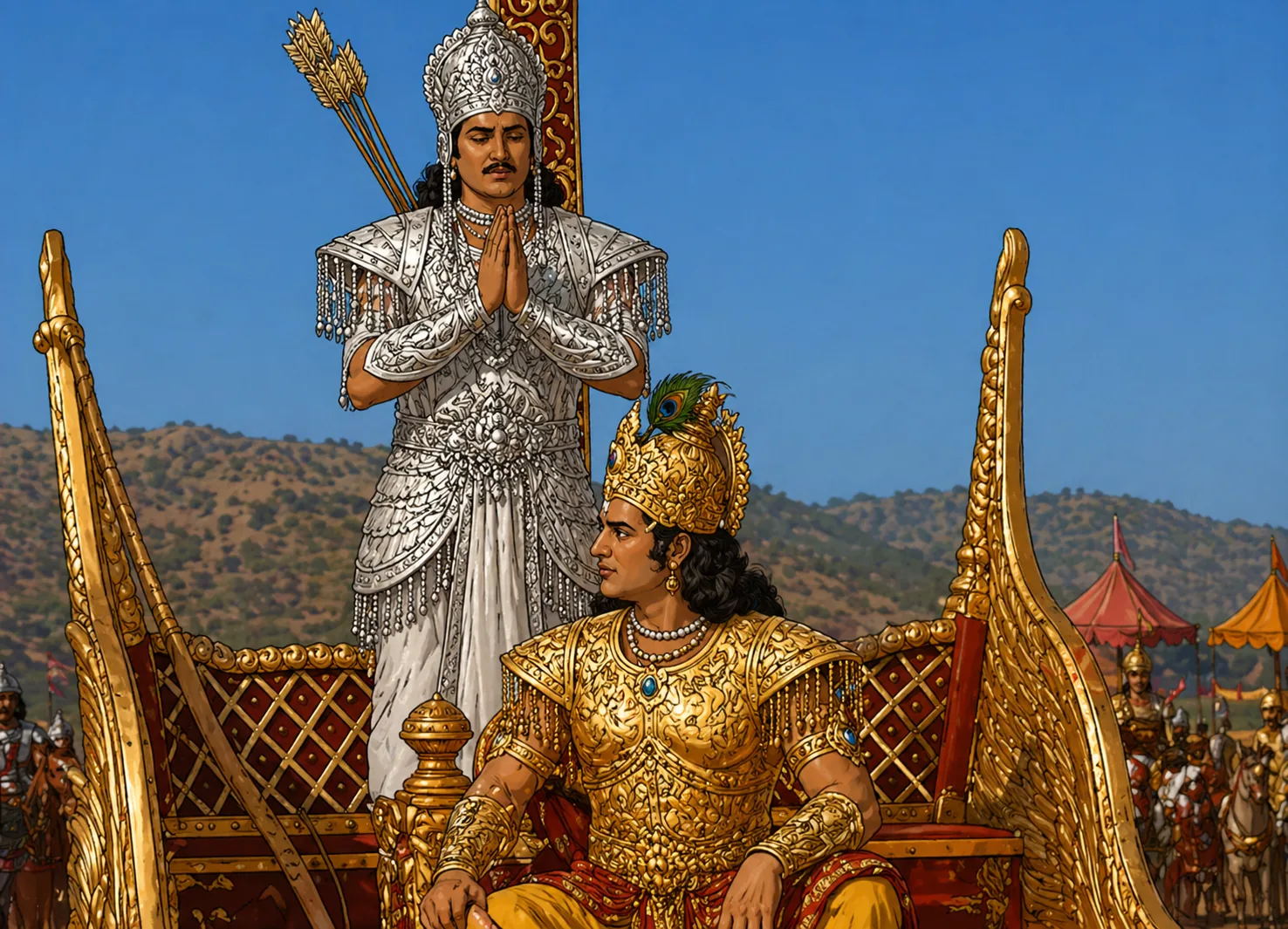
Chapter 7 is the seam in the Bhagavad Gita. The first six chapters were largely about you, your duty, your renunciation, your meditation, your inner climb. Beginning with Chapter 7, the camera pulls back. The teaching shifts from how do I act to what is actually going on. Krishna stops being primarily a coach and becomes, more openly, a metaphysical disclosure. The chapter is short, only thirty verses, but it changes the temperature of the whole book.
The chapter's title, Jnana Vijnana Yoga, is built on a distinction that English flattens. Jnana is knowledge: the part you can read, hear, memorise, defend in conversation. Vijnana is realization: the part that has actually arrived in you, that is no longer theory, that you can no longer un-see. Most spiritual ambition stalls at jnana. The Gita's interest is in the rare crossing into vijnana. Verse 7.3 says, with characteristic bluntness, that of those who strive, almost none arrive. That is not pessimism. It is calibration. The Gita is telling you: this is harder than you think, and the difficulty is not where you assumed it was.
How Rare Is What You're Actually Looking For
Chapter 7 opens with Krishna setting expectations. He is about to teach Arjuna something most people never reach. Not because it is hidden, but because most people stop earlier than they realize. Verse 7.3 contains one of the most quietly devastating sentences in the Gita: among thousands who try, one perhaps strives sincerely; among those who strive, one perhaps actually knows. This is not the bragging of an exclusive club. It is the Gita being honest about how far the journey actually goes.
If you have ever felt that your spiritual reading has accumulated but your spiritual seeing has not, this verse names the gap. The Gita is going to spend the next twelve chapters trying to close that gap. But the closing requires a different posture than the one most readers bring, less acquisition, more recognition.
यततामपि सिद्धानां कश्चिन्मां वेत्ति तत्त्वतः ॥
yatatām api siddhānāṃ kaścin māṃ vetti tattvataḥ ||
The honest reading of 7.3: This is not a verse to feel discouraged by. It is a verse to feel relieved by. If realization were easy, you would have to wonder why so many people who have practiced their whole lives still seem unsettled. The verse explains. The difficulty is not unique to you.
Pearls Strung on a Thread, the Gita's Image for Everything
Verse 7.7 contains an image so simple it can be missed. Imagine a string of pearls. The pearls are distinct, beautiful, each in its place. But what holds them in a single line is something you cannot see from the outside, a thread, threaded through every pearl. Without the thread, the pearls scatter. With the thread, they are a necklace.
Krishna's claim is that reality is the same shape. Every thing you see, each person, each object, each event, is the pearl. The Divine is the thread. The thread is not louder than the pearls. It is not even visible most of the time. But it is what makes the collection of pearls into something coherent. The Gita is not asking you to abandon the world of pearls. It is asking you to notice the thread.
मयि सर्वमिदं प्रोतं सूत्रे मणिगणा इव ॥
mayi sarvam idaṃ protaṃ sūtre maṇi-gaṇā iva ||
"All this is strung on me, as pearls are strung on a thread."Bhagavad Gita 7.7
Taste in Water, Light in the Sun: the Divine in Ordinary Things
Right after the pearls-on-a-thread image, Krishna does something extraordinary. He gets specific. He names where exactly the thread is, and the list is not where you would expect. He says: I am the taste in water. The light in the sun and moon. The sound in space. The strength in human beings. Notice what the list is not. There is no temple. No ritual object. No abstract metaphysical category. The Gita's first inventory of divine presence is in the simplest sensory experiences.
This is the Gita's quiet, persistent counter-argument to every form of spiritual escapism. The sacred is not somewhere else. It is in the glass of water you drank this morning. The sunlight on your wall. The sound of a conversation in the next room. You do not have to leave your life to find the Divine. You have to notice your life more carefully.
प्रणवः सर्ववेदेषु शब्दः खे पौरुषं नृषु ॥
praṇavaḥ sarva-vedeṣu śabdaḥ khe pauruṣaṃ nṛṣu ||
Maya, and Why You Cannot Think Your Way Out
Halfway through the chapter comes one of the Gita's most psychologically honest verses. Krishna says: my divine māyā, made of the three qualities of nature, is hard to cross. Those who take refuge in me, they cross it. Everyone else stays inside.
Note what the verse does not say. It does not say you can think your way out of māyā. It does not say more reading, more practice, more discipline alone can do it. It says the way through illusion is refuge. Not effort. Refuge. This will be controversial to anyone whose spiritual self-image is built on independence. The Gita is making a structural claim: there is a layer of confusion that no amount of self-generated effort can clear, because the effort itself is happening inside the confusion. The only way out is to lean on something outside the system.
मामेव ये प्रपद्यन्ते मायामेतां तरन्ति ते ॥
mām eva ye prapadyante māyām etāṃ taranti te ||
If you have ever lain awake at 2 a.m. trying to think yourself out of a loop: This is the verse for that experience. The Gita is saying, at this level, more thinking will not work. You have already tried that. The way out is a different kind of move altogether: putting the weight down.
The Four Kinds of Seekers, and Why Krishna Loves the Last One
Verses 7.16 and 7.17 contain one of the Gita's most generous and most pointed teachings. Krishna says four kinds of people turn to the Divine. The person in distress. The person seeking understanding. The person seeking wealth or material good. And the wise person, the jnani, who has stopped needing anything in particular and turns toward the Divine for the Divine itself.
What is generous about this list: all four are welcomed. The person who prays after a panic attack, the person who reads scripture because they cannot let go of the question, the person who asks for help with a job interview, none of them are turned away. What is pointed: Krishna says the fourth, the wise devotee whose love is no longer instrumental, is dearest. The hierarchy is not moral. It is structural. The first three loves something through the Divine. The fourth loves the Divine. They are different relationships.
आर्तो जिज्ञासुरर्थार्थी ज्ञानी च भरतर्षभ ॥
ārto jijñāsur arthārthī jñānī ca bharatarṣabha ||
प्रियो हि ज्ञानिनोऽत्यर्थमहं स च मम प्रियः ॥
priyo hi jñānino'tyartham ahaṃ sa ca mama priyaḥ ||
"I am dear to the wise one, and the wise one is dear to me."Bhagavad Gita 7.17
After Many Lifetimes: The Recognition That Ends Searching
Verse 7.19 is one of the most quietly weighty verses in the entire book. It says: after many lifetimes, the wise one surrenders, recognising that vāsudevaḥ sarvam iti, Bhagavan is all this. That recognition, Krishna says, makes the person a great atman, and very rare.
The verse can be read in two ways. The traditional reading is literal, many lifetimes, real ones, before the recognition arrives. The psychological reading is that this is what it feels like even within a single life: that the recognition seems to arrive after enormous distance has been crossed. Either way, the destination is the same and is named clearly: Bhagavan is all this. Not Bhagavan is somewhere, beyond. Bhagavan is here, as this. The thread is the pearls, seen finally as the thread.
वासुदेवः सर्वमिति स महात्मा सुदुर्लभः ॥
vāsudevaḥ sarvam iti sa mahātmā su-durlabhaḥ ||
Why the Divine Stays Hidden in Plain Sight
Chapter 7 closes with a recurring question: if the Divine is everywhere, strung through everything like a thread, why does almost no one see it? Krishna's answer is honest and unflinching. The Divine is not absent. The seeing is distorted. The veil is on the seer, not on the world.
This matters for how we live. If the problem were absence, we would need to search. The problem being distorted seeing, we need to clean the seeing. Different verb, different practice. The rest of the Gita is, in many ways, a long instruction on how to clean the seeing, through devotion, through equanimity, through service, through trust. Chapter 7 ends by naming the problem precisely. Chapter 8 onward begins to answer it.
मूढोऽयं नाभिजानाति लोको मामजमव्ययम् ॥
mūḍho'yaṃ nābhijānāti loko mām ajam avyayam ||
How Chapter 7 sets up the rest of the Gita: By Chapter 7, the Gita has stopped trying to give you new information. It is now trying to change what information you can perceive. The pearls have always been on a thread. You are being trained to see it. That training continues for the remaining eleven chapters.
The Complete Verse Reference
| Verse | Speaker | Teaching Essence |
|---|---|---|
| 7.1 | Krishna | Refuge and practice open the way to complete knowing |
| 7.2 | Krishna | Real knowing leaves no unfinished hunger for more |
| 7.3 | Krishna | True knowing is rarer than striving, even among the successful |
| 7.4 | Krishna | What changes is not the whole of what you are |
| 7.5 | Krishna | What sustains the world is subtler than what the senses first show |
| 7.6 | Krishna | Everything that appears rises from one source and returns there |
| 7.7 | Krishna | Everything is held in one sustaining reality |
| 7.8 | Krishna | The sacred is already inside ordinary experience |
| 7.9 | Krishna | The sacred is already inside nature, vitality, and discipline |
| 7.10 | Krishna | All brilliance is borrowed from the same source |
| 7.11 | Krishna | Strength becomes clean when desire no longer fights dharma |
| 7.12 | Krishna | All qualities arise in the divine, yet the divine is not bound by any |
| 7.13 | Krishna | Three qualities can hide the imperishable reality from plain sight |
| 7.14 | Krishna | The way beyond the veil is not force, but refuge |
| 7.15 | Krishna | A corrupted mind cannot recognise what would free it |
| 7.16 | Krishna | Different needs can still lead to one real turning toward the divine |
| 7.17 | Krishna | Deep knowing and devoted love become a mutual bond |
| 7.18 | Krishna | Deep knowing turns devotion into identity |
| 7.19 | Krishna | Deep seeing ends in surrender to the one reality in all things |
| 7.20 | Krishna | Desire clouds judgment and sends the mind toward smaller refuges |
| 7.21 | Krishna | Faith becomes firm where the devotee turns |
| 7.22 | Krishna | Faith draws the result, but the deeper order grants it |
| 7.23 | Krishna | Finite worship brings finite results; devotion returns you to Krishna |
| 7.24 | Krishna | Form can hide the imperishable reality beneath it |
| 7.25 | Krishna | The hidden divine is missed by confused seeing, not by absence |
| 7.26 | Krishna | Everything is visible to the divine; the divine remains unseen to ordinary minds |
| 7.27 | Krishna | Desire and aversion turn clear seeing into confusion |
| 7.28 | Krishna | Clear hearts stop wavering and move toward the divine with resolve |
| 7.29 | Krishna | Refuge in the divine opens total understanding of reality, inner life, and action |
| 7.30 | Krishna | Complete understanding remains steady even at the moment of departure |
Did you like this article?