Krishna's Three Paths:
Karma, Jnana, Bhakti and Why the Gita Offers Three Roads to the Same Reality
Krishna does not say there is one way. He lays out three (Action, Wisdom, Devotion) and tells Arjuna each one will carry him home. A deep reading, grounded in the verses, with parallels from Tulsidas's Ramcharitmanas and what modern psychology has begun to confirm.
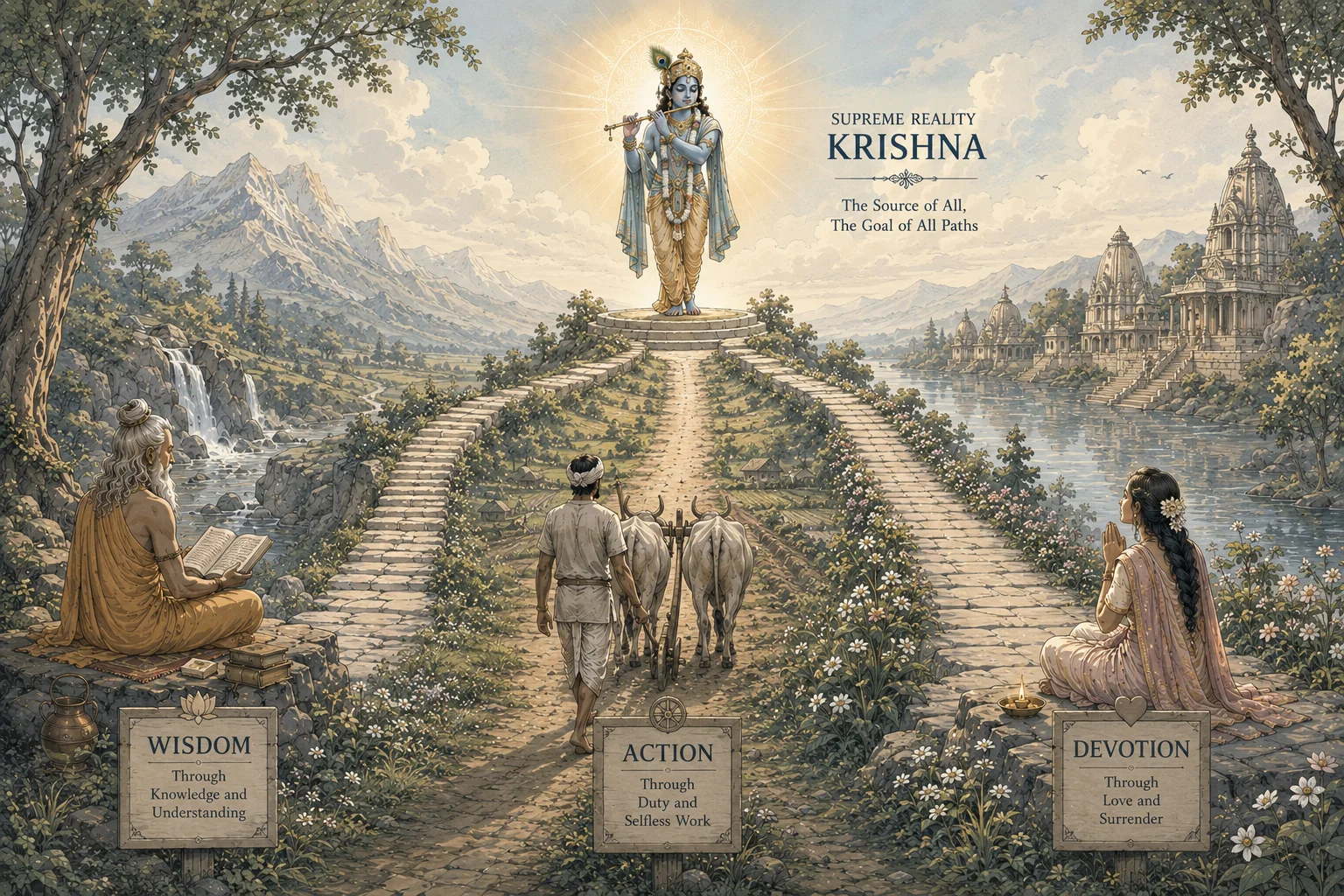
Somewhere on a battlefield in Kurukshetra, a man asks the oldest question in human spiritual life: What am I supposed to do with myself? Arjuna is not asking only about the war. He is asking what the rest of us also ask, in our own way, in our own decades: how does a person actually live? What is the right relationship between thinking, doing, and feeling? Krishna's answer is the Bhagavad Gita. And his answer is not one path. It is three.
This is the part of the Gita most people miss. The Gita does not say: here is the one true method; everyone, do this. It says: here are three doors into the same room; walk through the one that fits your nature, and the others will open from inside. The three doors have names. Krishna calls them Karma Yoga (the path of action, the focus of Chapter 3); Jnana Yoga (the path of knowledge, the focus of Chapter 4); and Bhakti Yoga (the path of devotion, given its most compressed expression in Chapter 12). In chapter 13, verse 24, Krishna himself lays out the spectrum: some realize the Self through meditation, some through Sankhya yoga, and some through karma yoga (BG 13.24).
The premise underneath all three is the same. The names are different (Krishna, Brahman, Atman, the Supreme) but the destination is one. What changes is the road, because the people walking are different. The Gita is psychologically honest in a way most spiritual texts are not: it admits that human beings are not uniform. Some of us live in our hands. Some live in our minds. Some live in our hearts. Krishna does not ask any of us to leave the place we live. He asks us to use that place as a door.
What this article covers
- Karma Yoga: action without attachment, and the surprising relief of not owning the result
- Jnana Yoga: the knowledge that ends seeking, and why it cuts rumination at the root
- Bhakti Yoga: devotion as the easiest path, and the science of surrender
- Where they meet: the four kinds of seekers, the summit verse, and Tulsidas's same teaching in different words
- Which path is yours: and how the Wisdom app places you on it
Karma Yoga, Act, but Stop Owning the Outcome
The Gita's most quoted verse belongs to this path. It is the answer Krishna gives in chapter 2 when Arjuna's collapse has reached its lowest point, when the warrior has put down his bow and is ready to leave the field. Krishna does not console him. He does not say you do not have to fight. He gives him a different relationship with the act of fighting:
मा कर्मफलहेतुर्भूर्मा ते सङ्गोऽस्त्वकर्मणि ॥
mā karmaphalahetur bhūr mā te saṅgo'stvakarmaṇi ||
The reason this teaching survives across three millennia is that it solves a very specific psychological problem. We are wired to act for outcomes. We pour effort in and we expect proportional return. When the return does not come, or when it comes late, or in the wrong currency, we collapse, we blame, we burn out. Krishna's teaching is not care less. It is care fully, but separate the caring from the demanding. He repeats it a chapter later, more directly:
असक्तो ह्याचरन्कर्म परमाप्नोति पूरुषः ॥
asakto hyācarankarma paramāpnoti pūruṣaḥ ||
And then, in chapter 3, Krishna gives the verse that turns Karma Yoga from a personal discipline into something cosmic, an offering:
निराशीर्निर्ममो भूत्वा युध्यस्व विगतज्वरः ॥
nirāśīrnirmamo bhūtvā yudhyasva vigatajvaraḥ ||
Tulsidas, eight hundred years later, in different words
Krishna's Karma Yoga did not stay sealed in Sanskrit. It walked out into the bhakti era and into common languages. Tulsidas, writing the Ramcharitmanas in Awadhi in the sixteenth century, delivered the same teaching in a chaupai that is still recited across northern India. (We have a separate piece on what karma actually means in the Gita. The cliché version most people carry is wrong in instructive ways.)
The Gita does not say karma is mechanical fate. It says karma is real cause. Your actions shape what comes back, not always in the form you expect, not always on the schedule you wanted, but they do. Karma Yoga's teaching is what you do with that fact: you take it seriously enough to act well, and you take it gently enough not to obsess over the receipt.
Modern parallel, the value-driven life
Contemporary psychology has, in the last twenty years, arrived at something remarkably close to Karma Yoga from a completely different direction. Acceptance and Commitment Therapy (ACT) distinguishes between outcome-driven living (I will be happy when X happens) and value-driven living (I will act in line with what matters to me, regardless of whether X happens). The first is fragile; it requires the world to comply. The second is portable; it works on a Tuesday morning when nothing in the world has cooperated. Krishna is teaching value-driven action, three thousand years earlier, in Sanskrit verse. The clinical research is now catching up to the chaupai.
Karma Yoga in one sentence
Do the work fully. Hand the result over. The fever leaves, and the action, done from this place, becomes the thing that finally carries you somewhere.
Jnana Yoga, Knowledge as the Fire That Burns Confusion
The second path is for a different kind of restlessness. The Karma Yogi cannot sit still; the Jnana Yogi cannot stop asking. For this seeker, the relief comes not from doing the right thing but from seeing the right thing clearly, finally, without the haze that ordinary thought leaves behind. Krishna's claim in chapter 4 is unusually large:
तत्स्वयं योगसंसिद्धः कालेनात्मनि विन्दति ॥
tatsvayaṃ yogasaṃsiddhaḥ kālenātmani vindati ||
But this knowledge is not bought cheaply. The Gita has very specific instructions for how it is approached:
उपदेक्ष्यन्ति ते ज्ञानं ज्ञानिनस्तत्त्वदर्शिनः ॥
upadekṣyanti te jñānaṃ jñāninastattvadarśinaḥ ||
The content of this knowledge (what the Jnani actually comes to see) is laid out across the middle chapters of the Gita, and most cleanly in chapter 13. Here Krishna draws the central distinction of the entire tradition: between kshetra (the field: the body, the mind, the emotions, all observable experience) and kshetrajna (the knower of the field: pure awareness, watching). Almost everything we suffer about is in the field. The knower has never been wounded.
सर्वथा वर्तमानोऽपि न स भूयोऽभिजायते ॥
sarvathā vartamāno'pi na sa bhūyo'bhijāyate ||
The Upanishadic root, neti, neti
Jnana Yoga did not begin with Krishna. He inherited it from the Upanishads, whose central method, neti, neti (“not this, not this”), is the original Jnana practice. The sage Yajnavalkya in the Brihadaranyaka Upanishad teaches that the self cannot be grasped as an object, because it is what is doing the grasping. You proceed by eliminating: you are not the body, because you can observe the body. You are not the mind, because you can observe the mind. What remains, when everything you can observe has been set aside, is what you have been all along. The Ashtavakra Gita, the Avadhuta Gita, and other lesser-known Gitas carry this method to its furthest expression. Krishna's gift in chapter 13 was to compress it into a structure ordinary people could actually use.
Modern parallel, metacognition and the witness
Cognitive science has, in the last thirty years, identified rumination (the repetitive recycling of negative thought) as one of the strongest predictors of depression and chronic anxiety. The most successful interventions for rumination are not techniques to think better thoughts. They are techniques to watch thoughts, to develop what psychologists call “metacognitive awareness,” the capacity to notice that you are thinking, without being identical to the thought. This is, almost word for word, the Jnana practice of distinguishing kshetra from kshetrajna. The witness is therapeutic precisely because it is true.
The thought arises in you, but you are not the thought. Notice this once, and the day softens. Notice it consistently, and the architecture of suffering begins to come apart.
Bhakti Yoga, Devotion as the Easiest, and the Hardest, Path
The third path begins where the second ends. Jnana Yoga asks you to see clearly, but Krishna, with disarming honesty, admits in chapter 12 that this is hard:
अव्यक्ता हि गतिर्दुःखं देहवद्भिरवाप्यते ॥
avyaktā hi gatirduḥkhaṃ dehavadbhiravāpyate ||
That alternative is Bhakti. Where Jnana asks what is real?, Bhakti asks whom do I love?. The answer is the same (the Supreme) but the route is utterly different. Bhakti uses what is already in the human heart: the capacity for attachment, longing, surrender. It does not eliminate emotion; it reorients it. The same energy that gets spent on a hundred small attachments is gathered up and turned toward the one source from which all attachment seemed to come in the first place.
निवसिष्यसि मय्येव अत ऊर्ध्वं न संशयः ॥
nivasiṣyasi mayyeva ata ūrdhvaṃ na saṃśayaḥ ||
And then, in chapter 9, Krishna gives the verse that has comforted more sufferers than possibly any other line in the book, the promise underneath the entire path:
तेषां नित्याभियुक्तानां योगक्षेमं वहाम्यहम् ॥
teṣāṃ nityābhiyuktānāṃ yogakṣemaṃ vahāmyaham ||
The most beautiful thing about Bhakti is the smallness of the offering it requires. There is no minimum donation. There is no spiritual qualification. Krishna says this directly:
तदहं भक्त्युपहृतमश्नामि प्रयतात्मनः ॥
tadahaṃ bhaktyupahṛtamaśnāmi prayatātmanaḥ ||
Tulsidas, surrender in Awadhi verse
If Krishna's Karma teaching reached Tulsidas as karam pradhan bisva kari rakha, his Bhakti teaching reached Tulsidas as a different chaupai entirely, spoken by Shiva in the Bal Kand after Sati's collapse, when nothing more can be argued:
And then, the verse that closes the entire Gita, the line Krishna calls the most secret teaching of all:
अहं त्वा सर्वपापेभ्यो मोक्षयिष्यामि मा शुचः ॥
ahaṃ tvā sarvapāpebhyo mokṣayiṣyāmi mā śucaḥ ||
Modern parallel, surrender as a regulated nervous system
What does Bhakti actually do, physiologically? Modern attachment science has begun to answer this. A secure attachment relationship (the felt sense of being held by something larger and reliable) is what regulates the human nervous system. Infants who experience this consistently develop the capacity to self-soothe. Adults who experience this in relationships are measurably calmer, more flexible, more resilient. Bhakti is the spiritual version of this experience: the felt sense that you are held by something that does not let go. It works on the same neural machinery. The devotee who can genuinely place the day in Krishna's hands is doing what attachment researchers call co-regulation, and it works precisely as it works in a healthy human bond.
Why Krishna calls Bhakti the easiest path
Because it does not require you to renounce anything you already have. It does not require silence. It does not require scholarship. It does not require you to fix yourself first. It asks only that you turn, and turn again, toward what you most love. The leaf, the flower, the fruit, the water. The same psyche that was scattered across a hundred small attachments becomes whole when finally pointed at one large one.
Where the Three Paths Meet
Once you see all three paths in front of you, the obvious question becomes: are they really separate? Or are they three faces of one thing? Krishna's answer, across the Gita, is both. They are different enough that a person should not try to walk all three at once. Start with the one that fits your nature. And they are united enough that the deeper you go, the more they begin to flow into each other.
The clearest single statement of this is in chapter 7, where Krishna describes the four kinds of people who turn toward him:
आर्तो जिज्ञासुरर्थार्थी ज्ञानी च भरतर्षभ ॥
ārto jijñāsurarthārthī jñānī ca bharatarṣabha ||
And immediately after, Krishna admits something tender: that of these four, one is dearer than the others. Not because the others are unworthy, but because in this one the paths have already fused:
प्रियो हि ज्ञानिनोऽत्यर्थमहं स च मम प्रियः ॥
priyo hi jñānino'tyarthamahaṃ sa ca mama priyaḥ ||
And in chapter 4, one of the most pluralistic verses Krishna ever delivers, a single line that has carried more spiritual generosity than perhaps any other:
मम वर्त्मानुवर्तन्ते मनुष्याः पार्थ सर्वशः ॥
mama vartmānuvartante manuṣyāḥ pārtha sarvaśaḥ ||
And finally, in chapter 12, the great verse that some have read as a ranking and others as a sequence, but is best read as a description of where each path naturally settles:
ध्यानात्कर्मफलत्यागस्त्यागाच्छान्तिरनन्तरम् ॥
dhyānātkarmaphalatyāgastyāgācchāntiranantaram ||
The path you can actually walk is more important than the path that sounds most impressive. Krishna's genius is to have laid out three real roads, and to have said, in his own voice, that he is at the end of every one.
Three Paths, Three Modern Wounds
The reason Krishna's three-path structure has survived three millennia is that it is psychologically accurate. Human beings are not uniform, and the things that go wrong inside us are also not uniform. Each of the three paths is a precise response to a recognizable form of modern suffering.
Karma Yoga is the antidote to outcome-anxiety: the chronic, low-grade fever of needing the next thing to go well before you can breathe. This is the texture of most contemporary professional life. Krishna's prescription is not to care less; it is to care without holding the result hostage. ACT therapy calls this values clarification and defusion from outcomes. The Gita called it nishkama karma (desireless action) and asked you to fight, but without the fever.
Jnana Yoga is the antidote to rumination: the looping, self-attacking thought that has become the signature wound of the over-educated, over-introspective modern psyche. The Jnana practice is to step out of the loop by recognizing the watcher. You are not the thought. The thought is something you notice. This is the foundation of metacognitive therapy, the foundation of mindfulness-based cognitive therapy, the foundation of every modern approach that has shown durable results in chronic depression. Krishna gave it the name kshetrajna (the knower of the field) and said clearly that this knowing frees you while life continues.
Bhakti Yoga is the antidote to disconnection: the loneliness epidemic, the sense of being unheld in the universe, the orphan-feeling of a culture that no longer has a shared sacred. Bhakti is the felt experience of being held. Attachment science now confirms what bhakti traditions always knew: that nervous systems regulate themselves in the presence of secure connection, and that this regulation is not optional. It is a biological requirement for sustained well-being. Krishna's offer of yogakshema vahami aham (“I carry your welfare and security”) is not poetry. It is, for those who can receive it, a form of co-regulation that the body responds to. (For a focused reading on what the Gita says about anxiety and mental peace, we have a separate piece.)
The Gita does not say one of these wounds is more important. It says they are different wounds, in different people, and that the medicine has to fit. The mistake most spiritual seekers make, and most therapists make, and most teachers make, is to assume one answer for everyone. Krishna's answer is more honest: three answers, depending on who is asking.
Which Path Is Yours?
A useful diagnostic, drawn from how the Gita itself describes the temperaments: notice what your restlessness wants.
If your restlessness wants to do, if sitting still is the hardest thing, if your relief comes from solving something, building something, finishing something, your path likely begins with Karma Yoga. The discipline is not to do less. It is to keep doing, fully, while progressively letting go of the part of you that demands a particular result. The verse to live with is 2.47.
If your restlessness wants to understand, if you cannot put a question down until it has been answered properly, if your relief comes from a model that finally fits, from a piece of language that finally lands, your path likely begins with Jnana Yoga. The discipline is to keep questioning, but to turn the question inward at the questioner. The verse to live with is 13.24.
If your restlessness wants to belong, if you feel deeply, if connection is what makes you feel real, if you are most yourself when you are in love with something or someone, your path likely begins with Bhakti Yoga. The discipline is to refine that love until it lands on something that can actually hold it. The verse to live with is 9.22.
And then, as Krishna promises in 4.11, the path you walk will start to walk back to meet you. The Karma Yogi will, in time, find that their work has become contemplative. The Jnani will find that their clarity has become tender. The Bhakta will find that their love has become wise. The three paths converge, not because you forced them to, but because at the summit, the view from any side is the same.
The Three Paths, Rebuilt for a Modern Practice
Everything above is theory until you do something with it. The Wisdom app exists because Krishna's three paths are too important to leave in the abstract, and because the modern reader rarely has a guru to ask which path is theirs.
Inside Wisdom, the three paths are not just an idea. They are the structure of the app. When you begin, you are placed on the path that fits your temperament: the Path of Action, the Path of Wisdom, or the Path of Devotion. Each path is a sequence of nodes: Stillness, Witness and Gyan Mastery on the Path of Wisdom; Trust, Devotion and Bhakti Mastery on the Path of Devotion; the corresponding discipline nodes on the Path of Action. Each node is a short daily practice, a verse from the Bhagavad Gita or a related scripture paired with a two-minute reflection, that moves you a little further along the road Krishna laid out.
You begin with the path that fits you. As you deepen, you can move between paths, because, as Krishna himself says in 7.17, the seeker who has gathered both wisdom and devotion is the one closest to him. The architecture of the app is not invented. It is the architecture of the Gita itself, made walkable.
A Closing Thought
The Gita does not end with chapter 18 because Krishna ran out of things to say. It ends because at some point, the seeker has to put the book down and walk. The three paths are not a menu to study; they are roads to walk. The road you choose matters less than the walking itself. Krishna's assurance, and the assurance of Tulsidas eight centuries later and of every teacher in this tradition, is the same: the destination is real, the paths to it are many, and the one who walks any of them with sincerity does not arrive alone.
Hoihi soi jo Rama rachi rakha. Whatever will happen, has already been scripted. Your job is only to walk, and to choose the road on which the walking feels most like yourself.
Related Reading on the Three Paths
If you want to go deeper into any one of the three paths individually, the long-form chapter studies and topic guides below pick up where this overview leaves off.
- Bhagavad Gita Chapter 3, Karma Yoga, “Why You Cannot Run”The full chapter on action: yajna, lokasamgraha, and why desire is the real enemy.
- Bhagavad Gita Chapter 4, Jnana Yoga, “The Fire That Burns Karma”Knowledge as the highest offering, and the Gita's model for how to learn from a real teacher.
- Bhagavad Gita Chapter 12, Bhakti Yoga, “How a Devotee Actually Lives”The shortest chapter, and one of the most practical. The four-step ladder for when meditation is too hard.
- Bhagavad Gita Chapter 18, Moksha Sannyasa YogaThe closing chapter, including 18.66, the Gita's final teaching on surrender.
- What Karma Actually Means in the Bhagavad GitaKarma doesn't mean “what goes around comes around.” Here is the real definition.
- What the Gita Says About Anxiety & Mental PeaceA focused reading for those approaching the Gita through the door of psychological suffering.
- Beyond the Bhagavad Gita, 7 Lesser-Known Gitas on Inner PeaceAshtavakra, Avadhuta, Ram Gita and more: the wider Jnana tradition the chapter above draws from.
- The Bhagavad Gita as a Story, How Krishna Builds His ArgumentThe structural arc of all 18 chapters, how the three paths unfold across the text.
- Bhagavad Gita for Beginners, Where to Start700 verses, 18 chapters. A no-nonsense guide for the first-time reader.