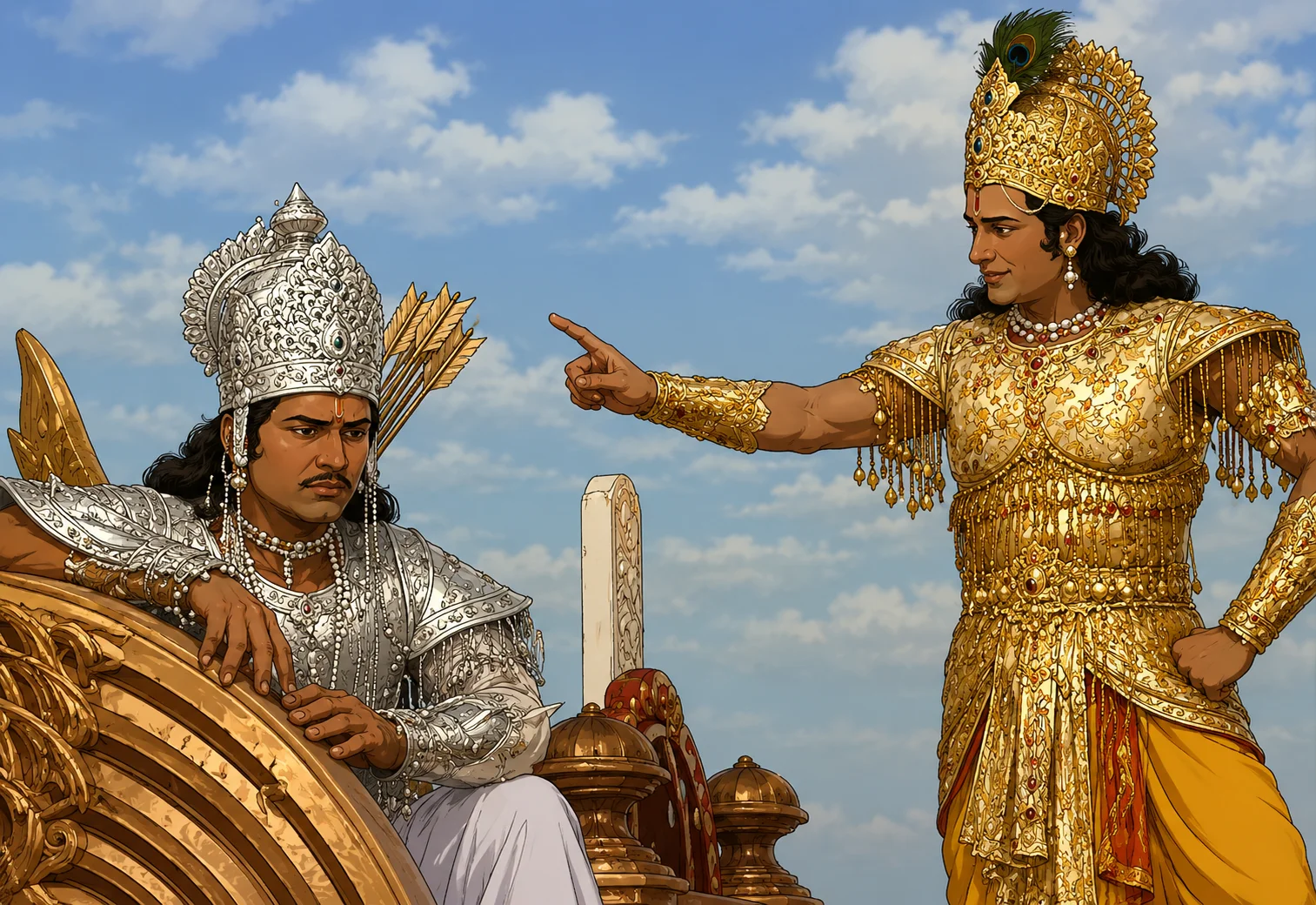
Arjuna wants out. He has set down his bow, and now he is making his case to Krishna: if knowledge is superior to action, why should he fight? Why not renounce the world, sit quiet in meditation, and let others wage war?
The question is coherent. The logic is sound. And Chapter 3 is Krishna taking it apart, premise by premise, and rebuilding something harder in its place. Not permission to withdraw. Not validation of the desire to escape. But a teaching that restructures how we think about duty, action, and the spiritual life itself.
This is where the Gita stops being a philosophical comfort and becomes a challenge.
The Question That Cannot Be Dismissed
Arjuna has watched Chapter 2 with careful attention. He has heard Krishna teach that the Self is eternal, that the body dies but the atman does not, that action without attachment is the path to freedom. And he has listened to all of it. But now he asks Krishna directly:
If wisdom is higher than action, why do you ask me to engage in this terrible war?
The logic seems airtight. If knowledge liberates, why not just gain the knowledge and sit? Why all this slaughter?
Chapter 3 is Krishna saying: because you're operating on a false premise about what renunciation means. And because action is not something you can opt out of. You're already acting. Even the desire to avoid acting is an action. Even sitting still is action. The only real choice is this: will you act with awareness, or act blindly?
The deeper pattern: Notice that both Arjuna's collapse in Chapter 1 and his demand for escape in Chapter 3 follow the same impulse, a desire to get out. First out of the battle. Now out of action itself. The Gita is not gentle on this impulse. It names it directly: this is delusion. And what creates the delusion is not cowardice or weakness, but a fundamental misunderstanding of what freedom means.
Two Legitimate Paths
ज्ञानयोगेन सांख्यानां कर्मयोगेन योगिनाम् ॥
jñānayogena sāṃkhyānāṃ karmayogena yoginām ||
This verse is Krishna's opening move. He's not dismissing Arjuna's interest in knowledge. He's saying: yes, both paths exist. But for you, someone born into the warrior caste, trained in action your whole life, attempting to forcibly transform yourself into a wandering ascetic is not spirituality. It's escape. It's using the language of spirituality to justify the desire to run away.
The Gita's argument is sophisticated here. It's saying that your nature, your temperament, your gifts, your conditioning, is not an obstacle to overcome. It's the foundation of your spiritual path. The question is not: how do I become someone else? The question is: how do I fully become myself?
You Cannot Avoid Action
कार्यते ह्यवशः कर्म सर्वः प्रकृतिजैर्गुणैः ॥
kāryate hyavaśaḥ karma sarvaḥ prakṛtijairguṇaiḥ ||
This verse is ruthless in its honesty. The person who sits in the forest with closed eyes, claiming non-action, is still breathing. Still thinking. Still experiencing. The breath is action. The thought is action. The experience is action. To claim that you are performing no action is not humility, it's self-deception.
What Krishna is saying is: the choice has never been between action and inaction. That choice doesn't exist. The only real choice is this: will you perform your actions with consciousness, responsibility, and care? Or will you perform them blindly, in denial, telling yourself that you're not doing what you're obviously doing?
"Everyone is made to act, helplessly, by the qualities born of material nature."Bhagavad Gita 3.5
When Action Becomes Offering
If you cannot avoid action, the question becomes: how do you prevent action from becoming bondage? How do you act without being trapped by the results?
Krishna's answer is yajna, often translated as "sacrifice," but meaning something more fundamental: the transformation of action into an offering. When you stop doing something for yourself and start doing it for something larger, the entire quality of the action changes.
तदर्थं कर्म कौन्तेय मुक्तसंगः समाचर ॥
tadarthaṃ karma kaunteya muktasaṃgaḥ samācara ||
This is where the Wisdom app becomes relevant to understanding this teaching. Every day, the app sends a shloka, a verse from the Gita, not for the user to profit from or compete over, but to deepen their understanding of what freedom truly means. The same text, received as knowledge rather than as information. The shift from self-serving to service-oriented is everything.
The Weight of What Others Will Do
Now Krishna introduces a concept that cuts deeper than personal liberation. It's not enough to act without attachment. You also have to accept that your actions become a standard. Great people, wise people, those with influence, their actions are watched. Their choices become permissions.
स यत्प्रमाणं कुरुते लोकस्तदनुवर्तते ॥
sa yatpramāṇaṃ kurute lokastadanuvartate ||
This verse has a sting in it. It means that Arjuna's desire to renounce is not just his own choice. If the greatest warrior of the age puts down his bow and runs to the forest, others will see that and think: renunciation is possible, withdrawal is permissible, the world's problems are not my concern. His refusal to act has ripple effects.
Lokasamgraha, the welfare of the world, is not a burden you choose to take on. It's a fact that's already true. You're already setting an example. The only question is whether you'll do it consciously or unconsciously.
Who Is the Doer?
अहङ्कारविमूढात्मा कर्ताऽहमिति मन्यते ॥
ahaṅkāravimūḍhātmā kartā'hamiti manyate ||
This is one of the Gita's most paradoxical teachings. It's saying that while you cannot avoid action, you also cannot truly be the sole author of action. The qualities of nature, sattva, rajas, tamas, are constantly acting through you. Your body is made of these qualities. Your mind is made of these qualities. Your preferences and aversions are made of these qualities.
So where is the "I" that is doing? The teaching suggests something much subtler: the true self is a witness to all this action, not a participant in it. You can act fully while knowing, at a deeper level, that the action is happening through you, not by you.
Better Your Own Path Imperfectly
स्वधर्मे निधनं श्रेयः परधर्मो भयावहः ॥
svadharme nidhanaṃ śreyaḥ paradharmo bhayāvahaḥ ||
This verse is a salve and a challenge simultaneously. It says: you don't need to be perfect at your own dharma. You can stumble. You can fail. You can be clumsy and uncertain. That's still better than being perfect at someone else's calling.
But it also says: the temptation to abandon your path for another's is rooted in fear, not wisdom. Why do you want to follow another's path? Because it looks easier from the outside? Because you admire how well they do it? Because you're afraid you'll fail at your own? Those are the wrong reasons. Your dharma is the only authentic ground you have.
What Actually Drives Us to Harm
Having established that you cannot avoid action and that your action matters, Krishna now identifies what actually corrupts action. It's not action itself. It's not engagement in the world. It's something more specific: desire and anger.
महाशनो महापाप्मा विद्ध्येनमिह वैरिणम् ॥
mahāśano mahāpāpmā viddhyenamiha vairiṇam ||
Here is where Chapter 3 moves from philosophy to psychology. The enemy isn't external. You've been fighting the wrong fight if you think the problem is other people, circumstances, or even your own inaction. The real enemy is the restless wanting in the mind, the craving for what you don't have and the rejection of what you do.
Desire is never satisfied. Anger is never resolved by getting what you want. They will consume you from the inside, using action as their tool.
The Ladder from Body to Self
Chapter 3 ends with a structure. It describes the hierarchy of the inner life and shows how freedom is actually constructed.
मनसस्तु परा बुद्धिर्यो बुद्धेः परतस्तु सः ॥ एवं बुद्धेः परं बुद्ध्वा संस्तभ्यात्मानमात्मना ।
जहि शत्रुं महाबाहो कामरूपं दुरासदम् ॥
manasastu parā buddhiryo buddheḥ paratastu saḥ ||
evaṃ buddheḥ paraṃ buddhvā saṃstabhyātmānamātmanā |
jahi śatruṃ mahābāho kāmarūpaṃ durāsadam ||
The chapter ends not with withdrawal but with mastery. Not with escape but with building a structure inside yourself where the higher can govern the lower. Your body wants. Your senses seek. Your mind desires. Your intellect rationalizes. And beyond all of this is the Self, the witness, the awareness that stands free of all of it.
To access that freedom, you don't leave the body behind. You stop being run by it. You don't abandon the mind. You stop being unconscious within it. This is the real renunciation: not abandoning action, but abandoning the delusion that you are only the part of yourself that craves and reacts.
The Complete Chapter
| Verse | Speaker | Core Teaching |
|---|---|---|
| 3.1 | Arjuna | If knowledge is superior to action, why must I fight? |
| 3.2 | Arjuna | Your words confuse me, teach me clearly. |
| 3.3 | Krishna | Two paths: knowledge yoga for scholars, karma yoga for doers. |
| 3.4 | Krishna | Freedom comes through wise action, not escape. |
| 3.5 | Krishna | You cannot avoid action, nature compels you. |
| 3.6 | Krishna | True self-control means aligning thoughts and actions. |
| 3.7 | Krishna | Master your senses; act without attachment. |
| 3.8 | Krishna | Meaningful action matters, even for basic survival. |
| 3.9 | Krishna | Act as an offering; freedom comes from selfless service. |
| 3.10 | Krishna | Through selfless action, the world sustains itself. |
| 3.11 | Krishna | Through mutual service, you create shared prosperity. |
| 3.12 | Krishna | What you receive is meant to be shared. |
| 3.13 | Krishna | Freedom comes from selfless giving, not hoarding. |
| 3.14 | Krishna | Selfless action nourishes both self and world. |
| 3.15 | Krishna | See every action as a sacred offering. |
| 3.16 | Krishna | To live only for pleasure is to waste your life. |
| 3.17 | Krishna | True contentment is found within, not in external achievement. |
| 3.18 | Krishna | Fulfillment comes from selfless action, not results. |
| 3.19 | Krishna | Perform your duty without attachment, this leads to freedom. |
| 3.20 | Krishna | Selfless action uplifts both self and society. |
| 3.21 | Krishna | Great people set the standard; others follow their example. |
| 3.22 | Krishna | Do your duty regardless of gain or need. |
| 3.23 | Krishna | Your actions shape what others believe is possible. |
| 3.24 | Krishna | Your actions echo, lead with awareness. |
| 3.25 | Krishna | True wisdom serves through action and humble example. |
| 3.26 | Krishna | Lead by example with empathy, inspire, don't impose. |
| 3.27 | Krishna | Nature acts through you, the ego claims the credit. |
| 3.28 | Krishna | Understanding the nature of action leads to freedom. |
| 3.29 | Krishna | True wisdom holds space for others' journeys. |
| 3.30 | Krishna | Offer your actions; let go of attachment; find freedom. |
| 3.31 | Krishna | Faithful, non-judgmental action leads to freedom. |
| 3.32 | Krishna | Humility and openness to wisdom lead to progress. |
| 3.33 | Krishna | True transformation comes from working with your nature. |
| 3.34 | Krishna | Freedom comes from not letting likes and dislikes rule you. |
| 3.35 | Krishna | Your dharma imperfectly is better than another's perfectly. |
| 3.36 | Arjuna | What forces drive a person toward papa? |
| 3.37 | Krishna | Desire and anger are the real enemies, overcome them. |
| 3.38 | Krishna | Desires obscure wisdom like smoke conceals fire. |
| 3.39 | Krishna | Desire is a fire that is never satisfied. |
| 3.40 | Krishna | Guard your senses, mind, and intellect, they're gateways of desire. |
| 3.41 | Krishna | Mastery over senses is the foundation of wisdom. |
| 3.42 | Krishna | The Self is subtler and more powerful than senses, mind, or intellect. |
| 3.43 | Krishna | With self-mastery, overcome desire, the formidable inner enemy. |
Did you like this article?