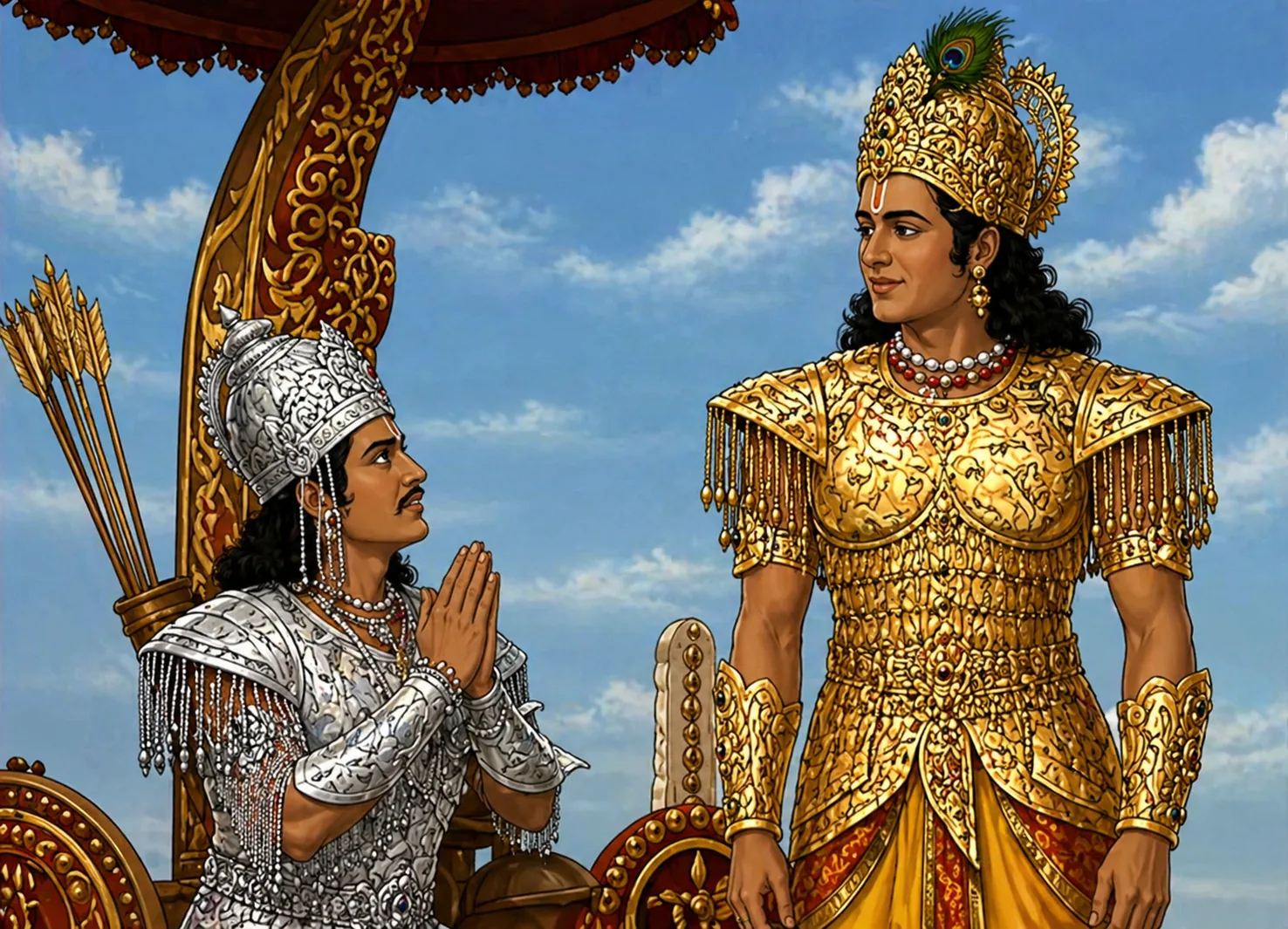
Chapter 1 ends in silence. Arjuna has put down his bow, sunk into his chariot, and told Krishna he will not fight. For the first and only time in the Gita, the great archer has surrendered, not to an enemy, but to his own grief. Chapter 2 is what happens next. And what happens is that the entire framework of how to think about life, action, death, and identity gets rebuilt from the ground up.
Krishna speaks for the first time. And his opening words are not comforting. They are diagnostic.
Krishna's First Words: You Are Wrong
Krishna doesn't begin with philosophy. He begins with a diagnosis. Look at verse 2.11.
गतासूनगतासूंश्च नानुशोचन्ति पण्डिताः ॥
gatāsūnagatāsūṃśca nānuśocanti paṇḍitāḥ ||
This is crucial to understand. Krishna's first direct words are not "I understand your pain" or "Let me comfort you." He says, in effect: your grief and your words are in contradiction. You claim to speak wisdom but you're acting as though you believe something you've just said you don't believe. This isn't cruelty. This is clarity. The Gita is fundamentally a text about inconsistency, about seeing where we contradict ourselves.
The Foundation: What Cannot Die
Before Krishna gives Arjuna any practical instruction, he has to establish what kind of thing Arjuna actually is. This is not abstract philosophy. It is the foundation that makes everything else in the Gita make sense. If you don't understand what the self is, you can't understand why certain actions matter and others don't.
Verse 2.20 is the bedrock of the entire Gita.
अजो नित्यः शाश्वतोऽयं पुराणो न हन्यते हन्यमाने शरीरे ॥
ajo nityaḥ śāśvato'yaṃ purāṇo na hanyate hanyamāne śarīre ||
The logic is elegant. If the atman is unborn and eternal, then "birth" and "death" are not absolute events, they are transitions of the body, not the self. They are like changing clothes.
तथा शरीराणि विहाय जीर्णान्यन्यानि संयाति नवानि देही ॥
tathā śarīrāṇi vihāya jīrṇānyanyāni saṃyāti navāni dehī ||
And between these two verses, Krishna gives a third piece of advice: endure what comes. Verse 2.14 speaks to the transient nature of sensation, pain and pleasure come and go, heat and cold come and go. Build the capacity to endure them without being destabilized. What you cannot control, you must outlast.
आगमापायिनोऽनित्यास्तांस्तितिक्षस्व भारत ॥
āgamāpāyino'nityāstāṃstitikṣasva bhārata ||
The Dharma Argument: Why Arjuna Must Act
Krishna now shifts from metaphysics to duty. He has established what the self is. Now he establishes what Arjuna's specific obligation is. And the argument is precise: for Arjuna, right now, in this situation, not fighting is the ethical failure.
Understanding dharma in the Gita: Dharma is not a universal rule. It is the unique duty that arises from who you are, what your role is, and what the moment demands. For Arjuna, who was born as a kshatriya, a warrior, whose entire training has been in the martial arts, whose family has a righteous claim, and whose opponent is himself leading an unrighteous war, the dharma is to fight. This is not "always fight." This is "for you, now, in this exact moment, this is what duty demands."
The Verse Everyone Quotes (and Misunderstands)
2.47 is the most quoted verse of the Gita. In boardrooms, yoga studios, and self-help books, it shows up as a teaching on detachment. But people almost always quote only the first half and miss the verse's full force. The verse has four parts, and they're all equally important.
मा कर्मफलहेतुर्भूर्मा ते सङ्गोऽस्त्वकर्मणि ॥
mā karmaphalaheturbhūrmā te saṅgo'stvakarmaṇi ||
The verse is saying: you must act. You have a right to action. But you have no right to demand the universe give you the outcome you want. Your job is to act with full effort and integrity. The results are not in your control, and trying to control them is the path to suffering. But not acting, using detachment as an excuse for inaction, is the opposite extreme, and the verse explicitly forbids it.
The very next verse clarifies what this looks like in practice.
सिद्ध्यसिद्ध्योः समो भूत्वा समत्वं योग उच्यते ॥
siddhyasiddhyoḥ samo bhūtvā samatvaṃ yoga ucyate ||
What Avoiding Your Duty Actually Costs You
Arjuna made several sophisticated-sounding arguments for why he shouldn't fight. He said fighting would create sin. He said destroying families would cause chaos. He said it was better to die unarmed. These weren't simplistic objections, they came from a place of genuine moral concern. And Krishna addresses each one not by dismissing Arjuna's worry, but by showing where his logic fails.
The Gita is extremely direct here: the desire to step back from your responsibility is often dressed up as moral sensitivity. It looks like wisdom. It sounds like wisdom. But it's a form of self-deception. You're protecting yourself from discomfort and calling it ethics. And the Gita spends all of Chapter 2 and 3 dismantling the specific rationalizations we use to avoid our duty.
This is something most modern discussions of the Gita miss entirely. We want it to be about universal truths, don't be attached, don't grasp at outcomes. But it's equally about particularity: you have a specific duty, arising from who you are. And avoiding it is not noble. It's escape. The Gita doesn't let you off the hook.
From Thought to Ruin: The Cascade
Toward the end of Chapter 2, Krishna gives what is perhaps the Gita's most precise description of psychological collapse. It's a sequence, and understanding it is crucial because it shows you where the break in the chain can happen.
सङ्गात् संजायते कामः कामात्क्रोधोऽभिजायते ॥
saṅgāt saṃjāyate kāmaḥ kāmātkrodho'bhijāyate ||
स्मृतिभ्रंशाद् बुद्धिनाशो बुद्धिनाशात्प्रणश्यति ॥
smṛtibhraṃśād buddhināśo buddhināśātpraṇaśyati ||
This is the Gita's 2500-year-old theory of how the mind falls apart. The sequence is: dwelling on something → attachment → desire → anger (when blocked) → confusion → memory loss → loss of judgment → self-destruction. Each step is both inevitable and avoidable. The key insight is that the interruption point is always the first link: what you allow your mind to dwell on.
The Portrait of a Sthitaprajna
The chapter reaches its culmination in one of the Gita's most important passages. Arjuna asks Krishna a question that is both simple and profound.
स्थितधीः किं प्रभाषेत किमासीत व्रजेत किम् ॥
sthitadhīḥ kiṃ prabhāṣeta kimāsīta vrajeta kim ||
And Krishna answers with a portrait that spans verses 2.55 through 2.72. It is not a portrait of a detached saint sitting in a cave. It is a portrait of a person who remains functional, clear, and present even when life is burning around them.
आत्मन्येवात्मना तुष्टः स्थितप्रज्ञस्तदोच्यते ॥
ātmanyevātmanā tuṣṭaḥ sthitaprajñastadocyate ||
वीतरागभयक्रोधः स्थितधीर्मुनिरुच्यते ॥
vītarāgabhayakrodhaḥ sthitadhīrmunirucyate ||
This is the portrait. Not an ascetic. Not someone withdrawn from life. But someone who can remain clear, integrated, and functional regardless of what life brings. Someone who has broken the connection between what happens externally and their internal stability.
All 72 Shlokas at a Glance
| Verse | Speaker | Essence |
|---|---|---|
| 2.1 | Sanjaya | Even heroes feel lost, help arrives at the darkest hour |
| 2.2 | Krishna | In moments of challenge, choose courage over retreat |
| 2.3 | Krishna | Do not let fear dictate your actions; rise with courage |
| 2.4 | Arjuna | Facing duty can conflict with deep feelings, it's human |
| 2.5 | Arjuna | Never achieve your goals at the cost of your principles |
| 2.6 | Arjuna | Honest self-doubt is a step before clarity |
| 2.7 | Arjuna | Wisdom begins with the willingness to ask for guidance |
| 2.8 | Arjuna | Outer achievements cannot heal inner wounds |
| 2.9 | Sanjaya | Even the wisest pause before acting; silence signals a search |
| 2.10 | Krishna | In darkness, a calm guide restores hope |
| 2.11 | Krishna | Wise people do not grieve for the inevitable |
| 2.12 | Krishna | You are eternal; your true self never perishes |
| 2.13 | Krishna | Our true nature is changeless and eternal |
| 2.14 | Krishna | Endure life's changing experiences, they are temporary |
| 2.15 | Krishna | Equanimity amidst all experiences brings true strength |
| 2.16 | Krishna | The real endures; the unreal fades away |
| 2.17 | Krishna | Your true self is eternal and cannot be destroyed |
| 2.18 | Krishna | Your true self is beyond destruction, act with courage |
| 2.19 | Krishna | Your real self is never harmed by what happens to the body |
| 2.20 | Krishna | You are eternal, nothing can destroy your true self |
| 2.21 | Krishna | You are the eternal atman; unaffected by change |
| 2.22 | Krishna | You are the eternal atman, not the temporary body |
| 2.23 | Krishna | Your spirit is unbreakable, beyond all external harm |
| 2.24 | Krishna | The atman is indestructible, nothing can harm your innermost self |
| 2.25 | Krishna | You are the unchanging atman; do not grieve for passing things |
| 2.26 | Krishna | Let go of sorrow over the inevitable; peace lies in acceptance |
| 2.27 | Krishna | All things change; acceptance brings peace |
| 2.28 | Krishna | Life is a temporary appearance; the true self is beyond birth and death |
| 2.29 | Krishna | The atman is a wondrous mystery, beyond easy understanding |
| 2.30 | Krishna | The atman is eternal, do not grieve over temporary changes |
| 2.31 | Krishna | Honoring your unique duty leads to true fulfillment |
| 2.32 | Krishna | Life's unexpected duties can be your greatest opportunities |
| 2.33 | Krishna | True peace comes from courageously walking your path |
| 2.34 | Krishna | Honor and integrity are worth more than life itself |
| 2.35 | Krishna | How you respond to fear determines your standing in life |
| 2.36 | Krishna | Do not let harsh words deter you from your true path |
| 2.37 | Krishna | Take decisive action, growth comes from commitment, not results |
| 2.38 | Krishna | Act with inner balance; be free from anxiety |
| 2.39 | Krishna | Act with inner balance; transcend the bonds of your actions |
| 2.40 | Krishna | Every sincere effort, no matter how small, is never wasted |
| 2.41 | Krishna | True success comes from a focused, unwavering mind |
| 2.42 | Krishna | Look beyond outward pleasures; seek lasting wisdom within |
| 2.43 | Krishna | Don't let desire for rewards distract you from deeper fulfillment |
| 2.44 | Krishna | When the mind obsesses on pleasure, spiritual focus fades |
| 2.45 | Krishna | Lasting peace comes from being rooted in your true Self |
| 2.46 | Krishna | True wisdom transcends the need for lesser, fragmented knowledge |
| 2.47 | Krishna | Do your duty; let go of the outcome |
| 2.48 | Krishna | True yoga is remaining balanced in success and failure |
| 2.49 | Krishna | Let go of attachment to results; act with wisdom |
| 2.50 | Krishna | Find balance in action; let go of attachment to outcomes |
| 2.51 | Krishna | Freedom blooms when you let go of demanding specific results |
| 2.52 | Krishna | Clarity brings spontaneous peace and detachment |
| 2.53 | Krishna | A steady mind leads to true spiritual union |
| 2.54 | Arjuna | The sincere seeker asks: what does true inner balance look like? |
| 2.55 | Krishna | Freedom from desire brings deep contentment |
| 2.56 | Krishna | Steadiness in suffering and restraint in happiness, this is wisdom |
| 2.57 | Krishna | A steady mind leads to true wisdom unaffected by life's changes |
| 2.58 | Krishna | Withdraw from distractions; wisdom grows in self-control |
| 2.59 | Krishna | Inner thirst fades only when quenched by something truly greater |
| 2.60 | Krishna | Even the wise must guard their senses |
| 2.61 | Krishna | Steady wisdom comes from controlling the senses |
| 2.62 | Krishna | Dwelling on desires creates attachment; attachment creates anger |
| 2.63 | Krishna | Anger clouds the mind; a clouded mind destroys intelligence |
| 2.64 | Krishna | Self-mastery and freedom from attachment lead to lasting peace |
| 2.65 | Krishna | A calm, purified mind is the foundation of peace and wisdom |
| 2.66 | Krishna | A disciplined mind is the key to unwavering peace |
| 2.67 | Krishna | Guarding the mind from the senses preserves wisdom |
| 2.68 | Krishna | Master your senses and your mind finds peace |
| 2.69 | Krishna | True wisdom means waking up to what the world overlooks |
| 2.70 | Krishna | True peace comes from steadiness, not from fulfilling desires |
| 2.71 | Krishna | Peace comes from letting go of desire, ownership, and ego |
| 2.72 | Krishna | Unshakeable inner wisdom leads to enduring peace and ultimate freedom |
Did you like this article?