| Question | Stoicism | Bhagavad Gita |
|---|---|---|
| What is up to me? | Judgments, desires, actions — the dichotomy of control (Epictetus). | The action itself, never the fruit — nishkama karma (BG 2.47). |
| What is the good? | Virtue alone. Externals are preferred indifferents. | Dharma lived without craving results. |
| What holds it together? | Impersonal Logos — cosmic reason. | Bhagavan — personal, and relatable through bhakti. |
| What is the self? | Rational faculty (hēgemonikon) — dispersed at death. | Atman — unborn, undying, witness (BG 2.20). |
| The goal? | Eudaimonia — flourishing, in this life, through reason. | Moksha — liberation, beyond the guna framework. |
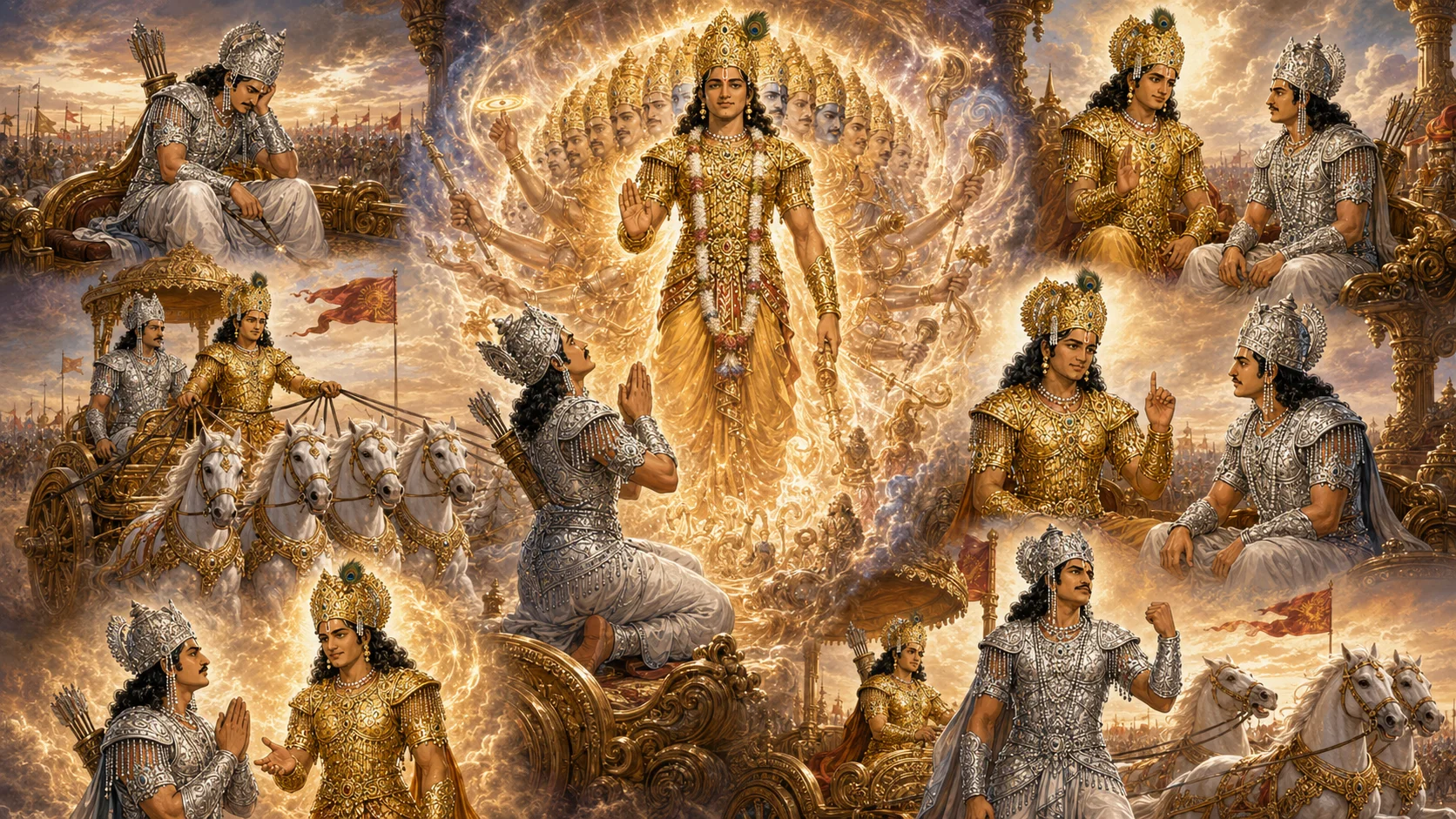
The Stoics and the Gita were written in different languages, different centuries, different continents. Marcus Aurelius never heard of Krishna. And yet, if you place the Meditations next to the Bhagavad Gita, you keep encountering the same sentence in slightly different clothes. This is not coincidence. It suggests something about the questions themselves: that certain problems of human life, how to act under pressure, how to handle what you cannot control, how to do your duty without being destroyed by it, produce similar answers regardless of where you ask them.
Brief Background
Stoicism began with Zeno of Citium, who founded a school in Athens around 300 BCE. It was developed by Cleanthes, Chrysippus, and later popularized in Rome by Epictetus (a former slave) and Marcus Aurelius (an emperor). Stoicism teaches that the good life consists in living according to reason and nature, focusing on what is within your control — what Epictetus called ta eph' hēmin (things up to us) — and accepting with equanimity everything that is not.
The Bhagavad Gita is set within the Mahabharata. Its date is actively debated. Mainstream scholarship places the text's composition or final compilation between 400 BCE and 200 CE. However, recent researchers using astronomical methods have proposed significantly earlier dates for the underlying events. Nilesh Oak, in When Did the Mahabharata War Happen? (2011), cross-references the sky descriptions and planetary positions within the Mahabharata against historical astronomy, arriving at a date of around 5561 BCE for the war itself — suggesting the oral tradition that became the Gita is far older than the compiled text. This line of research is not yet part of the academic mainstream, but it represents a serious and growing body of inquiry. It records a conversation between the warrior Arjuna and his charioteer Krishna (an avatar of Vishnu) on the eve of a war. The core of Krishna's teaching is about the nature of action, duty, self, and liberation. It is one of the most widely read philosophical texts in human history.
The two traditions almost certainly did not influence each other. What they share, they arrived at independently.
Similarity 1: Control What You Can, Release What You Cannot
Epictetus opens the Enchiridion with what he calls the fundamental distinction in philosophy: some things are in our power, and some are not. He builds the entire Stoic practice on this distinction.
Similarity 2: Virtue Is the Only True Good
Stoicism holds that external goods, wealth, reputation, health, success, are "preferred indifferents." They are not bad. But they are not the good. The only true good is virtue: wisdom, justice, courage, moderation.
The Gita's nishkama karma, action without desire for the fruit, makes the same structural claim. You do not act in order to acquire something external. You act because the action is the right thing to do, because it is your dharma. The quality of the action is what matters. The external reward is incidental.
Virtue is the only true good. External outcomes are preferred indifferents. Moral integrity cannot be traded for any external gain.
Act from dharma, not from desire for reward. Nishkama karma: action without attachment to its fruits. The quality of action is what you own.
Similarity 3: The Present Moment
Marcus Aurelius returns again and again to the present moment as the only real location of life and action. He writes about how much suffering comes from projecting into the past (regret) or the future (anxiety).
The Gita's teaching on karma yoga makes the same point structurally. Act now. Fully. Without dwelling on past results or anticipating future ones. BG 2.47 in practice means: this moment is the only place action can happen. The fruit belongs to the future. The past karma is gone. What you have is the present action.
Similarity 4: The Role You Are Given
Epictetus, who was born a slave, developed a specific teaching about the roles you find yourself in. You don't always choose the role. You choose how well you play it.
Similarity 5: Equanimity in Success and Failure
ततो युद्धाय युज्यस्व नैवं पापमवाप्स्यसि ॥
tato yuddhāya yujyasva naivaṃ pāpamavāpsyasi ||
Similarity 6: The Inner Citadel
Marcus Aurelius had a concept he returned to frequently: the inner citadel, the idea that there is a place within yourself that external circumstances cannot reach. He wrote:
The Gita's teaching on the atman is the metaphysical version of the same insight. The atman is the unchanging witness self, the part of you that watches the gunas rise and fall, that is not destroyed by circumstances, that cannot be cut by weapons or burned by fire (BG 2.23). This is the "retreating into yourself" that Marcus describes, but grounded in a full theory of consciousness rather than merely as a psychological practice.
Similarity 7: Memento Mori and the Eternal Self
Stoicism practices memento mori, the active contemplation of death, as a way to clarify what matters and to stop treating trivial things as catastrophic. The fear of death, for the Stoics, is the root of most irrational behavior.
उभौ तौ न विजानीतो नायं हन्ति न हन्यते ॥
ubhau tau na vijānīto nāyaṃ hanti na hanyate ||
Similarity 8: Service, Duty, and the Common Good
Stoicism teaches cosmopolitanism: you are a citizen of the world, not just your city or country. Marcus wrote about this frequently as a Roman emperor who could have defined his obligations very narrowly but chose to frame them in terms of humanity.
The Gita's karma yoga frames selfless action as yajna, an offering to all. In BG 3.9, Krishna says actions performed as offerings are liberating; actions performed only for personal gain create bondage. The frame is different: the Gita's is explicitly religious, the Stoic's is cosmopolitan and rational. But both arrive at the same ethical instruction: act for the good of the whole, not only for personal benefit.
Similarity 9: The Examined Life
Stoicism and the Gita both treat unexamined emotion and unreflective action as the source of most human suffering. Marcus Aurelius kept a private journal (the Meditations) to examine his own motives, reactions, and failures with clinical honesty. He was an emperor writing to himself about how he was falling short.
The Gita requires the same self-examination. Krishna spends eighteen chapters asking Arjuna to look at his own motives: is he refusing to fight from genuine moral scruple, or from attachment and fear? The diagnosis of delusion (moha) requires the same willingness to look honestly at what is actually driving you. Both traditions distrust the story you tell yourself about your own goodness.
Where They Genuinely Differ
The comparisons above are real. The differences are also real and should not be flattened.
Genuine Differences
The Gita has bhakti. Stoicism does not. The Gita's final teaching in Chapter 18 is surrender to Krishna through devotion. There is Bhagavan, a personal relationship, and kripa that descends to the devotee. Stoicism's Logos is impersonal. You align with it through reason. There is no divine relationship, no surrender, no grace.
The Gita has a full metaphysics of atman and Brahman: the individual self and the cosmic self are ultimately identical. Stoicism has no equivalent. The Stoics believed the atman dispersed at death. They had no concept of moksha, liberation from the cycle of birth and death.
The Gita offers multiple paths, karma yoga, jnana yoga, bhakti yoga, raja yoga, for different types of practitioners. Stoicism is essentially one path: reason applied consistently to the dichotomy of control. This makes Stoicism simpler and in some ways more portable. The Gita is more expansive.
The Gita is more relational and more cosmic. The relationship between Arjuna and Krishna, a human and the divine, is at the center of the text. Stoicism is more solitary: Marcus writing alone in his tent, Epictetus reasoning through his circumstances alone.
Why This Comparison Matters
The point of placing these two traditions next to each other is not to flatten them into one. They are not the same. The Gita is richer in metaphysics and in devotion. Stoicism is more austere and more purely philosophical. Both are worth reading on their own terms.
The comparison matters because it reveals something about the questions. When very different civilizations, separated by centuries and geography, ask "how should a person act when the outcome is uncertain and the stakes are high?" they reach similar answers. That convergence is interesting. It suggests that some features of a good answer are not culturally specific but are genuinely responses to the structure of human experience.
Both Krishna and Marcus are saying: what you control is how you show up. That is also what you are responsible for. Start there.
If you have found Stoicism useful and have not read the Gita, the second is likely to reward you. If you have read the Gita and find the Meditations unfamiliar, the overlay is closer than you might expect. The disagreements, where they exist, are worth sitting with too.
Primary Sources and Further Reading
Stoic texts: The Meditations of Marcus Aurelius (tr. George Long, Project Gutenberg) and the Enchiridion of Epictetus (tr. Elizabeth Carter, MIT Classics Archive) are available free online. For scholarly context on Stoic ethics and the doctrine of indifferents, see the Stanford Encyclopedia of Philosophy entry on Stoicism (Baltzly, 2023) and the entry on Epictetus (Graver, 2025).
Bhagavad Gita: Browse the full text verse by verse at wisdomquotes.in/gita, with Sanskrit, transliteration, and meaning for all 700 shlokas. The key verses discussed in this article: BG 2.47 (nishkama karma), BG 2.38 (equanimity), BG 2.19–20 (the atman), BG 3.35 and BG 18.47 (svadharma). For the nishkama karma doctrine in depth, see our dedicated piece on nishkama karma.
Note on translations: Stoic quotes in this article draw on three English translations: George Long (1862, public domain), A.S.L. Farquharson (Oxford, 1944), and Gregory Hays (Modern Library, 2002). Where the translation used differs from the Project Gutenberg (Long) text, it is noted inline. The Gita translations follow the Sanskrit closely; karma (action), phala (fruit/result), dharma (duty/cosmic order), and svadharma (one's own duty) are used in their original sense throughout.