The verse in reading order — each Sanskrit word with its meaning beneath. Hover a word to focus on it.
ममैवmy indeedअंशःpartजीवलोकेin the world of living beingsजीवभूतःbecome a living beingसनातनःeternalमनःषष्ठानिmind as the sixth, together with the fiveइन्द्रियाणिsensesप्रकृतिस्थानिsituated in natureकर्षतिdraws, pulls
Read literallymy indeed · part · in the world of living beings · become a living being · eternal · mind as the sixth, together with the five · senses · situated in nature · draws, pulls
Understanding the verse
✦
It shifts attention from blaming the self to seeing how nature drags awareness into identification.
The living being is Krishna's eternal part, but it gets pulled by the mind and senses that belong to nature and mistakes them for itself.
02
On the battlefield
Context & commentary
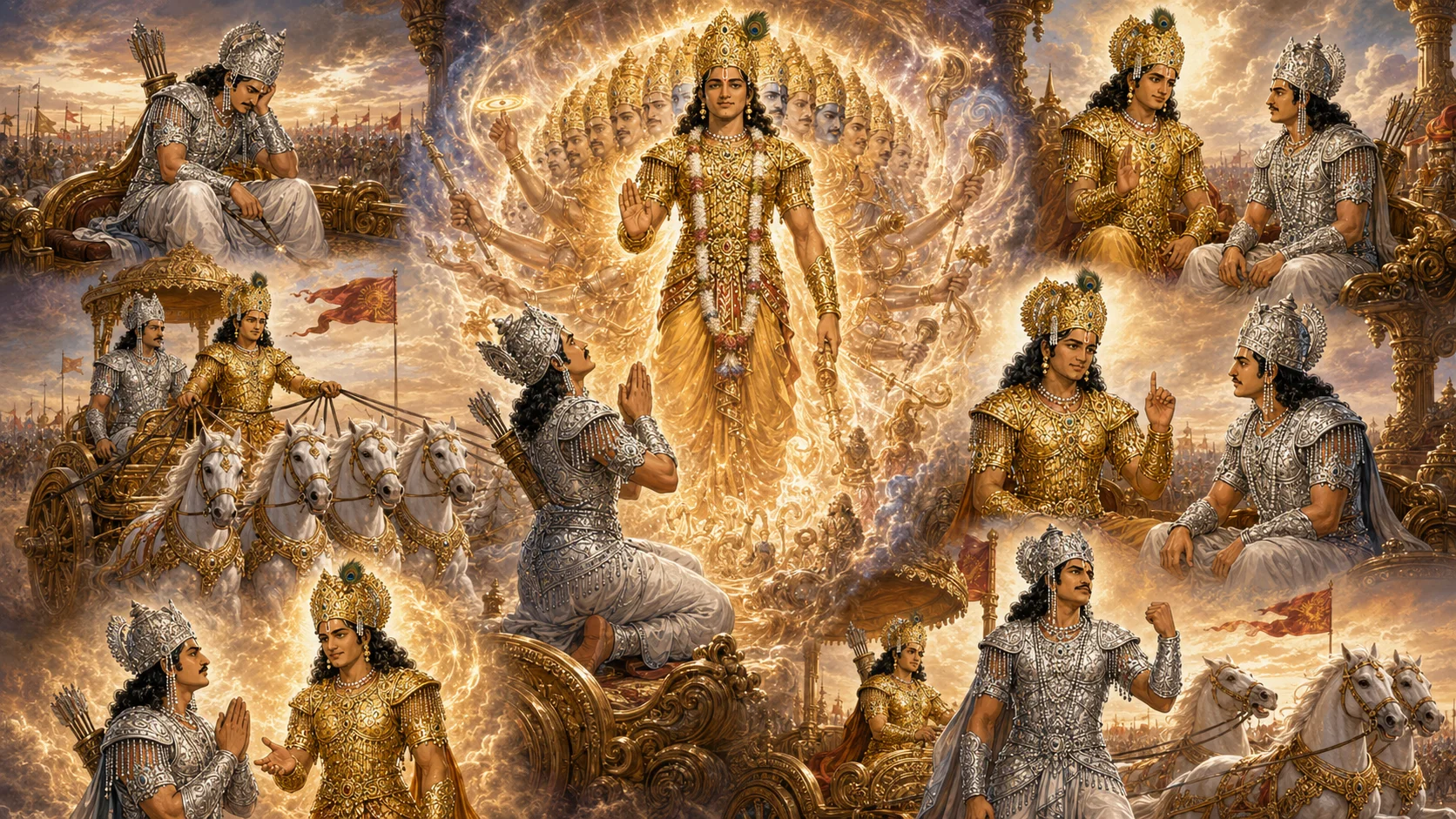
On Kurukshetra, after Krishna has pointed Arjuna toward the supreme abode, he explains why embodied beings still wander. The true self is eternal and related to Krishna, yet the mind and senses, rooted in changing nature, pull it into identification and confusion.
03
In your life
Why this verse still matters
You know the feeling: you meant to stay calm, then one comment, one craving, one memory drags you off center. The verse explains that pull as the mind and senses taking over.
The takeaway
“You are larger than the impulses that tug at you.”
The living being is Krishna's eternal part, but it gets pulled by the mind and senses that belong to nature and mistakes them for itself.
Who speaks Bhagavad Gita 15.7?
Krishna speaks this verse, on the battlefield of Kurukshetra, in the chapter titled "Purushottama Yoga" (The Yoga of the Supreme Person).
Which chapter of the Bhagavad Gita contains verse 15.7?
Verse 7 sits in Chapter 15 of the Bhagavad Gita — Purushottama Yoga, "The Yoga of the Supreme Person". The chapter has 20 verses in total.
Why does Bhagavad Gita 15.7 matter today?
You know the feeling: you meant to stay calm, then one comment, one craving, one memory drags you off center. The verse explains that pull as the mind and senses taking over.
It shifts attention from blaming the self to seeing how nature drags awareness into identification.
What this verse means
The living being is Krishna's eternal part, but it gets pulled by the mind and senses that belong to nature and mistakes them for itself.
Context & commentary
On Kurukshetra, after Krishna has pointed Arjuna toward the supreme abode, he explains why embodied beings still wander. The true self is eternal and related to Krishna, yet the mind and senses, rooted in changing nature, pull it into identification and confusion.
Why this verse still matters
You know the feeling: you meant to stay calm, then one comment, one craving, one memory drags you off center. The verse explains that pull as the mind and senses taking over.
“You are larger than the impulses that tug at you.”
Explore related themes: manas (49 verses), prakriti (31 verses), purushottama (14 verses)