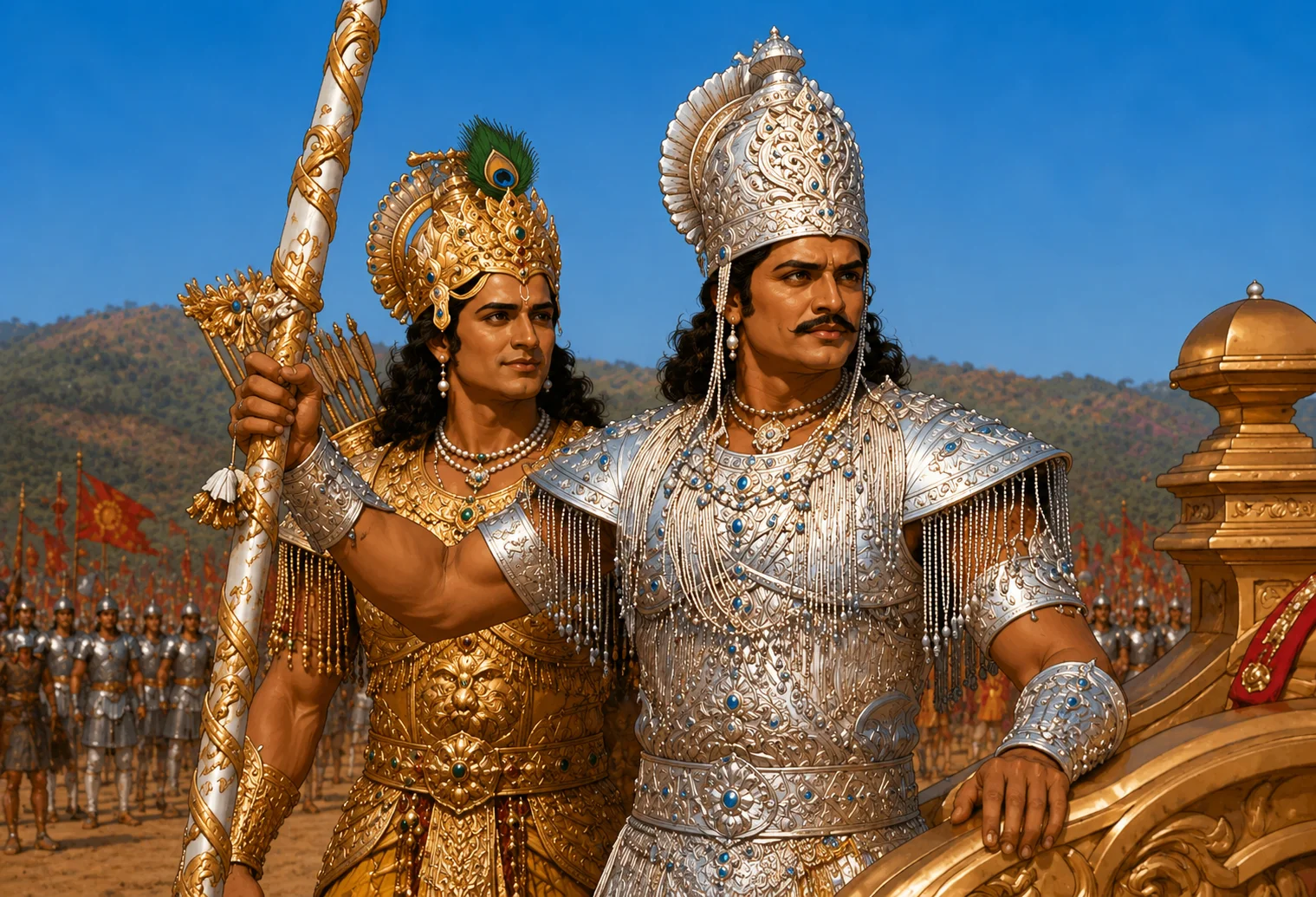
If you have grown up in India, you have almost certainly encountered the “Geeta Saar” that circulates on WhatsApp and printed on posters in every railway station. It begins something like: क्या लेकर आए थे, क्या लेकर जाओगे? — what did you bring, what will you take? It is beautiful. It is deeply Hindu. It is also not, in any direct sense, from the Bhagavad Gita.
That viral text is a folk paraphrase, likely popularized by B. R. Chopra's Mahabharat television serial in the late 1980s. It captures a general sentiment about impermanence, but if you look for a Sanskrit source, you will not find one. What Krishna actually said to Arjuna on the battlefield of Kurukshetra is longer, harder, and considerably more precise. This article is an attempt to give you the real Geeta Saar — the essence pulled from the actual text, one chapter at a time.
What you will find in this piece
First, why the famous WhatsApp version is a paraphrase and not a quote. Then the four Sanskrit verses most traditional commentators consider the true essence of the Gita. Then one representative verse for each of the 18 chapters — the line that carries the chapter's core teaching. And finally the seven ideas that hold the whole book together.
The Famous Geeta Saar That Is Not in the Gita
Let us start by looking honestly at the text most people call “Geeta Saar.” The Hindi passage in wide circulation reads something like this:
जो हुआ, वह अच्छा हुआ। जो हो रहा है, वह अच्छा हो रहा है। जो होगा, वह भी अच्छा ही होगा।
तुम क्या लेकर आए थे, जो तुमने खो दिया? तुम क्या लेकर आए थे जो नष्ट हो गया?
जो लिया, यहीं से लिया। जो दिया, यहीं पर दिया। जो लिया, इसी (भगवान) से लिया।
It is a beautiful piece of devotional Hindi prose. It is also a compression that puts thoughts in Krishna's mouth that Krishna does not literally say. The Gita is not a text about “whatever happens is for the good.” It is a text in which Krishna repeatedly tells Arjuna that his current understanding is wrong and needs to be corrected. That is a very different kind of teaching.
The line closest to a real Gita source is the middle passage about the atman not being born and not dying. That echoes BG 2.20 quite directly. The rest — “whatever happened was good,” “what did you bring” — is affectionate Hindu commentary, not translation. Knowing this matters. The Gita's actual teaching is more surgical.
The Four Verses Most Commentators Call the Real Essence
Traditional commentators — Shankaracharya, Ramanuja, Madhusudana Saraswati, Sridhara Swami — identify a small number of verses as the “seed” or “essence” of the whole Gita. The four below are the most consistently named. If you memorize nothing else from this article, memorize these.
1. BG 2.47 — The Instruction Verse
This is the most-quoted line in the Gita, and it deserves the recognition. In one sloka Krishna delivers the entire practical teaching of karma yoga.
मा कर्मफलहेतुर्भूर्मा ते सङ्गोऽस्त्वकर्मणि ॥
mā karmaphalaheturbhūrmā te saṅgo'stvakarmaṇi ||
2. BG 15.7 — The Seed Verse
If BG 2.47 is the instruction verse, BG 15.7 is the metaphysical foundation. Krishna states outright what the individual atman actually is. Everything else in the Gita rests on this.
मनःषष्ठानीन्द्रियाणि प्रकृतिस्थानि कर्षति ॥
manaḥṣaṣṭhānīndriyāṇi prakṛtisthāni karṣati ||
3. BG 18.66 — The Final Instruction
This is Krishna's parting sentence, and traditional commentators call it the charama shloka — the ultimate verse. It is what he leaves Arjuna with after 700 verses of preparation.
अहं त्वा सर्वपापेभ्यो मोक्षयिष्यामि मा शुचः ॥
ahaṃ tvā sarvapāpebhyo mokṣayiṣyāmi mā śucaḥ ||
4. BG 9.22 — The Promise Verse
The fourth verse most often cited as the “essence” is a promise. It is the closest the Gita comes to a covenant.
तेषां नित्याभियुक्तानां योगक्षेमं वहाम्यहम् ॥
teṣāṃ nityābhiyuktānāṃ yogakṣemaṃ vahāmyaham ||
The 18 Chapters, One Essence at a Time
Below is the essence of each of the eighteen chapters, in the order Krishna delivers them. Each chapter's core teaching is drawn from one representative verse, not a summary. This is what the argument actually looks like when you follow it in sequence.
The Seven Ideas That Hold the Whole Book Together
If you step back from the 18 chapters, the Gita repeats seven themes so consistently that any real saar has to name them. Everything else is elaboration on these.
- 1. The imperishable Self. Whatever you fundamentally are is not born and does not die. Fear of ending is fear of losing something you never actually were. This is the metaphysical foundation of everything that follows.
- 2. Action without craving for the fruit. The signature teaching of the book. Do your work fully; release the outcome. The Gita is not asking you to be indifferent. It is asking you to stop being owned by the result.
- 3. Your own dharma, imperfectly. Sva-dharma over para-dharma. Your own duty, even done badly, is better than someone else's done well. This is the Gita's answer to the fantasy that a different life would have been the right one.
- 4. Equanimity as the mark of wisdom. The sthitaprajna in chapter 2, the karma yogi in chapter 5, the devotee in chapter 12, the tri-gunatita in chapter 14 — the same portrait keeps returning. Steady in pleasure and pain. Equal to friend and foe. The Gita measures wisdom by this steadiness.
- 5. Devotion as the direct path. Bhakti is not one option among many; the Gita treats it as the shortest and most complete route. Chapters 7 through 12 are essentially an argument that whole-hearted devotion contains everything the other paths deliver, and more.
- 6. The world is a manifestation of the divine. Krishna is not far away. He is the taste of water, the light of the sun, the intelligence of the intelligent. The world is not something to escape; it is something to see through.
- 7. Surrender is the final teaching. After all the paths — action, knowledge, meditation, devotion — the final verse is release. Abandon every dharma, take refuge, do not grieve. Everything the book has taught comes to rest here.
Three Common Misreadings, and What the Text Actually Says
Misreading 1: “The Gita teaches passivity”
BG 2.47 is often quoted as though it teaches indifference to results. It does not. The verse contains four instructions, and the fourth — “do not fall into inaction” — is Krishna directly blocking the passivity reading. The Gita is a book delivered on a battlefield to a soldier who wanted to leave. Its message is: act, act fully, but release the craving.
Misreading 2: “Whatever happens is for the good”
This is the WhatsApp Geeta Saar reading. It is a consolation, and it is not what Krishna says. The Gita is not fatalistic. It insists on right action. What Krishna teaches is not that outcomes do not matter, but that outcomes do not define you. Those are very different claims.
Misreading 3: “The Gita is a Hindu book”
The Gita is embedded in the Mahabharata and forms part of the Hindu canon, yes. But its problem — a person paralyzed before a hard, unavoidable duty — is a human problem. Gandhi, Emerson, Thoreau, Vivekananda, Aldous Huxley all read the Gita as a universal document. The essence does not require you to be Hindu. It requires you to have faced a genuinely difficult choice.
If someone asks you for the Geeta Saar in one sentence
You are an eternal fragment of the divine, temporarily embodied. Do your own duty fully. Release the craving for its fruit. Face what is in front of you with equanimity. When it becomes too much, take refuge. Do not grieve.
How to Actually Use This Saar
A summary is a map, not the territory. The Gita is written as a dialogue for a reason: watching Arjuna change over 700 verses does something a bullet list cannot do. Here is a practical way to use the essence without abandoning the source.
- Start with chapters 2, 12, and 18. If you only ever read three chapters, read these. Chapter 2 gives you the metaphysical foundation and the karma yoga instruction. Chapter 12 gives you the practical portrait of a devotee. Chapter 18 closes the whole argument.
- Memorize the four essence verses. 2.47, 15.7, 18.66, 9.22. Keep them in a note on your phone. Return to them when you are anxious about outcomes, uncertain about who you are, exhausted by too many dharmas, or wondering if effort is worth it.
- Read one chapter's essence a day for eighteen days. Use the chapter grid above as a daily reflection. Not more than one at a time. Sit with the essence, look up the chapter, then move on. In three weeks you will have carried the whole book in your body.
- Do not stop at the saar. The essence is compressed. The verses expand it. If a chapter's essence pulls at you, read the full chapter that week. The Gita rewards slow reading in a way summaries cannot reproduce.
The Real Geeta Saar
If you take away one thing, take away this. The Gita is not a WhatsApp forward about how everything is for the good. It is a book delivered to a warrior who wanted to run, and its instruction is more difficult than a poster on a wall. Do your work. Release the fruit. Take refuge when the dharma frameworks fail. Trust that whatever you fundamentally are cannot be destroyed. That is the essence. Everything else in the book is Krishna helping Arjuna understand why this instruction is possible.
Arjuna, at the end of chapter 18, says: naṣṭo mohaḥ smṛtir labdhā — my delusion is gone and I have recovered my memory. That line is the human report on the whole teaching. The saar worked. He remembers who he is. He is ready to act.