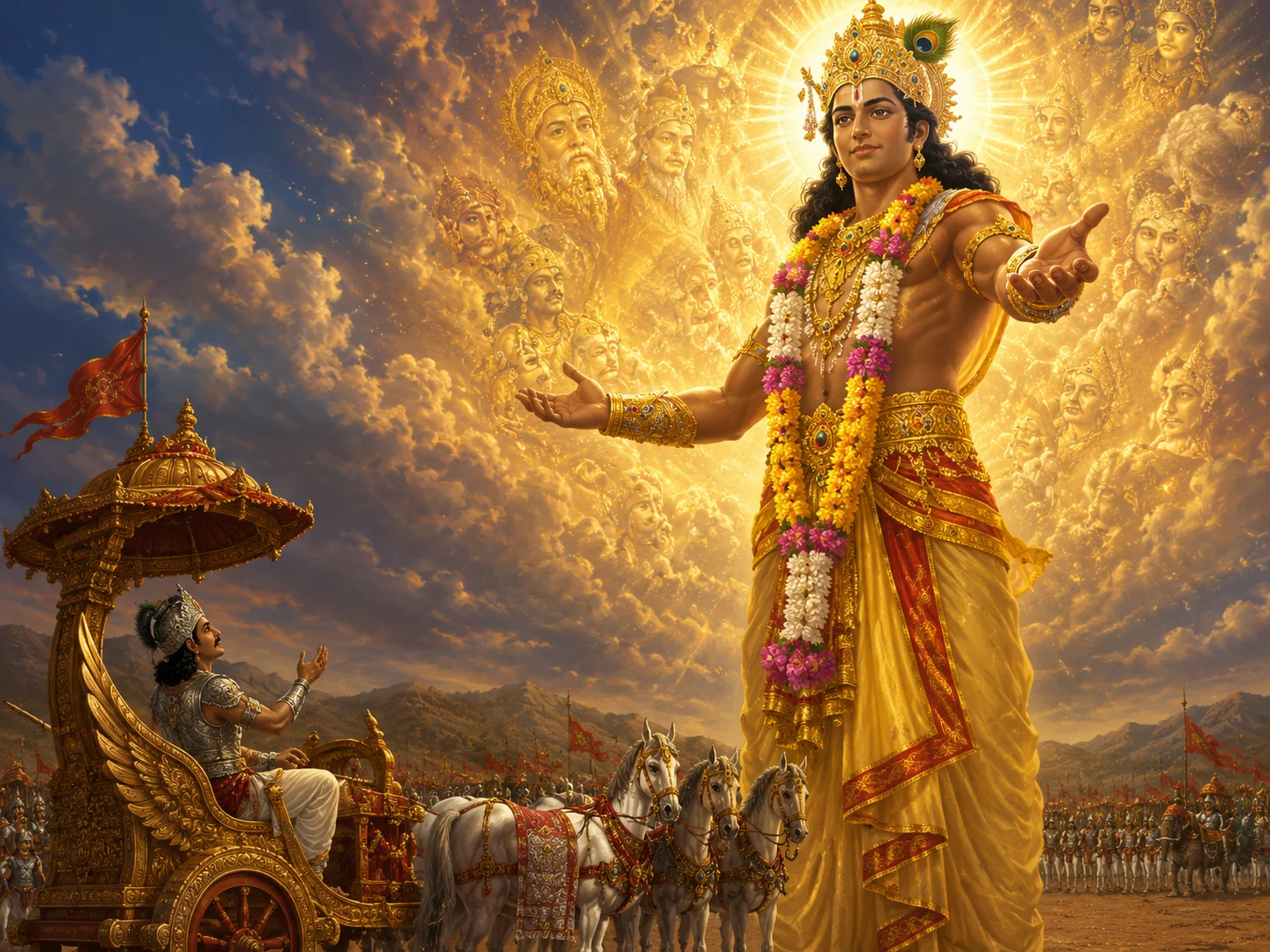
Chapter 11 is the climax of the Gita. After ten chapters of teaching, after the catalogue of manifestations in Chapter 10 (among rivers I am the Ganga, among letters I am A): Arjuna does what readers across two thousand years have wanted to do. He asks to see. Not as analogy. Not as inference. As direct vision. He says: I believe everything you have said, but show me. Draṣṭum icchāmi te rūpam aiśvaram: I want to see your sovereign form.
Krishna agrees, gives Arjuna a divine eye (because ordinary eyes are not equipped for this), and then the chapter delivers what is probably the most overwhelming passage in any scripture. A thousand suns blazing at once. Infinite mouths. Bodies of beings rushing into those mouths and being destroyed. The narrator, Sanjaya, has to break in to describe it. Arjuna himself has lost the capacity to speak. And then, at the centre of the vision, comes a line that has echoed beyond the chapter, beyond the book, into the conscience of the twentieth century: kālo'smi loka-kṣaya-kṛt pravṛddhaḥ. I am Time. The great destroyer of worlds.
Arjuna Asks to See, And What It Means to Ask
Chapter 11 begins with one of the most psychologically honest moments in the Gita. Arjuna says: I believe everything you have told me. Every word is true. And yet I want to see. There is no contradiction in this. It is exactly how belief in something enormous actually works: you can hold the proposition and still need a direct encounter to make it real for you. The Gita does not treat Arjuna's request as a failure of faith. It treats it as the natural next step of faith.
What is also remarkable: Arjuna asks softly. If you think I am capable of seeing it, then show me. The asker is not demanding. He recognizes that the seeing may not be in his control, that the asking itself is a kind of surrender. This is what makes the request work. The Gita does not give cosmic vision to anyone who insists. It gives it to one who has acknowledged that the seeing is a gift, not an entitlement.
द्रष्टुमिच्छामि ते रूपमैश्वरं पुरुषोत्तम ॥
draṣṭum icchāmi te rūpam aiśvaraṃ puruṣottama ||
If a Thousand Suns Rose at Once
Krishna gives Arjuna the divine eye and reveals the cosmic form. Arjuna immediately reaches for a comparison, and the comparison breaks. He says: if a thousand suns rose in the sky at the same moment, their light might begin to approach the radiance of this Great Being. The point of the verse is not the number. The point is the failure of measurement itself. Even the maximum the imagination can stretch to does not reach. The vision has exceeded scale.
This is one of the most cited verses in the Gita, partly because Robert Oppenheimer reached for it when he watched the first atomic bomb detonate. The instinct was correct. When ordinary language fails, when the event you are witnessing has overflowed every comparison, Sanskrit's reach for a thousand suns has a precision that ordinary English does not. The verse names the experience of confronting something so large that the act of seeing it changes you. Not just intellectually. Existentially.
यदि भाः सदृशी सा स्याद्भासस्तस्य महात्मनः ॥
yadi bhāḥ sadṛśī sā syād bhāsas tasya mahātmanaḥ ||
"If a thousand suns rose at once in the sky, their light might begin to compare with the radiance of that Great Self."Bhagavad Gita 11.12
When the Vision Exceeds the One Who Asked For It
What follows is sustained overwhelm. Arjuna sees infinite arms, infinite mouths, the gods themselves bowing in awe, the cosmos itself trembling. By verse 11.19, Arjuna is no longer describing what he sees as a calm observer. He is being undone by it. He says: I see you scorching this world with your own radiance. By 11.24, he confesses, I cannot find composure. I have no peace. The vision he asked for has obliterated the asker.
This is the Gita's honesty about religious experience. The encounter with the absolute is not pleasant. It is not the soft comfort that contemporary spirituality often promises. It is the meeting of finite consciousness with infinite reality, and finite consciousness does not survive the meeting intact. Arjuna does not collapse into bliss. He collapses into terror, then into reverence. The chapter is teaching that the highest experience is not the most pleasant one, and that the difference matters.
पश्यामि त्वां दीप्तहुताशवक्त्रंस्वतेजसा विश्वमिदं तपन्तम् ॥
paśyāmi tvāṃ dīpta-hutāśa-vaktraṃ sva-tejasā viśvam idaṃ tapantam ||
Why the chapter does not feel comforting: Because comfort was never the point. Chapter 11 is not selling tranquility. It is showing Arjuna (and through Arjuna, every reader who has wanted direct contact with the absolute) what direct contact actually feels like. It is not bliss first. It is dismantling first. The bliss comes later, on the other side of the dismantling, if you survive it.
I Am Time, the Sentence That Has Outlived Its Chapter
Then comes the line. Arjuna asks who this overwhelming form is, and Krishna's reply is one of the most quoted sentences in any sacred text. Kālo'smi loka-kṣaya-kṛt pravṛddhaḥ. I am Time, grown great, the destroyer of worlds. The verse continues: even without you, all these warriors arranged in hostile ranks will not survive. The war is already decided. The destroying force is not Krishna in any local sense. It is Time: the most patient and most absolute reaper there is.
Read the verse outside of the war context, and it widens. The relationship is already changing. The job is already ending. The body is already aging. Whatever you are gripping is already loosening, not because you are doing anything wrong but because Time is what Time is. The verse is unsparing. But it is also, paradoxically, freeing. The thing you fear losing is not yours to keep. Knowing this is not despair. It is accuracy, and accuracy is the precondition for clean action.
ऋतेऽपि त्वां न भविष्यन्ति सर्वेयेऽवस्थिताः प्रत्यनीकेषु योधाः ॥
kālo'smi loka-kṣaya-kṛt pravṛddho lokān samāhartum iha pravṛttaḥ |
ṛte'pi tvāṃ na bhaviṣyanti sarve ye'vasthitāḥ pratyanīkeṣu yodhāḥ ||
"I am Time, grown great, destroyer of worlds. Even without you, they will not survive."Bhagavad Gita 11.32
Nimitta-matram Bhava, Become the Instrument
If 11.32 is the chapter's hardest verse, 11.33 is its most practical. Krishna says: therefore, rise. Win fame. Conquer your enemies. Enjoy a flourishing kingdom. They have already been slain by me. Become only the instrument, Arjuna. The Sanskrit is nimitta-mātraṃ bhava savya-sācin: be only the instrument.
Read this verse outside the immediate war context, and it becomes a working principle for every difficult act. You are not the originator of what is going to happen. You are not the final cause. You are the instrument, present, accountable, attentive, through which a larger pattern moves. This is one of the Gita's most freeing teachings, because it dissolves the most exhausting illusion in adult life: the illusion that you are personally responsible for outcomes you do not control. The work is still yours to do. The outcome was never yours to own.
मयैवैते निहताः पूर्वमेवनिमित्तमात्रं भव सव्यसाचिन् ॥
mayaivaite nihatāḥ pūrvam eva nimitta-mātraṃ bhava savya-sācin ||
Arjuna's Humbling, and the Request for Forgiveness
After the vision, Arjuna does something unusual. He apologises. In verses 11.41 to 11.44, he confesses that he had treated Krishna as a friend, calling him casually, joking with him, eating with him, without realizing who Krishna really was. He says: forgive what I have done, as a father forgives a son, as a friend forgives a friend, as a lover forgives a beloved.
The honesty here is unusual in spiritual literature. Most religious texts establish the supremacy of the Divine and stop there. The Gita lets Arjuna feel embarrassed about the prior familiarity. Then it does something even more important, it makes clear that the familiarity was not wrong. Krishna will, by the end of the chapter, take back his cosmic form and reappear as the human friend. The vision does not replace the friendship. It enlarges what the friendship has always contained.
पितेव पुत्रस्य सखेव सख्युःप्रियः प्रियायार्हसि देव सोढुम् ॥
piteva putrasya sakheva sakhyuḥ priyaḥ priyāyārhasi deva soḍhum ||
What the apology models for any reader: When you have done something that, in hindsight, looks worse than it felt at the time, the move is the same. Bow. Acknowledge. Ask forgiveness without manufacturing reasons. The Gita rewards this exact posture with restoration. Krishna does not punish Arjuna's prior familiarity. He returns to it.
The Final, Gentler Reveal: Only Devotion Sees This
The chapter ends with a quieter, almost confessional teaching. Krishna says: this form, what you have just seen, cannot be reached by study of the Vedas, by austerity, by charity, or by ritual. It can be reached only by undivided devotion. The verse is, in some ways, a deflation of every transactional path the tradition had offered before. Knowledge alone does not earn this. Discipline alone does not earn this. Generosity alone does not earn this. Only love, undivided, makes the seeing possible.
And then comes the verse that ends the chapter, and ends, in some sense, the central teaching of the entire Gita. The one who works for me, takes me as the supreme, is devoted to me, free from attachment, without hatred for any being: that one comes to me. That is the formula. Work, oriented toward the Divine. Devotion. Non-attachment to outcomes. Non-hatred toward beings. Four ingredients, simple to list, hard to hold together, but together they are the complete recipe. Everything the Gita has been teaching, finally, reduces to this verse.
शक्य एवंविधो द्रष्टुं दृष्टवानसि मां यथा ॥
śakya evaṃ-vidho draṣṭuṃ dṛṣṭavān asi māṃ yathā ||
निर्वैरः सर्वभूतेषु यः स मामेति पाण्डव ॥
nirvairaḥ sarva-bhūteṣu yaḥ sa mām eti pāṇḍava ||
"Work for me. Take me as supreme. Be devoted. Drop attachment. Hold no enmity. That one comes to me."Bhagavad Gita 11.55
The Complete Verse Reference
| Verse | Speaker | Teaching Essence |
|---|---|---|
| 11.1 | Arjuna | Clarity arrives when hidden teaching is finally heard as personal grace |
| 11.2 | Arjuna | All change is clear only beside what does not change |
| 11.3 | Arjuna | Belief becomes complete only when it wants to see |
| 11.4 | Arjuna | Real vision begins when control gives way to asking |
| 11.5 | Krishna | The divine cannot be contained in one shape |
| 11.6 | Krishna | The familiar universe is only a small part of what Krishna reveals |
| 11.7 | Krishna | Everything you seek is already gathered in the divine form |
| 11.8 | Krishna | Ordinary sight cannot hold the infinite; grace must widen the eye |
| 11.9 | Sanjaya | The answer is not a theory; it arrives as a vision |
| 11.10 | Sanjaya | The divine form cannot be held inside one human image |
| 11.11 | Arjuna | The divine presence is beautiful, boundless, and impossible to face from one side |
| 11.12 | Arjuna | Even the brightest familiar light cannot measure the cosmic form's radiance |
| 11.13 | Arjuna | One form can contain the whole universe |
| 11.14 | Arjuna | A glimpse of the vast can turn shock into surrender |
| 11.15 | Arjuna | The many forms of existence appear within one vast body |
| 11.16 | Arjuna | The largest reality has no edge the mind can grasp |
| 11.17 | Arjuna | What is most real cannot be fully held by sight |
| 11.18 | Arjuna | What appears overwhelming is actually the world's deepest support |
| 11.19 | Arjuna | What overwhelms the mind can also dissolve its resistance |
| 11.20 | Arjuna | One vision can overwhelm every boundary you thought was real |
| 11.21 | Arjuna | Even the highest beings bow when the vast form appears |
| 11.22 | Arjuna | Even the highest beings stand astonished before Krishna's vastness |
| 11.23 | Arjuna | A vision of total vastness can shake every observer at once |
| 11.24 | Arjuna | A true vision can shatter the mind before it can steady it |
| 11.25 | Arjuna | True awe ends control and turns the heart toward surrender |
| 11.26 | Arjuna | Even the greatest warriors are swallowed by what exceeds them |
| 11.27 | Arjuna | All fighters are already being consumed by time |
| 11.28 | Arjuna | All motion is already rushing toward its end |
| 11.29 | Arjuna | Blind desire runs straight into its own ruin |
| 11.30 | Arjuna | Total power leaves no room for control |
| 11.31 | Arjuna | Fear bows first, then asks to know what stands before it |
| 11.32 | Krishna | What is ending was never in your hands to preserve |
| 11.33 | Krishna | Act fully, but let the larger order carry the result |
| 11.34 | Krishna | The battle is already decided; your task is only to act |
| 11.35 | Sanjaya | Awe can break speech before it becomes prayer |
| 11.36 | Arjuna | The divine name can turn fear into devotion and disorder into reverence |
| 11.37 | Arjuna | What exceeds all categories naturally draws surrender |
| 11.38 | Arjuna | The one you seek is the ground that already holds everything |
| 11.39 | Arjuna | All powers and forces bow inside the one you face |
| 11.40 | Arjuna | Total awe ends the illusion of separation |
| 11.41 | Arjuna | Familiarity without recognition becomes disrespect; awe restores right relation |
| 11.42 | Arjuna | Familiarity can hide greatness until awe breaks through |
| 11.43 | Arjuna | Recognition of the highest power dissolves all comparison |
| 11.44 | Arjuna | True reverence asks forgiveness without excuses |
| 11.45 | Arjuna | A vision can awaken joy and fear at once |
| 11.46 | Arjuna | The infinite can overwhelm; devotion asks for a form the heart can bear |
| 11.47 | Krishna | What is most sacred is seen only by grace |
| 11.48 | Krishna | The highest vision cannot be forced; it arrives only through grace |
| 11.49 | Krishna | Fear must drop before the deeper vision can be seen |
| 11.50 | Sanjaya | A vision can shake you; compassion brings you back |
| 11.51 | Arjuna | Gentleness restores the mind after overwhelming awe |
| 11.52 | Krishna | The vision Arjuna saw is beyond ordinary access, even for radiant beings |
| 11.53 | Krishna | The deepest vision comes through devotion, not mere accomplishment |
| 11.54 | Krishna | Undivided devotion reaches what effort cannot |
| 11.55 | Krishna | Devotion matures into freedom when attachment and hostility are gone |
Did you like this article?